| |
|
|
|
| |
Leica Definitions &
Photography Definitions
- A Work in Progress |
|
|
| |
By Thorsten von Overgaard. February 2007. Last edited on January 30, 2024. |
|
| |
|
|
|
Add to Flipboard Magazine.
Leica Definitions & Photography Definitions
This is the ongoing project of collecting the words used in photography and Leica.
| |
 |
| |
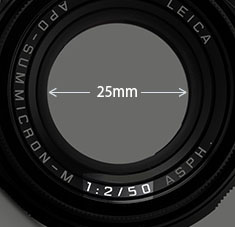
1:2/50 the description says.
But what does it mean? |
| |
|
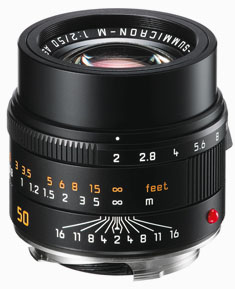
1: = Basically means 1 divided with. On the lens to the right, it means that the diameter of the hole throught he lens is 25mm.
We would normall call it
a 50mm f/2.0 lens. The writing of 1:2/50 is a tradition from the 1800's of specifying a lens, which reveals quite a bit about the construction:
Focal length 50mm simply means that the distance from center of focus inside the lens to the focusing plane (the sensor or film) is 50mm, and the aperture of f/2 or 1:2 means that the diameter of the hole the light comes throught is 25mm (50mm divided with 2 = 25mm).
In traditional lens design, one could usually tell from looking at the length of a lens if it was a 400mm, 100mm or 35mm. Newer designs with mirrors (in tele lenses) and more corrections (in wide lenses) can make the size of the lenses shorter or longer, but the distance from center of focus to sensor in a modern 50mm lens will still be 50mm for a 50mm and 400mm for a 400mm, and so on.
See Focal length and Aperture further down for more.
35mm
a) 35mm lens is a lens that has a viewing angle of view is 63°vertically, 54° horizontally and 38° vertically within a 35mm film frame or "full-frame" 24x36mm digital format. See Focal length further down.
b) 35mm focal length: the distance from center of focus inside the lens to the focusing plane (the sensor or film) is 35mm.
| |
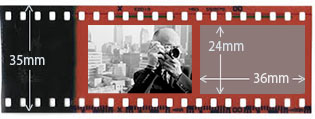 |
| |
35mm film format (also known as full-frame) |
| |
|
c) 35mm film format (also known as full-frame in digital sensors) was a standard film format that came about in 1892 where the width of the film roll was 35mm, and it's been the most used format ever since. Only a format of 24 x 36mm is used for the photo on the film roll.
35mm film format was first used in 1892 by William Dickson and Thomas Edison for moving pictures with frames of 24 x 18mm, using film supplied by George Eastman (Kodak), and this became the international standard for motion picture negative film in 1909. Later other motion picture formats came about, such as Academy Ratio (22 x 16 mm), Widescreen (21.95 x 18.6 mm), Super 35 (24.89 x 18.66 mm) and Techiscope (22 x 9.47 mm).
The inventor of the Leica camera, Oskar Barnack, built his prototype Ur-Leica in 1913 as a device to test film stock and\ motion picture lenses and had it patented. Putting 35mm film format into a small camera gave him the idea "small negative, large print" and he decided to increase the size of each frame on the 35mm film to 24x36mm (for more detail and sharpness), and then invented an enlarger to make large prints from the small negative. The length of a film, 36 pictures, is said to have become the standard because that was how far Oskar Barnack could stretch his arms (when cutting film from larger rolls to put them into film rolls for the Leica camera).
d) 35mm equivalent is often given as a standard when talking about lenses in small compact-cameras or large format cameras with other sensor/film format than the 24 x 36mm frame. Example: A camera with a 12 x 18 mm sensor has a 14mm lens on it, and even the lens is actually a 14mm, it is specified as a 28mm lens because the viewing angle that ends up on the sensor is equivalent to a 28mm lens on a 35mm of full-frame camera.
| |
 |
| |
The Leica 50mm APO-Summicron-M
ASPH f/2.0 lens |
| |
|
50mm
a) 50mm lens is a lens that has a viewing angle of view is 47° vertically, 40° horizontally and 27° vertically within a 35mm film frame.
b)
50mm means there is 50mm from the center of focus inside the lens to the focal plane (sensor or film).
c) 50mm lens is often compared to the human eye. Not because of viewing angle (how wide it sees) but because of size ratio (how it sees). The 50mm lens is the lens that comes closest to the size that the human eye see things. Whereas the human eye has a much wider angle of view [120-200°] than the 50mm lens [47°].
AEL = Auto Exposure Lock. This is a function that can be used when you want to reframe the scene, but keep the current exposure from changing.
AFL = Auto Focus Lock. This is a function that can be used when you want to reframe the scene, but keep the current focusing from changing.
AF = Auto Focus. The idea is that the camera does the focusing itself (the word auto comes from Greek "self"). See more under "Auto Focus".
AF Assist Lamp = A little red lamp that some cameras have on the front, which will light up in dark places so as to help the Auto Focus to see in the dark. If you put a hand in front of the lens and press the shutter release button, you can see it in action. The AF assist lamp can be turned off in the menu.
AOV - angle of view = Is the angle a lens 'see'. A 35mm lens has a 54° angle of view horizontally. Each human eye individually has anywhere from a 120-200° angle of viewn ags.
Aperture = The same function as the iris and pupil has in the eye. The pupil in the eye is the dark circular opening in the center of the iris of the eye, varying in size to regulate the amount of light reaching the retina (the sensor area inside the eye).
Aperture on a camera is the f/ stop on the camera that regulates how much light passes through the lens by increasing or decreasing the hole through the lens. On a f/2.0 lens the lens is fully open" at f/2.0. At f/2.8 the aperture inside the lens make the hole through the lens smaller so only half the amount of light at f/2.0 passes through. For each f/-stop (4.0 - 5.6 - 8.0 - 11 - 16) you halve the light. The aperture of the lens is basically the focal length divided with the f/-stop = size of the hole (50mm divided with f/2.0 = the hole is 25 mm in diameter).
Besides regulating the amount of light (so as to match the correct exposure), the aperture also affects the dept of field: , which is how deep the sharpness is. To get the sough-after photos with narrow depth of field where the background is blurry, the lens has to be wide open at f/2.0 or so. Stopping the lens down to f/8 or f/16 will result on more depth of field, meaning the background will start becoming in focus. To maintain narrow depth of field, one can use the ISO sensitivity and/or the shutter speed to match the correct exposure (as aperture is only one of three ways to control the exposure; the correct amount of light).
ORIGIN: Late Middle English : from Latin apertura, from apert- ‘opened,’ from aperire ‘to open’.
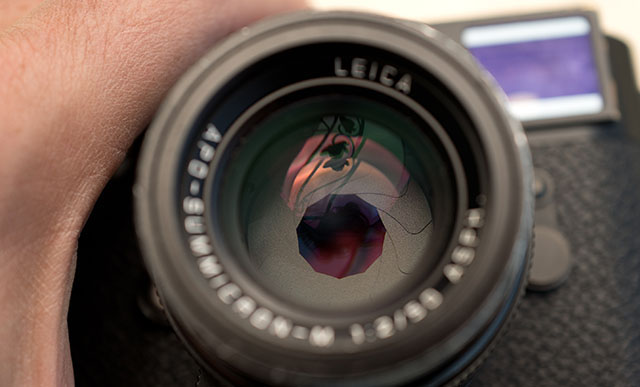
The aperture blades inside the consist of a number of blades that - as the aperture ring on the lens is rotated - narrow into a smaller and smaller hole. © Thorsten Overgaard.
| |
 |
| |
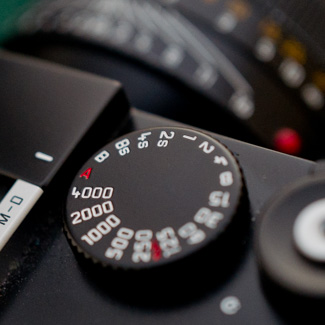
The camera in Aperture Priority Mode |
| |
|
Aperture Priority Mode = When the shutter speed dial on top of a Leica M camera is set to A, it is short for “Aperture Priority” and allows the user to set a specific aperture value (f-number) while the camera selects a shutter speed to match it that will result in proper exposure based on the lighting conditions as measured by the camera's light meter. In other words, you set the aperture as priority (f/1.4 for example), and the camera calculates a shutter speed (1/250 of a second) that matches that. If you change the aperture to f/2.0 by changing the aperture ring on the lens, the camera will re-calculate the speed to 1/125 so as to get the same amount of light to hit the sensor (f/2.0 is half the light through the lens as f/1.4 and 1/125 if twice the amount of light on the sensor as 1/250).
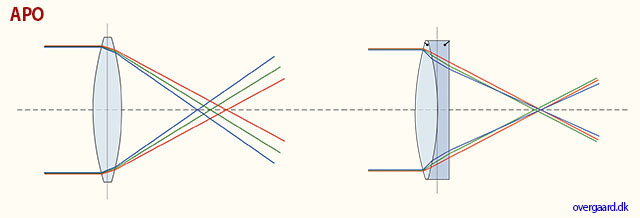
APO corrected basically means that the red, green and blue has been corrected to meet more precisely in the same spot. Clarity of colors and definition of details would be the result.
APO = in lens terminology stands for "apochromatically corrected". In most lenses, optical design concentrates the focus of blue light and green light into a single plane, but red light falls slightly into another plane of focus. In APO lenses, the design and expense has been put in to making red light focus on the same plane as blue and green. Under a microscope you would see that all light subject is now in focus, creating a sharper image overall. Many manufacturers offer APO designs, but in most of these only the very center of the lens is APO corrected. Leica prides itself on making most of the frame APO corrected.
APo-correction has traditionally been used for long tele lenses (and periscopes), but in recent years APO-correction has been applied to 50mm and wide angle lenses as well. One will notice that the colors are really bright and alive, almost more real than to the eye, in lenses like the Leica 90mm APO-Summicron-M ASPH f/2.0 and 50mm APO-Summicron-M ASPH f/2.0.
Apochromat; ORIGIN early 20th century, made of the two words; apo (Greek origin, away from) and chromatic (Latin origin, meaing relating to color).
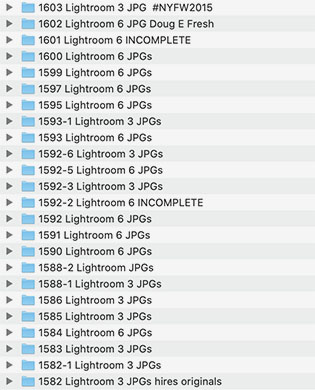
Archive = The place where one store historical documents and records, and they are organized and kept safe so you can find them again when you need them. For modern digital photography it is usually a hard drive, organized in folders and with keywords, and with a mirrored set of backup hard drives in case somethign happens to the original archive. In classic film photography, the negatives are stored in pockets or envelopes with notes on them to when, where and who, and prints of the pictures are stored in another archive based on year, location, who's in the photos or other system that make sense and make it easy to find things again. The product of being organized is freedom.
One could also call the archive for a library (originally from the word 'books', now meaning a collection of films, prints, recorded music, etc., organized systematically and kept for research, sale, printring or borrowing). Another word, in photography, could be stock (as in stock photo; the picture files or prints kept on the premises of a business or warehouse and available for sale or distribution). In the 1990's one would find Image libraries which was a business that kept stock of prints and photos from various photographers one could request for magazine use or advertising. You would simply call them and say you need a sunset with a bench, and they would find what might be usefull and send it off to you, and you would pay for the usage of the photo(s) that ended up in final print).
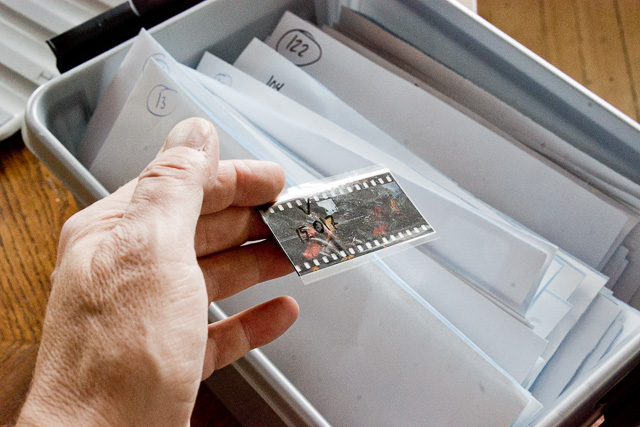
Film archive: Envelopes with numbers, date and description of each set. Image number 15_012 written on the protective foil of the negative and marked with a V that it has been scanned. The digital scanning has the same number in the hard drive archive.
| |
|
|
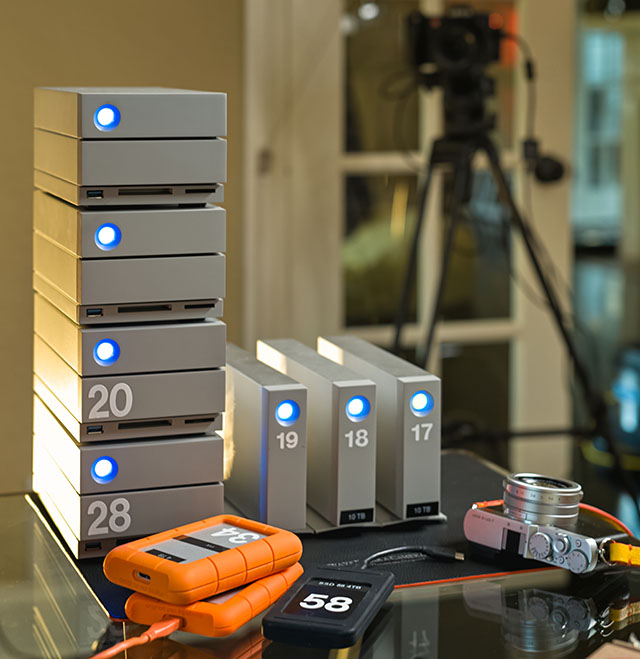
Digital hard drive archive of digital images (above). The picture folders on the hard drive (right) |
|
 |
| |
|
|
| |
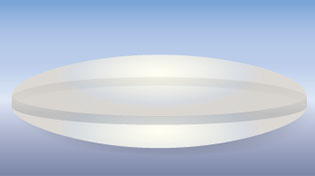
spherical (ball) |
| |
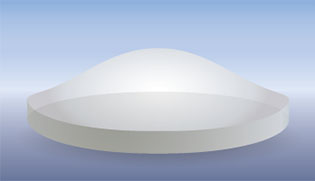
a-spherical (non-ball) |
| |
|
ASPH = (Aspherical lens) stands for "aspheric design".
Most lenses have a spherical design - that is, the radius
of curvature is constant. These are easy to manufacture by
grinding while "spinning" the glass. This design
however restricts the number of optical corrections that can
be made to the design to render the most realistic image possible.
ASPH lenses (a-spherical, meaning non-spherical), however, involve usually 1 element that does
*not* have a constant radius of curvature. These elements
can be made by 1) expensive manual grinding, 2) molded plastic,
or 3) Leica's patented "press" process, where the element
is pressed into an aspherical ("non-spherical")
shape. This design allows Leica to introduce corrections
into compact lens designs that weren't possible before. Practically,
the lens performs "better" (up to interpretation)
due to increased correction of the image, in a package not
significantly bigger than the spherical version.
There is another Aspherical lens manufacture technique: an uneven coating layer is applied to a spherical lens. The coating is thicker on the edges (or on the center, depending). Canon "Lens Work II" calls these "simulated" aspherical lenses. Simulated and Glass-Molded (GMo) asphericals show up in non-L Canon lenses, while the L lenses have actual ground aspheric elements.
A- means non, or without. From Latin, ex.
Sphere: ORIGIN Middle English : from Old French espere, from late Latin sphera, earlier sphaera, from Greek sphaira "ball".
| |
|
|
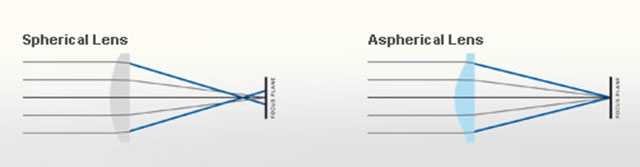 |
| Normal spheric lens (grinded) |
|
ASPH (note the shape of the glass as result of pressing rather than grinding) |
Auto- means “self”. The idea is that when a camera has auto-(something), it does that (something) by itself.
Auto Focus = The idea is that the camera does the focusing itself (the word "auto" comes from Greek "self"). Ironically and factually, it does not work that easily, which is why many types of Auto Focus have been added to this feature. Ironically, it was supposed to make it easy for the user to get sharp photos but has become a filter of focusing complexities in front of the user with a variety of made-up fancy names: Face detection, iAF (Intelligent Auto Focus), AFc (continuous), Tracking AF, Multi-Field AF, Eye Detection AF, Zone AF, and more.
Banding = Noise in digital images. Horizontal lines in a horizontal picture (if the camera is in portrait mode/vertical, the lines will obviously be vertical). It's simply noise; the result of uncontrolled algorithms working overtime with an image the sensor really can't see because it's very dark. (If your image has vertical lines in it, it is more likely that the sensor needs remapping).
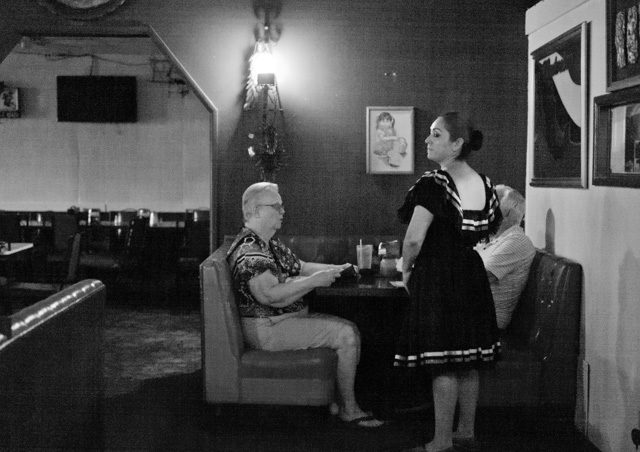
This image at 6400 ISO, underexposed and then brought up to correct exposure in Lightroom, displays banding: Horizontal lines in the image. Leica M-D 262 with Leica 50mm APO-Summicron-M ASPH f/2.0.
Base ISO = The ISO the digital sensor was born with. Even a digital sensor goes from say 50 ISO to 25,000 ISO, it only has one base ISO. Any other setting is an algorithm that figures out how the image whould look if there was 64 times more light, or half the light, etc.
When you go down from Base ISO (for example 200 to 100 ISO), you can expect a
decrease in quality. When you go up, the decrease is much less. For some sensors, you loose 2-3 stops by going down 1 step in ISO, but can go 8 steps up and only loose 1 stop in dynamic range. Basically, your ISO range should be from Base ISO and as far up as you can, before you see visible decrease in quality (mostly 3200 ISO - 6400 ISO).
Base ISO for Leica M9 is 160 ISO, for Leica M240 it is 200 ISO. For Leica M10 it is around 160 ISO. For Leica M Monochrom it is 320 ISO. For Leica Q and Leica Q2 it is around 100 ISO. For Panasonic Lumix S it is 200 ISO. For most Canon cameras the base ISO is around 100, for most Nikon cameras it is around 200 ISO.
Max Berek (1886-1949) was lens designer who joined Ernst Leitz Optische Werke in 1912 and became the head of the microscope development where he also designed the first lenses for the company's new adventure into photography, the Leica introduced in 1925. In particular, he calculated the Elmax 50mm f/3.5 lens for the so-called Ur-Leica.
Betriebsk = A designation engraved (or silk printed) on top of a Leica cameras produced for internal factory use only. For example, 25-50 "Leica MP Betriebsk" cameras was produced in 1957. For the Leica M7 for example, 100 "Leica M7 Betriebsk" cameras was produced, intended for Leica dealers to have as demonstration cameras.
Barn doors = Metal 'doors' on the side of a spotlight that can be adjusted to control where the light flows.
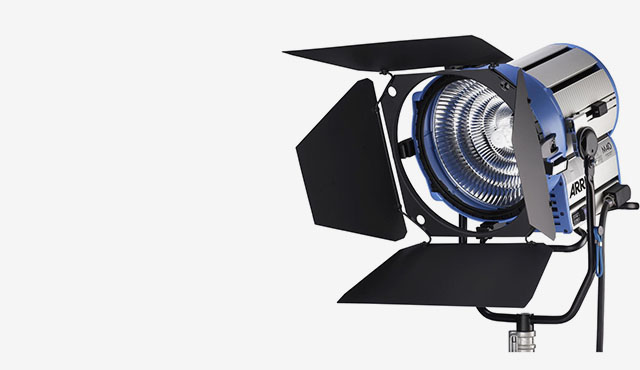
Barn doors on an ARRI 4,000W spotlight.
Beam Splitter = Describes the way light travels when it enters the R series Leica SLR bodies when viewing and composing. The light beam is split into two - one part goes through the semi-silvered mirror to the light meter at the base of the mirror box, the rest is reflected upwards through the pentaprism to the viewfinder.
It is because of this "beam splitting" that you have to use Circular Polarizing filters on R cameras in order to obtain correct light meter readings. With regular linear pol. filters, phase cancellation effects occur when the light travels through the mirror, resulting in inaccurate and unpredictable readings.
Bizofurex = A Leica Visoflex electronic viewfinder name for the new electronic viewfinder thatr was planned to be made for the Leica M10 introduction in 2017. Dues to too high expenses molding a new viewfinder, Leica decided to stay with the Leica visoflex EVF 020 that was originally med for the Leica T.
Bokeh = The visual quality of the out-of-focus areas of a photographic image, especially as rendered by a particular lens: It's a matter of taste and usually photographers discuss a 'nice' or 'pleasant' bokeh (the out-of-focus area is always unsharp, which is why the quality discussed is if one likes the way it renders or not by a particular lens). The closer you get to something, the 'more' bokeh' you get (in that the focus becomes less for the background and foreground at close distances than at long distances). ORIGIN from Japanese 'bo-ke' which mean 'fuzzines' or 'blur.'.
 Bokeh: The visual quality of the out-of-focus areas of a photographic image. Photo at Bar del Fico in Rome. Leica TL2 with Leica 35mm Summilux-TL ASPH f/1.4. © Thorsten Overgaard. Bokeh: The visual quality of the out-of-focus areas of a photographic image. Photo at Bar del Fico in Rome. Leica TL2 with Leica 35mm Summilux-TL ASPH f/1.4. © Thorsten Overgaard.
Bromide print = A photo print made using paper containing silver bromide. Bromide papers came into general use around 1880 and became the most popular and widely used paper for black and white photography in the twentieth century. It is produced in a range of finishes, matt, glossy and semi-matt.
Bromoil = Early 1900 print method with the purpose to make black and white photos look color-like as well as natural tones. Still performed by people with time on their hands. Bromoil is a chemical process where you wash out the black colors of the photographic print with chemicals (bromide), then apply colored oils onto the print which sticks where the black was. This way you got a sort-of color photo before it color photography existed.
At that time, early 1900's, many photographers experimented in ways to paint on photographs, etc. in an attempt to make it lookm like accepted artistic expressions like paintings and drawings. Ansel Adams and others did too in the early 1900's, but Ansel Adams was one who decided to go into “straight photography” which meant to make it with a camera and not trying to make a photo into any other art form like a painting. This was controversial at the time, and Ansel Adams wrote articles and did much foot-work with collectors, museums and galleries to get straight photography accepted - which eventually it was. Brom- is bromine (a chemical).
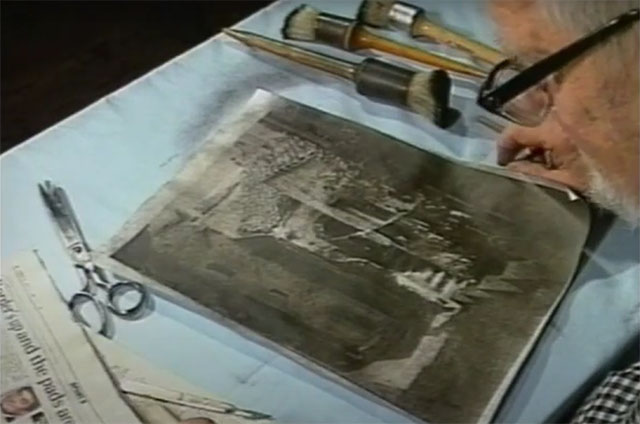
Bromoil print.
BSI = Backlit sensor = Back-Illuminated Sensor (also known as BI = Backside Illumination) sensor that uses a novel arrangement of the imaging elements to increase the amount of light captured and thereby improve low-light performance. These sensor types were first used for low-light security cameras and astronomy sensors, and then was brought into wider use, in the A7 II (2015), Nikon 850D (2017), Leica SL2-S (2021) and Leica M11 (2022), to increase the cameras performance in low light (high ISO).
Burning = Expose one area of a photos more (in the development in the darkroom by exposing more light from the negative onto the light-senisitive paper by shading for all other areas than one with two hands forming a hole, or a piece of metal or paper with a hole in it). In modern digital post processing (using editing software liek Lightroom or Capture One Pro), a digital tool "burn" a selected area and makes it darker digitally. (Also see "Dodging").
| |
|
| |
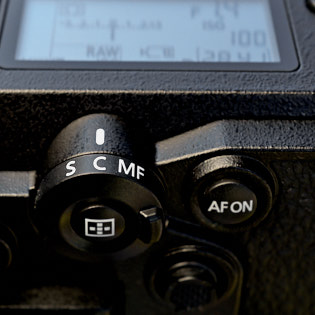
C for continious |
C = Continuous shooting. When the ring by the Shutter Release on top of the camera (or in the menu of digital cameras that doesn't have such a feature on the outide of the camera) is moved from OFF to C, the camera takes series of images as long as the shutter release is pressed down. In some cameras the speed of continious shooting can be adjusted. For exampel in the Leica Q under the menu point Continuous Shooting you can define if the Continuous should be Low (3 fps), Medium (5 fps) or High (19 fps).
C-Lux (Compact Lux) = a series of compact digital cameras by Leica Camera AG developed with Panasonic since 2006 as the smallest and most compact series of compact Leica Cameras. See my article "Compact Digital Leica Cameras". Lux comes from Latin and means Light.
C-stand = Short for Century stand, a 20" or 40" tall stand (usually with three fold-out legs that by themselves are known as 'turtle base') used in the movie industry and still photography studios to hold refletors and silk screens, but also lamps. The C-stand typically includes a gobo arm and gobo head that can hold a light modifier in front of a lamp (the lamp is mounted on the C-stand, and the gobo arm/grip arm reahes out in front of the lamp and holds a silk screen. Gobo is a Japanese word for a screen in front of a light to modify, shade or shape the light). Today, the C-stand and it's gobo arm/grip arm can be a great tool for holding iPhones, cameras, microphones and similar via a "Magic Arm", iPhone holder or similar devices when doing stills and video.
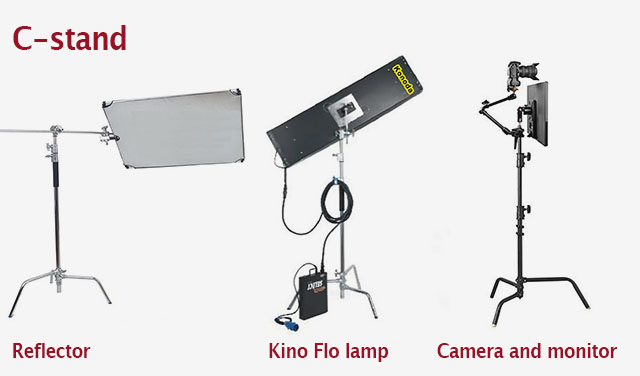
Calotype = An early photographic process introduced in 1841 by William Henry Fox Talbot, in which printswere made using paper coated with silver iodide. The word comes from Greek kalos that means "beautiful" and type that means "write".
Cam = A Leica transmission system for the Leica R lenses, seen as metal parts inside the lens bayonet. (A cam is a rotating part in machinery, designed to make sliding contact with another part).
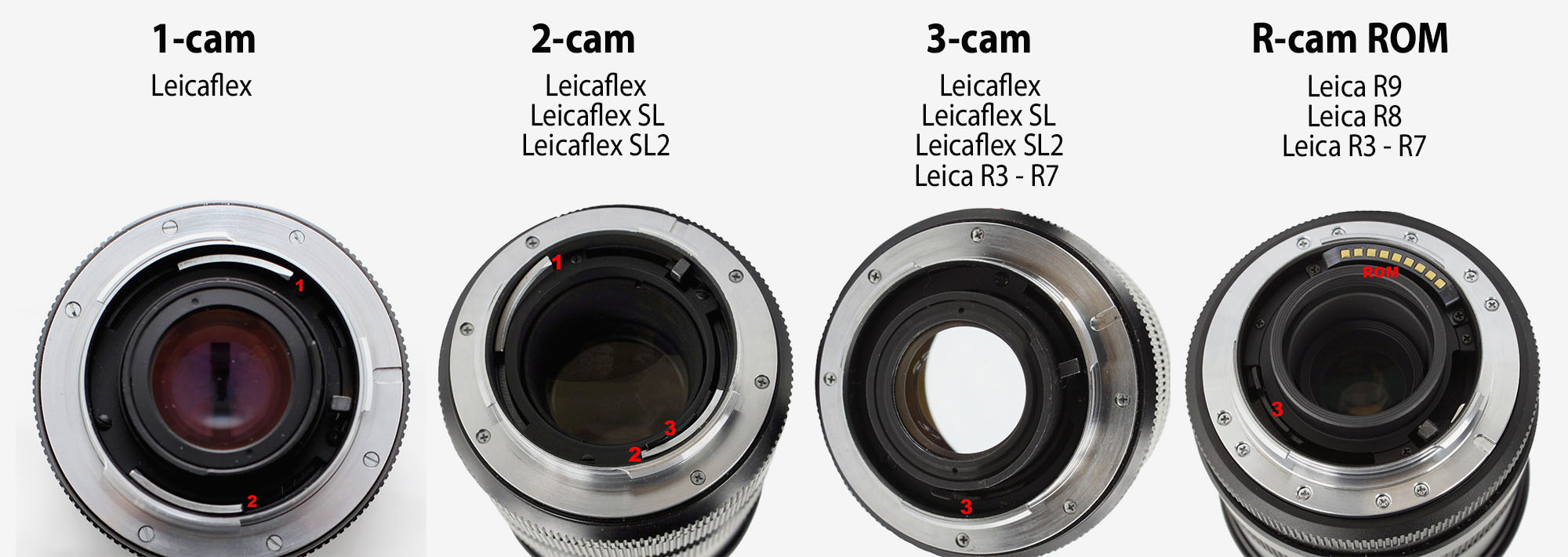
1-cam lenses (1964-68) was a curved chrome-bar between the mount and the rear lens element to transfer the aperture setting on the lens to the Leicaflex camera.
2-cam lenses (1968-76) came with the Leicaflex SL that supported TTL (Through The Lens light metering). Leica moved the curved cam to the opposite side of the lens mount. To make newer lenses could compatible with previous Leicaflex cameras, the first cam was maintained. The 2-cam is not recommended on the R8 and R9.
3-cam lenses (1976-96): The Leica R3, which was developed in cooperation with Minolta, introduced a different coupling mechanism, which was an adition to the 1-cam and 2-cam. The 3-cam is in the form of a triple-stepped, black projection on the inside of the lens bayonet. The 3-cam function on any Leicaflex, R3 and forward to Leica R9.
R-cam lenses (aka "R-cam only", "R-only): (1986-09). In 2086 Leica started to produce R-lenses that only had the third, stepped cam, but lacked the first and second cams. These lenses would not transmit any aperture information to the Leicaflex/SL/SL2 models, and Leica changed the shape of the lens mount slightly so the R-cam lenses (alternatively called "R-cam only", "R-only", "three-cam only", or "3-cam only" lenses) could not be mounted on the Leicaflex, Leicaflex SL and Leicaflex SL2.
(For more om ROM contacts for Leica R8/Leica R9 (1996-2009), see ROM futher down).
| CAM compatibility of Leica R lenses: |
| |
Leicaflex |
SL-SL2 |
R3-R7 |
R8-R9 |
| 1-cam |
+ |
o |
o |
[o] |
| 2-cam |
+ |
+ |
o |
[o] |
| 3-cam |
+ |
+ |
+ |
+ |
| R-cam |
- |
- |
+ |
+ |
| ROM |
- |
- |
+ |
+ |

Camera comes from Chambre, mostly in relation to Spanish soldiers’ rooms. Obscura means 'dark', so a dark room is basically the derivation for the word camera.
Camera - is today’s short name for Camera Obscura (meaning “a dark room”). Camera means Chambre and was used only as a Latin or alien word, actually only for Spanish soldiers’ rooms, until popularized in connection with photography in 1727: “Camera Obscura”. In 1793 the slang term “camera” was used by Sterne Tr. Shandy: “Will make drawings of you in the camera” and by Foster (1878), “The eye is a camera”. Camera Obscura was described by Iraqi scientist Ibn-al-Haytham in his book, “Book of Optics” (1021) and by Leonardo da Vinci in 1500; popularized and made widely known in 1589 by Baptista Porta when he mentioned the principle in his book “Natural Magic”. Johannes Kepler mentions Camera Obscura in 1604.
Camera = chambre (room), Obscura = dark (or cover).
| |
|
|
| |
Why is it called a "camera"..?
The word Camera is today's short name for Camera Obscura (which originally means “a dark room”).
Origin of the word Obscura means "dark" or "covered", and the word Camera means Chambre and was used originally only as a Latin or alien word, actually only for Spanish soldiers' rooms, until popularized in connection with photography in 1727: “Camera Obscura”.
In 1793 the slang term “camera” was used by Sterne Tr. Shandy: “Will make drawings of you in the camera” and by Foster (1878), “The eye is a camera”.
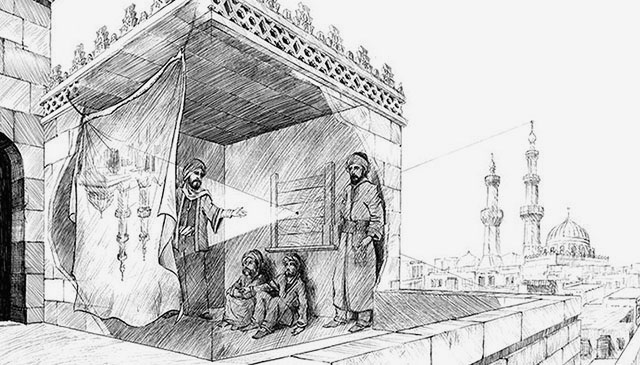
Ibn-al-Haytham mentioned Camera Obscura in his "Book of Optics" in 1021.
The concept of Camera Obscura was described by Iraqi scientist Ibn-al-Haytham in his book, “Book of Optics” (1021) and by Leonardo da Vinci in 1500; popularized and made widely known in 1589 by Baptista Porta when he mentioned the principle in his book “Natural Magic”. Johannes Kepler mentions Camera Obscura in 1604.
Camera = chambre (room), Obscura = dark (or cover). |
|
| |
|
|
CCD sensor (as used in Leica M8, M9, Leica S) = (Charged Coupling Devices) - The first digital cameras used CCD to turn images from analog light signals into digital pixels. They're made through a special manufacturing process that allows the conversion to take place in the chip without distortion. This creates high quality sensors that produce excellent images. But, because they require special manufacturing, they are more expensive than their newer CMOS counter parts.
| |
 |
| |
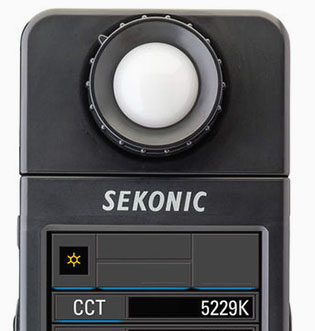
Color meters may use CCT scale, which is the same as Kelvin. In this case, 5229 CCT is the same as 5229 Kelvin. © Thorsten Overgaard. |
| |
|
CCT = Correlated Color Temperature,. CCT is basically another word for Kelvin color temperature. (CCT is defined in degrees Kelvin). Scientists and light researchers may talk about CCT, but photographers talk about Kelvin. However, on many light metering instruments one may find the Kelvin value given in "CCT".
CDAF = Contrast Detection Auto-Focus). With CDAF, the lens will often need to "hunt" back and forth before the best focus can be determined. Another system is PDAF where "focus pixels" on the sensor can determine the best focus and immediately adjust the lens directly to that focus in one action.
Central Shutter = Some lenses, for example the Leica S lenses and the Leica Q where a shutter is located in the lens itself. In most cameras there is a shutter curtain just in front of the sensor, and in SLR (Single Lens Reflex) cameras there is also a mirror in front of the shutter curtain.
In the Leica T/TL/TL2 the shutter is in front of the sensor, but only acts to "refresh" the sensor. In the Leica TL2, there is a mechanical shutter curtain from 30 sec. to 1/4000 shutter times, and digital shutter from 1/4100 to 1/40,000 shutter times. A digital shutter is simply "turning on/off the recording of the sensor.
CL = Compact Leicafilm camera (or Compact Light measuring). Used to be the name of the Leica CL "Mini M" that Leica Camera AG and Minolta made together in the 1980's. The name CL was used again for the digital Leica CL (2017), which is a digital camera that takes Leica L lenses (made for Leica TL and Leica SL). See my article Compact Leica Cameras for more.
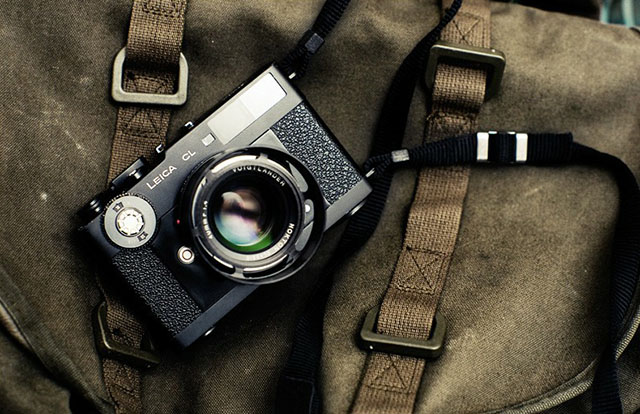
The Leica CL 35mm film camera was made as Leica CL and Minolta CL and shared technology. It also introduced three CL lenses together with it, as a compact and economical alternative to the Leica M camera. See more on the original Leica CL here.
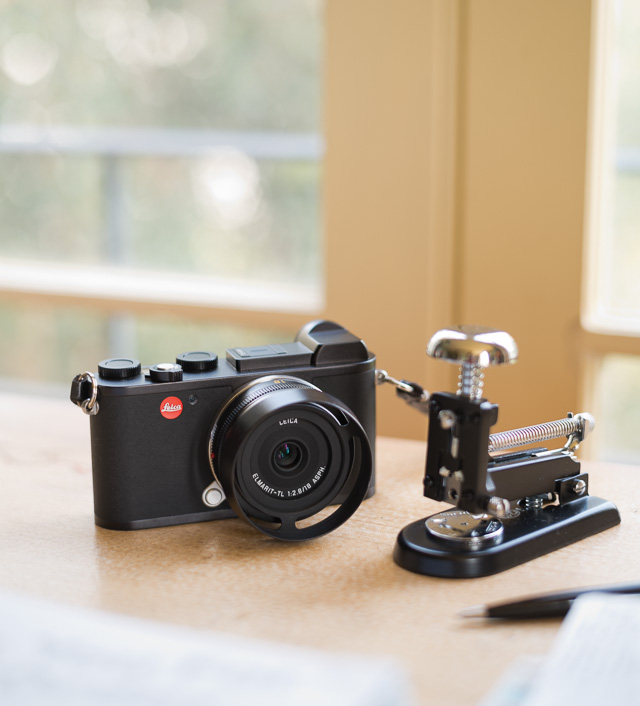
The digital Leica CL 2018 with 18mm Elmarit-TL f/2.8. © Thorsten von Overgaard.
CLA
An acronym for "(C)lean, (L)ubricate & (A)djust", whereby the item is merely re-lubricated, fine-adjusted and calibrated rather than repaired. "I just got my equipment back from CLA at Leica"
CMOS sensor (as used in Leica CL, Leica T/TL/TL2, Leica M10, Leica M 240, Leica M Monochrom Typ 246, Leica S Typ 007, Leica SL, Leica Q, Leica Q2, Leica M10, Leica X, Leica D-Lux, etc.) = (Complimentary Metal Oxide Semiconductor) chips use transistors at each pixel to move the charge through traditional wires. This offers flexibility because each pixel is treated individually. Traditional manufacturing processes are used to make CMOS. It's the same as creating microchips. Because they're easier to produce, CMOS sensors are cheaper than CCD sensors. CMOS allow Live View and use less energy than CCD.
Collapsible - Usually refers to a collapsible lens such as the Leica 50mm Elmarit-M f/2.8 Collapsible, or Leica 90mm Macro Elmar-M f4.0 Collapsible, etc. A collapsible lens is one that can collaps into a compact lens when not in use.
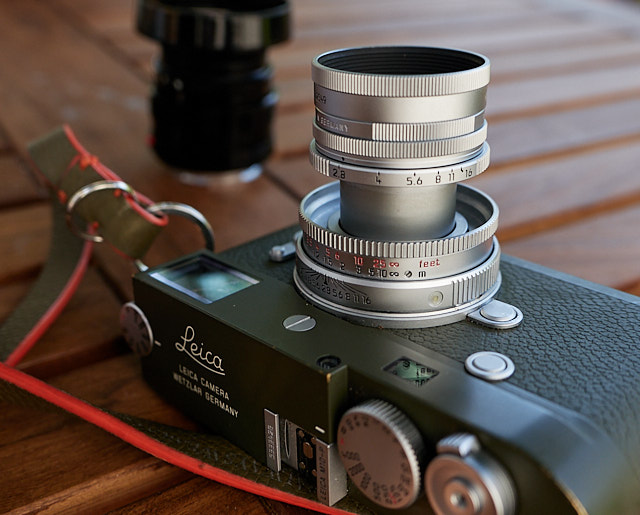
The Leica 50mm Elmar-M f/2.8 Collapsible on a Leica M10-P Safari. Here extruded for use; it can collapse into the camera so as to be more compact when not in use. © Thorsten Overgaard.
Compact Camera - A camera that is compact, usually the same as a point-and-shoot or beginners camera. See my article Leica Compact Cameras.
Compur
Leica I Compur camera (1926-1941) and Leitz Compur 50mm f/3.5 (1938) and Leica Summicron (II) Compur 50mm f2.0 lens (1959). Marketed as the Leica B, collectors have taken to calling it the Compur. It was fitted with a Compur leaf shutter. The Compur is a long-lived series of leaf shutters that were made by the German company F. Deckel AG, based in München.
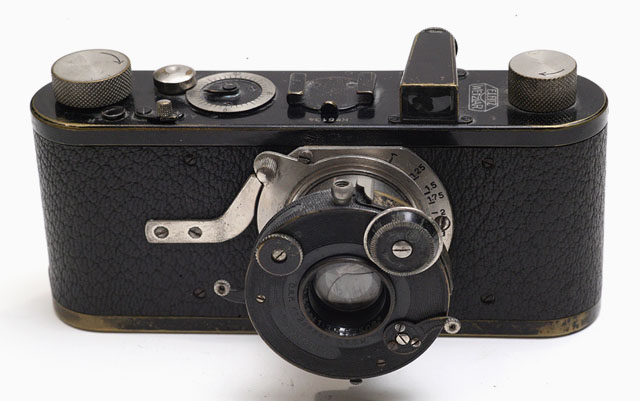
Leitz Compur (Model Leica B) camera designed by Oskar Barnack, lens designed by Oskar Barnack, with the Compur leaf shutte from Bruns & Deckel in Munich. (Size L x H x W - 133 x 65 x 30 mm / 5.24 x 2.60 x 1.54 in). Approx 1651 of these were made from 1926-1941.
Contrast - The degree of difference between tones in a picture. Latin contra- ‘against’ + stare ‘stand.’
 |
|
 |
| Normal to low contrast |
|
High contrast |
| |
|
|
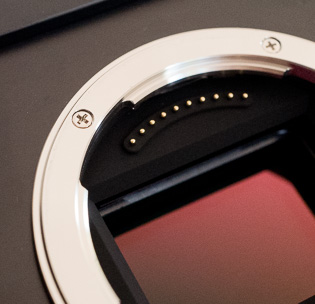
Contact strip = Electronic strip of contacs between lens and camera. The Leica L mount system (2013) features a Leica L bayonet with contact strip for communication between lens. It is simply contacts that allow communication back and forth between camera and lens: Share information to the camera about aperture, focal length and focusing distance of the lens (which in the Leica TL and Leica SL is used to calculate and display depth of field calculations inside the electronic viewfinder). The contact strip supply power and control to the lens for the auto focus and aperture.
|
|
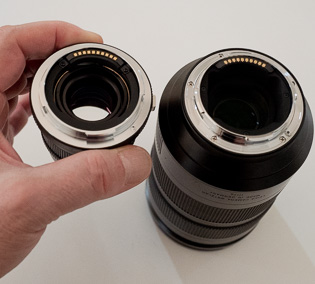
Leica L-mount lenses with contact strip |
CQS = Color Quality Scale. An expansion of CRI (see below), but overtaken by SSI (see further below). A measurement of color rendering based somewhat on CRI, but taking into account which colors people liked the best (!).
CRI = Color Rendering Index. A system used in the movie industry and some photography to measure, evaluate and optimize the light sources for color accuracy.
A value between 1-100 that is an index of how well colors will be correct under a given light source. Often given in Ra, (Rendering Average) from 0 to 100 when a lightsource (like the sun, an LED lamp, a Tungsten lamp) is measured with a spectrometer (color meter). It's a measurement of how colors are rendered under a type of light soruce, based on a selection of 8 key colors (R1-R8). There also exist Extended CRI, which is based on a larger selection of 15 of key colors (R1-R15).
CRI or Ra is calculated as the average value of R1 through R8. This Color Rendering Quality is overall often referred to as Ra, (Rendering Average). For example Ra 90 is considered as quality light for color rendering, whereas Ra 60 would result in problems with incorrect or missing colors. The daylight sun is usually Ra 94-96.
When the Extended CRI is used, the result may be summed up as Re (Rendering Extended).
CRI is based on the spectral sensitivity of the human eye (CIE 1931 "standard observer). Since 2017 the CRI has been replaced by SSI (Spectral Similarity Index) that is a standard that takes into the account the human spectrum, a digital still camera's sesors spectrum, the telvision camera's sensor spectrum, and the movie camera's sensor spectrum: And also takes into account the differences between models and brands. One could say that this is the expanded CRI, predicting how different types of ditgital recording mediums will render colors using different light sources.
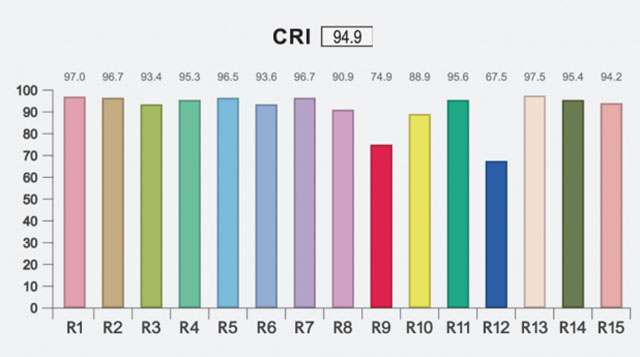
CRI measurement. While the overall CRI is 94.9, the red (R9) and blue (R12) are weak. These two, along with R15, are the most essential for correct colors of skin tones and more.
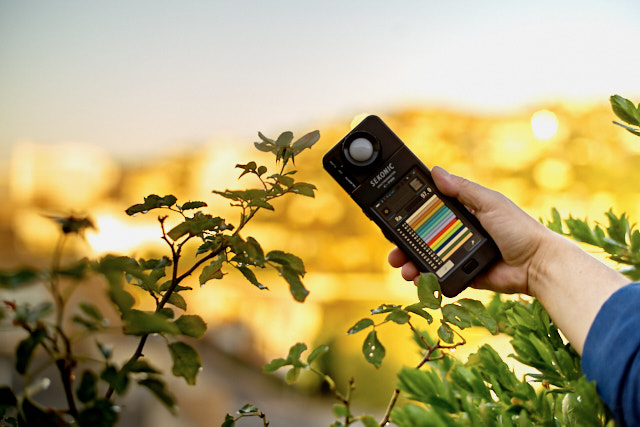
Color spectrometer used to measure the light quality, the CRI index. © Thorsten Overgaard.
CS = Central Shutter = As in the Leica S lenses for the Leica S where a shutter is located in the lens itself. In most cameras there is a shutter curtain just in front of the sensor, and in SLR (Single Lens Reflex) cameras there is also a mirror in front of the shutter curtain.
In the Leica Q and Leica Digilux 2 the shutter is in the lens which makes the camera mirrorless as well as very quiet because there is not a metal shutter curtain going up and down in front of the sensor.
Daguerreotype = Daguerreo pint. The first type of photography camera and photography technique (1939) on metal plates, named after Mr. Daguerreo, and -type means to print (from Greek tupos ‘impression, figure, type’).
To make the Daguerreotype image, a daguerrotypist would polish a sheet of silver-plated copper to a mirror finish, treat it with chemicals that made its surface light sensitive. After exposure in the camera, one would wash off the light-sensitive chemicals and add a layer of glass to the metal plate. The photo taken was the original, there was no printing of copies, enlarging or anything (a concept re-invented by Polaroid instant film in 1943).
| |
 |
| |
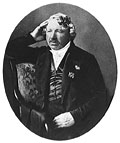
Daugerre self portrait 1848 |
The artist, scene-painter and physicist Louis-Jacques-Mandé Daguerre (1787-1851) and Joseph-Nicéphore Niépce never had exclusive rights to the process they invented. Instead Daguerre and Niépce received a pension from the French state, which declared photography a gift to the world.
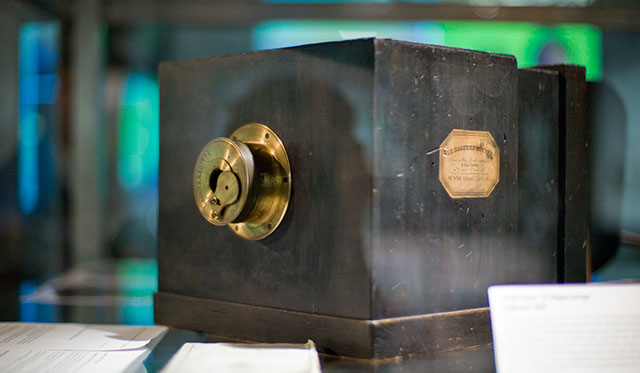 Daguerreotype camrea by Louis Daguerre from 1939. Nobody knows how many there was made, this sample is the only existing and they didn't use serial numbers. It was sold to Westlicht for 732,000 Euro in 2010 by a private owner who didn't know what it was. He had received it as a gift in the 1970s from his father after receiving his diploma as an optician. © Thorsten Overgaard. Daguerreotype camrea by Louis Daguerre from 1939. Nobody knows how many there was made, this sample is the only existing and they didn't use serial numbers. It was sold to Westlicht for 732,000 Euro in 2010 by a private owner who didn't know what it was. He had received it as a gift in the 1970s from his father after receiving his diploma as an optician. © Thorsten Overgaard.
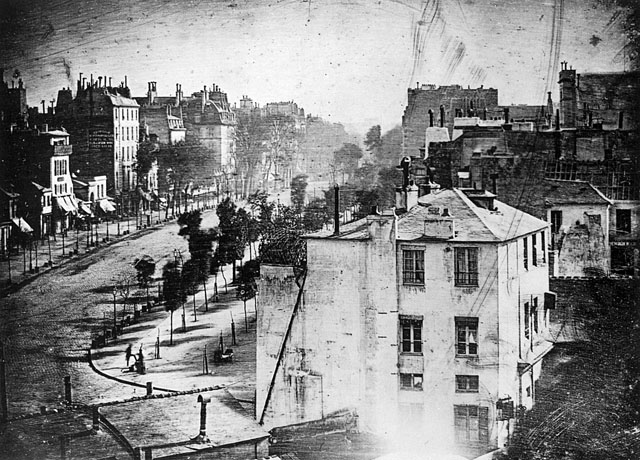
Daguerreotype by Louis Daguerre of Boulevard du Temple, Paris 1839.
D-Lux (Digital Lux) = A series of compact digital cameras by Leica Camera AG developed with Panasonic since 2003. See my article "Compact Digital Leica Cameras" and my Leica D-Lux 7 review. Lux comes from Latin and means Light.
Depth - Distance between front and back. Distance from viewer and object.
Digilux (Digital Lux) = A series of compact digital cameras by Leica Camera AG developed with Fuji from 1998, and then with Panasonic since 2002. The first models, Leica Digilux (1998) and Leica Digilux Zoom (2000) and Leica Digilux 4.3 (2000). With Panasonic, Leica Camera AG made the Leica Digilux 1 (2002), Digilux 2 (2004) and Leica Digilux 3 (2006). See my article Leica Digital Compact Cameras for more. Lux comes from Latin and means Light.
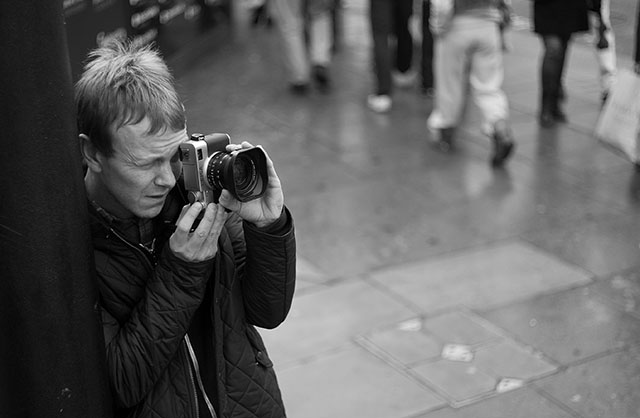
Graphic designer Charles Grant with his Leica Digilux 2 in 2009. © Thorsten Overgaard.
Digital rangefinders = The Leica M camera originates from 1925 and have been existing as film camera in many models. From 2006, the first Leica M digital rangefinder was launched, Leica M8. The Leica M7 (2002) is a film camera, so the new mode was Leia M8 and the main difference was that it had a crop digital sensor. The Next Leica M9 had a full-frame 24x36mm sensor. The Leica M240 had many features supposedly requested by users, the most noticeable was live view via a CMOS sensor, electronic viewfinder and video recording. Leica M10 was a return to the original Leica simplicity, including being a smaller body resembling the film cameras, and video and other features and buttons had been removed, a simplified menu created, and most noticeable an ISO dial to set the ISO on a wheel on the top left of the camera, very similar to the similar looking dial on older Leica film cameras where this dial was a rewind function for the film. Leica M11 (2022) was simplified even further, with a new sensor design that was designed to resemble classic color photography closer (Kodachrome and Leica M9 colors), yet featuring new technology such as triple-resolution sensor (where the sensor as a fourth function is also used as light meter), digital shutter and a new design where the battery is part of the bottom plate (no battery door, and no more bottom plate). was the rentwas simply digiral .
Digital Shutter = A shutter that operates silently by turning the cameras imaging sensor on and off to control exposure, rather than a traditional shutter where a foldable metal curtain keeps the sensor in the dark and goes up for a brief moment moment, like 1/125th of a second, and exposes the sensor to light. In the Leica TL2 (2017) , there is a mechanical shutter curtain from 30 sec. to 1/4000 shutter times, and digital shutter from 1/4100 to 1/40,000 shutter speeds. In the Leica M11 (2022) an electronic shutter can be activated from 60 seconds to 1/16000th second while a mechanical shutter goes from 60 minutes to 1/4000th second..The word shutter simply means to close something, like with a curtain. It comes from "desist from speaking" (14th century).
Digital Zoom = Refers to zooming in on a scene digitally. All that happens is that the camera zooms into the area of the sensor and records only that. The quality will be less as it's a smaller part of the same recording. Zoom is originally used for an optical zoom lens where optics move inside the lens so as to enlarge the subject optically. This does not reduce the image quality/resolution the same way as digital zoom does. Generally, digital zoom can be performed on any picture later in the computer as it's in essence simply a crop.
In the Leica Q Digital Zoom refers to the possibility to change the crop from 28mm to 35mm or 50mm (and for the Leica Q2, 75mm as well). Choosing a different "digital zoom" simply shows frame lines for the chosen focal length in the EVF and in the final image (that is in fact the full 28mm frame), there is a pre-selected crop for the chosen frame when you open the image in Lightroom or Capture One Prom.
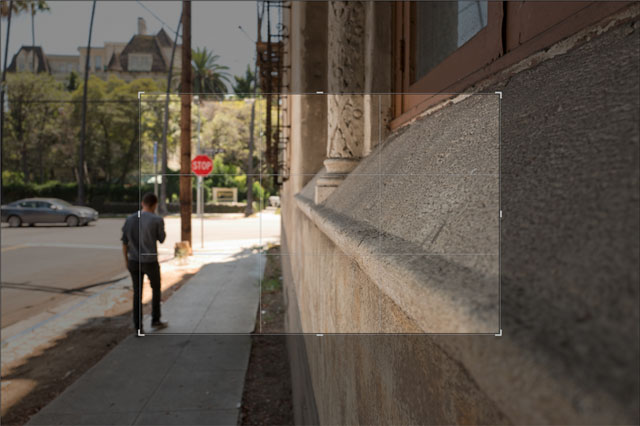
Digital zoom is in essence a crop of the image to make the scene appear closer. © 2017 Thorsten Overgaard.
Diopter adjustment = Adjustment in a camera viewfinder to fit to the eye's ability to focus. Often a camera has a little dial too adjust for eyesight less than perfect. For example the Leica Q3 has a -4 to +2 possible adjustment so that the electronic viewfinder will look sharp by moving the focus distance to the screen so it fits the eye.
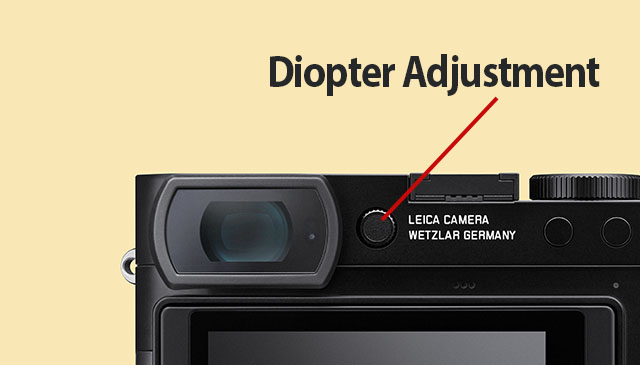
The Leica Q3 has a -4 to +2 possible adjustment so that the electronic viewfinder will look sharp by moving the focus distance to the screen so it fits the eye.
DIS = Digital Image Stabilization. This is a feature often offered in video recorders and sometimes for tele lens still photography (so as to avoid motion blur when the lens is moving during slow shutter speeds)
For example the Leica Q offers DIS but the factory recommend to set it to OFF. (The DIS is set to off from the factory because it can affect the image quality negatively, according to product director Stefan Daniel in an interview).
| |
 |
| |
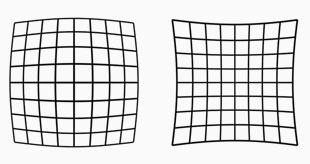
Lens distortion looks like this. The lines are not straight. Our eye uses distortion correction. Lens designers can design lenses so they have very little distortion, or they can make less complicated lens designs and "fix" the distortion in software. |
| |
|
Distortion = In photo optics/lenses: When straight lines in a scene don't remain straight because of optical aberration.
Lens designers can correct for distortion to a degree so the whole image field is perfect corrected and all lines remain straight. In modern lens design many designs rely on Software Distortion Correction (SDC).
The eye adjusts for distortion so we always see vertical and horizontal lines straight when we look at things. Even when you get new prescription glasses (if you use such), you will often experience distortion in your new glasses. After a few days they eyes have adjusted for the glasses and the distortion you saw to begin with is now gone. Software Distortion Correction (SDC) is far behind what the human eye can perform of adjustments. (Also see my definition on Perspective for more on the eye and optics)
DMR - Leica Digital Module R was presented in 2005 as a 10MP CDD sensor attachment to the Leica R8 and Leica R9 film cameras, made with Kodak and Imacon. About 3,000 units was produced from 2005-2006 and production likely stopped when Imacon (a Copenhagen company who made high-end film scanners) was bought by Hasselblad. New price in 2005 was $5,995 / €4,750. The image quality of the DMR is very close to Kodachrome film. Read more in my article Leica DMR digital back.
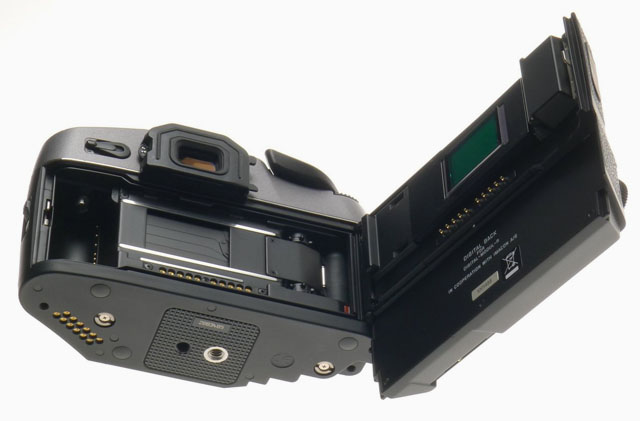
Leica DMR is an attachment to the Leica R8 and Leica R9 film cameras. You simply remove the film back and install the digital back instead.
DNG = Digital Negative, an open standard developed by Adobe. It is a single file that contains the raw image data from the sensor of the camera as well as date, time, GPS, focal length, settings, etc.
The alternative is a RAW file + XMP file where the RAW file contains the image information and the XMP contains the rest of information about where, how and when the picture was taken, as well as editing data when the photo is edited in Lightroom or Capture One.
A Camera Raw profile (that is specific for that camera) in the computer helps the software program, for example Adobe Lightroom, to translate the RAW data into the image. Camera producers provide a Camera profile with their camera, and Adobe makes their own 'refined' Adobe Raw camera profile for all new cameras.
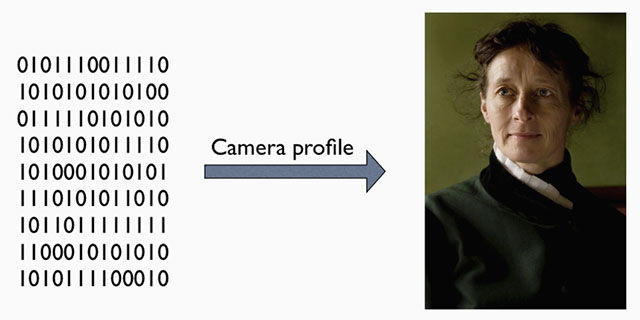
A raw file (or DNG) is simply the full recording of digital data (1's and 0's) from the sensor. In the computer, the sensor data is translated into the exact colors, via a camera profile.
Dodging = Expose one area of a photos less (in the development in the darkroom by exposing less light from the negative onto the light-senisitive paper by shading for an area with a hand or piece of metal of paper). In modern digital post processing (using editing software liek Lightroom or Capture One Pro), a digital tool "dodge" a selected area and makes it lighter digitally. Also see "Burning")
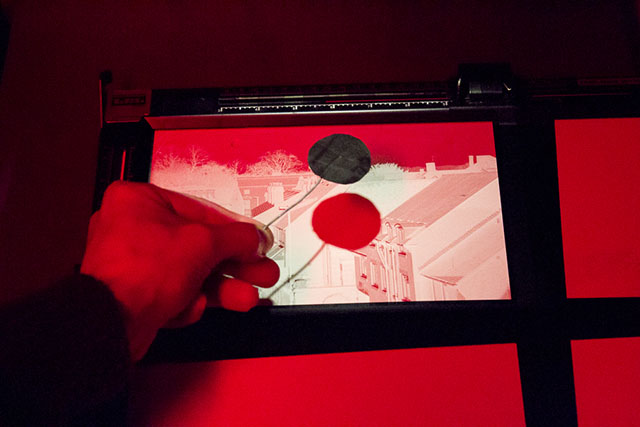
Dodging in the darkroom using a piece of metal or paper to shade so a portion of the light-sensitive paper gets less light. Photo: richardpickup.
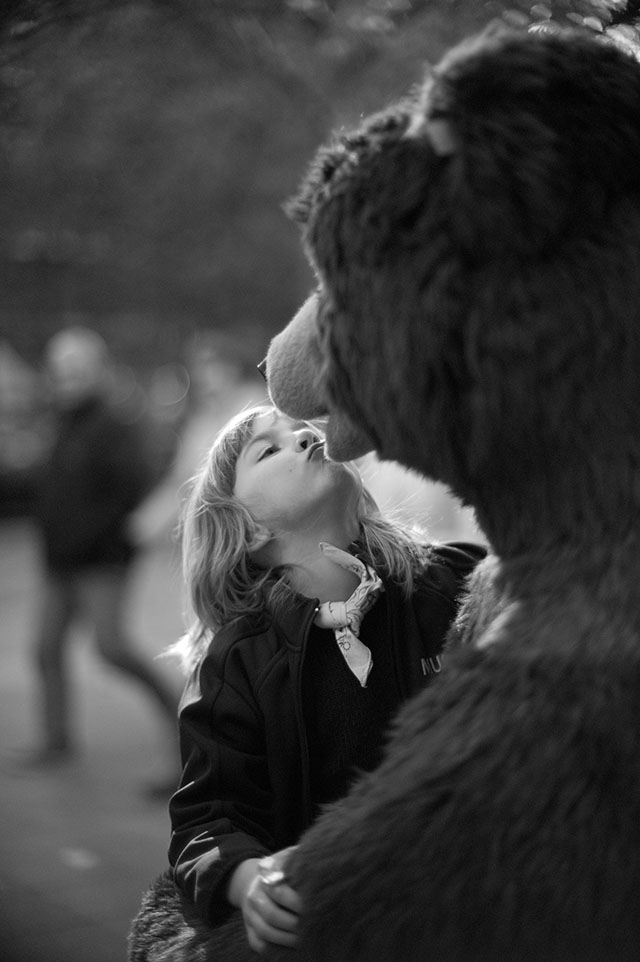
Narrow Dept Of Field in use: The face is in focus, the hand in front is slightly out of focus, the background is much out of focus and blurry, reduced to an atmosphere. Leica 50mm Noctilux f/1.0 at f/1.0 and 2.5 meters distance to subject in focus. © Thorsten Overgaard.
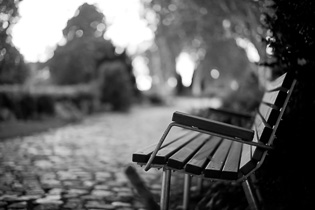 |
|
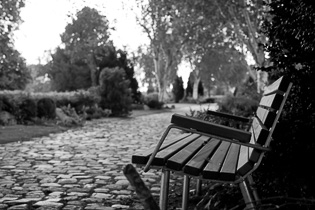 |
| 50mm f/1.4 lens at f/1.4. |
|
50mm f/1.4 lens at f/5.6 |
| |
|
|
| |
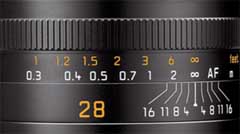 |
| |
The lines on this 28mm lens indicates the DOF. Here the focus is on infinity, and if the lens is stopped down to f/1.6, objects from 1.8 meter to ininity will be 'acceptable sharp'. |
| |
|
DOF = Depth of Field (or Depth of Focus), an expression for how deep the focus is, or (more often use to express) how narrow the area of focus is. This is how much of the image, measured in depth or ditance, will be in focus or "acceptable sharp".
The appearance of the DOF is determined by:
1) aperture (the smaller the aperture hole is, the deeper is the depth of field, and opposite, the wider open a lens you se, the more narrow will the DOF be) and
2) distance to the subject (the farther away, the larger area is sharp; the closer the subject in focus is, the more narrow the DOF gets)..
The DOF scale measurement on top of the Leica lenses shows lines for each f-stop that indicates from which distance to which distance the image will be sharp. Shallow DOF is a generally used term in photography that refer to lenses with very narrow focus tolerance, like f/1.4 and f/0.95 lenses, which can be used to do selective focus; making irrelevant subjects in the foreground and background blurry so only the subjects of essence are in focus and catches the viewers eye).
in modern cameras like the Leica SL2, the camera has a DOF scale inside the viewfinder. As DOF is the same for all lens brands and designs, only depending on focal length, distance and aperture f-stop, the camera can calculate it and show a 'digital DOF scale" in the viewfinder.
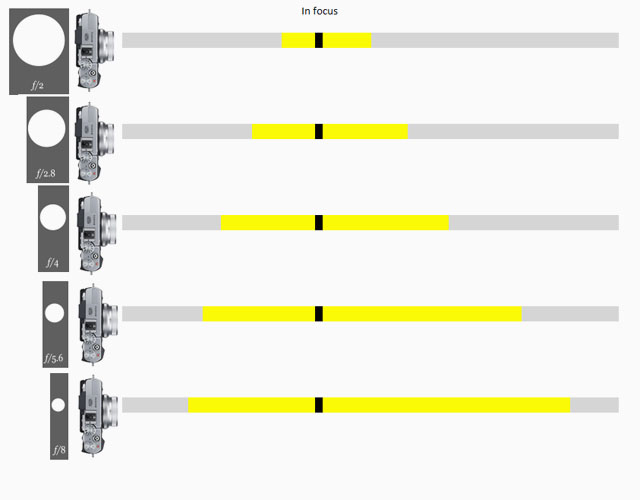
Depth Of Field scale from Fujifilm, same lens with different aperture settings from f/2.0 to f/8.0.

Depth of Field: Focus is on the flowers and the photograph on the desk and the foreground and background is blurred as the depth of field is narrow. If one stop down the aperture of the lens from f/1.4 to f/5.6, more will be in focus. If one stop down the lens to f/16 even more (if not all) will be in forcus. Another rule: The closer you go to a subject (the less focusing range), the more narrow the Depth of Field will be. © Thorsten Overgaard.
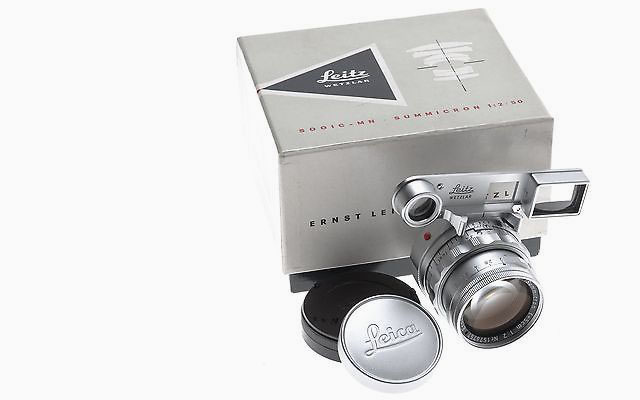 Leitz Summicron DR (Dual Range) f/2.0 (order no SOOIC-MN). Leitz Summicron DR (Dual Range) f/2.0 (order no SOOIC-MN).
DR = Dual Range lens. This is a type of Leitz/Leica lens that works as macro (near focus range) and normal lens, and comes with googles/"Eyes" for the macro function. The 50/2 Dual Range Summicron was made from 1956 to 1968, only in chrome, with a near-focusing range as close to 478mm.
You mount the googles/"Eyes" to focus at close range. If you use the lens in normal range, you can take off the googles/"Eyes"
The googles/"Eyes" can be critical for which camera the lens fits on. the Leica M6 TTL requires that the plastic tab onthe eyes is removed; and other Leica M models likewise. It fits on the Leica MP, M2, M3 and oterh models. .
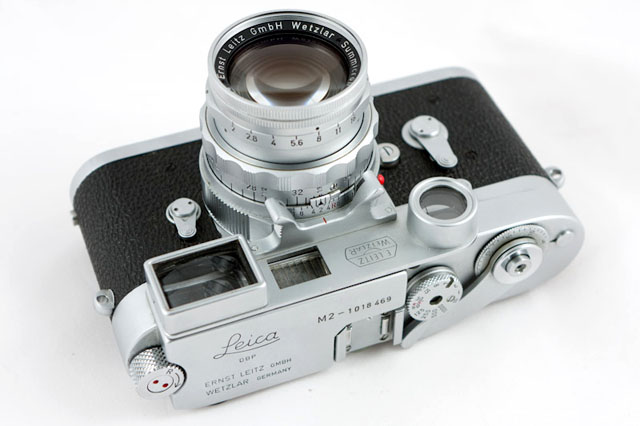
Leica M2 with Dual Range Summicron-M f2.0. © Dave Dunne.
Dynamic range. The grade of ‘contrast range’ (or number of tones) a film or sensor, or simply a photograph, possess between bright and dark tones. The human eye is said to have a dynamic range of 10-14 ‘stops’ (but because we scan area by area and compile a concept of the overall scene, they eye is often thought to have a much higher dynamic range), Film used to have 7-13 ‘stops’ and some modern sensors have up to 15-17 ‘stops’.
E - Diameter in Leica filters and screw diameter, as in E46 which means that the filter diameter is 49mm for this lens. In general language, one would see Ø46 used, as Ø is the general symbol for diameter.
Edge light = Also called hair light or rim lgith: A spotlight or strong light source from behind (outside the visible frame), reflecting on the side or top of the head to give edge to thehair and more three-dimensional feel to a portarit. If placed on the edge of the frame, it may also act as a sparkle of light (like a sun) and produce flare). If the key light on the face is a 300W spot, the keylight is usually a 100W - 150W spotlight. Can be equipped with a color gel (filter) to add a color. Edge light can also be used to add edge to a product photo, a photo of a chair, details ona car, etc.
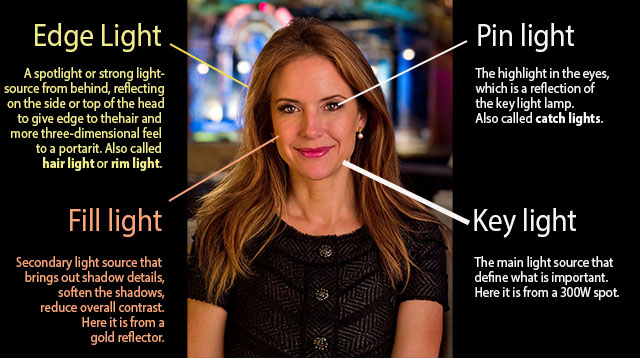
My portrait of Kelly Preston has edge light from a 150W spot placed outside the frame to the left behind her. The reflection in her eyes is pin light (catch light from the main light source, the key light, a 300W spot). The left side of her face is fill light from a gold reflecor reflecting the key light (two spotlights and a reflector was used for this photograph). © Thorsten Overgaard.
ELCAN - Ernst Leitz Canada, established 1952, was the Leitz family's guarantee against another war in Europe and/or invasion from Russia after WWII. Besides becoming a copy of the Wetzlar factory, it also became the somewhat military/industrial branch of Ernst Leitz . Because of the precision work, high standards and knowledge in optics for science and millietary, the ELCAN plant was sold to Raytheon (USA), who bought it from its previous owner, Hughes Aircraft Co.
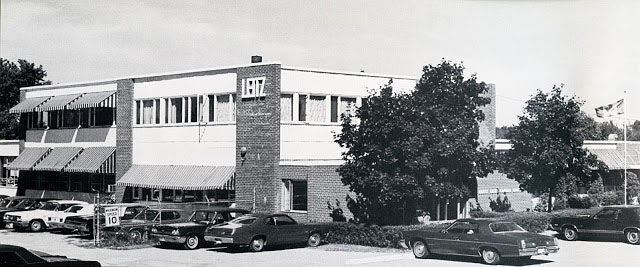
Ernst Leitz Canada (ELCAN) was established in 1952 close to Toronto in Canada.
Elcan-M is the name of lenses for M lenses that fits the Leica M system Leica M, as the U.S. Navy High Resolution Small Format Camera System during the Vietnam war.
Elcan-R is also the name of a series of R lenses made in the 1960ies and early 1970ies that fits Leica R system, as the U.S. Navy High Resolution Small Format Camera System during the Vietnam war.
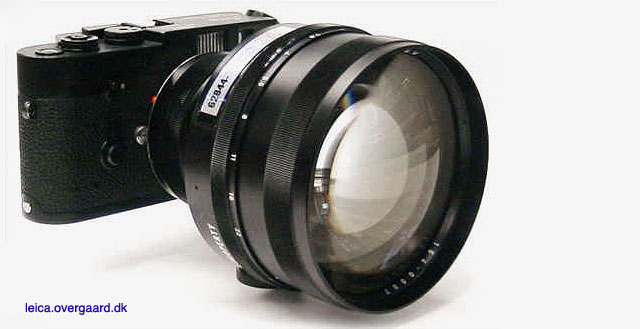
The Leitz ELCAN-M 90mm Noctilux-M f/1.0 model C164 on a Leica KE-7 film camera made for the U.S. Navy.
Electronic Shutter = A shutter that operates silently by turning the cameras imaging sensor on and off to control exposure, rather than a traditional shutter where a foldable metal curtain keeps the sensor in the dark and goes up for a brief moment moment, like 1/125th of a second, and exposes the sensor to light. In the Leica TL2 (2017), there is a mechanical shutter curtain from 30 sec. to 1/4000 shutter times, and digital shutter from 1/4100 to 1/40,000 shutter speeds. In the Leica M11 (2022) an electronic shutter can be activated from 60 seconds to 1/16000th second while a mechanical shutter goes from 60 minutes to 1/4000th second..The word shutter simply means to close something, like with a curtain. It comes from "desist from speaking" (14th century).
Electronic ViewFinder = See EVF.
ELDIA
Leitz slide copier used to dublicate slides if one for example had to make several sets of a slideshow.
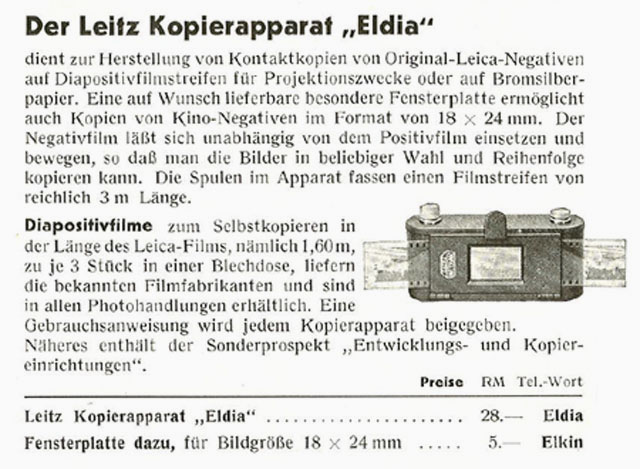 Ad for ELDIA slide copier. Ad for ELDIA slide copier.
ELDUR
Leitz slide copier used to dublicate slides if one for example had to make several sets of a slideshow.
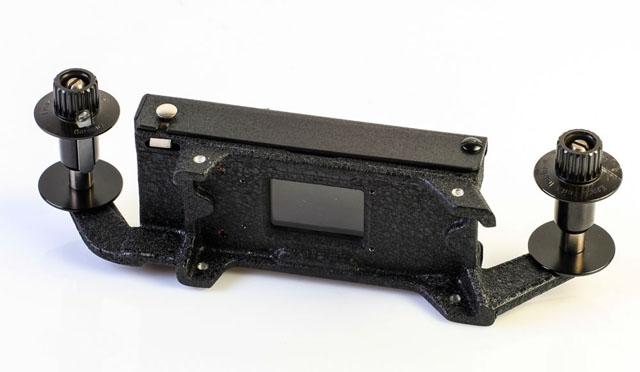
ELDUR Slide Printer
Elmar = Refers to the maximum lens aperture - here f3.5 . Historically derived from the original 1925 50mm f3.5 Elmax lens, which was an acronym of (E)rnst (L)ieca and Professor (Max) Berek, designer of the original lenses. Later that year the 50mm f3.5 Elmar superceded the Elmax, which was discontinued due to its complexity and high cost of manufacture.
Elmarit = Refers to the maximum lens aperture - here f2.8 . The name is obviously derived from the earlier (and slower) "Elmar" designation. Not every f/2.8 lens is called an "Elmarit" though, the most obvious current exception being the 50mm f2.8 Elmar-M collapsible lens which for nostalgia and marketing reasons has kept the original 1930's Elmar name (the 50mm f3.5 collapsible Elmar, manufactured 1930-59, was one of Leica's most famous and popular lenses). Vario-Elmarit (and Vario-Summicron, etc) is Leica Camera AG's name for zoom lenses.
Elmax
Elmax lens named after = Ernst Leitz + Max Berak. Ernst Leitz was the founder of Ernst Leitz Optical Industry which later became Leica. Professor Dr. Max Berak was employed at Leica in 1912 and was the architech of the first Leica lens which Ernst Leitz asked him to design for the "Barnack's camera" (the 1913-prototype named after Oscar Barnack who invented it). The lens was a f/3.5 50mm and was known as the Leitz Anstigmat and later the Elmax.
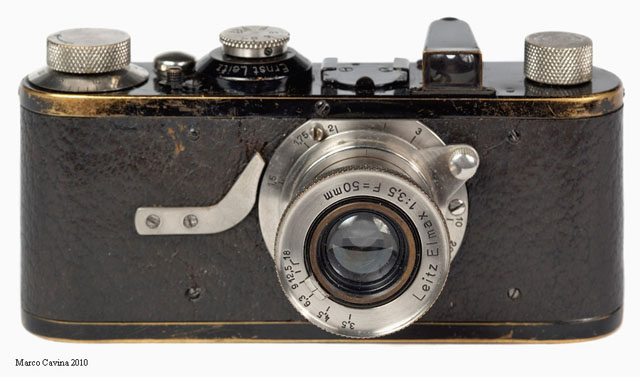
The Leitz Elmax 50mm f/3,5 (1925-1961) on the Leica A camera (1925) camera. Photo by Marco Cavina.
EVF = Electronic ViewFinder. A viewfinder where you look at a small screen through optics/prisms. The advantage is that you see what the sensor sees. Some cameras have built-in EVF (Leica CL, Leica SL, Leica Q, etc), others you can attach an EVF (Leica TL2, Leica M240, Leica M10, Leica M11).
Traditionally a viewfinder is a device on a camera showing the field of view of the lens, used in framing and focusing the picture. Some rangefinder cameras simply have optics that show an area in front of the camera with frames indicating what will be recorded on the film or sensor. SLR cameras have mirror and prisms so you see theough the lens of the camera. Electrnic viewfinders show on a small display inside the viewfinder what the sensor see.
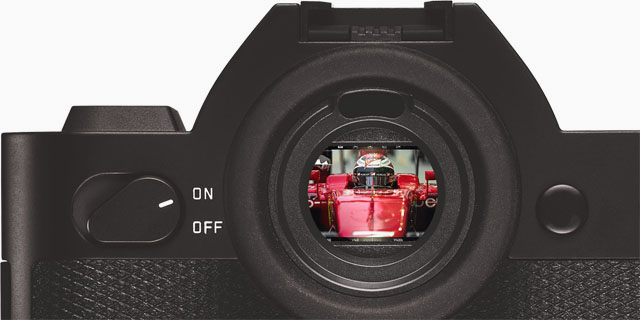
The EVF (Electronic Viewfinder) on the Leica SL.
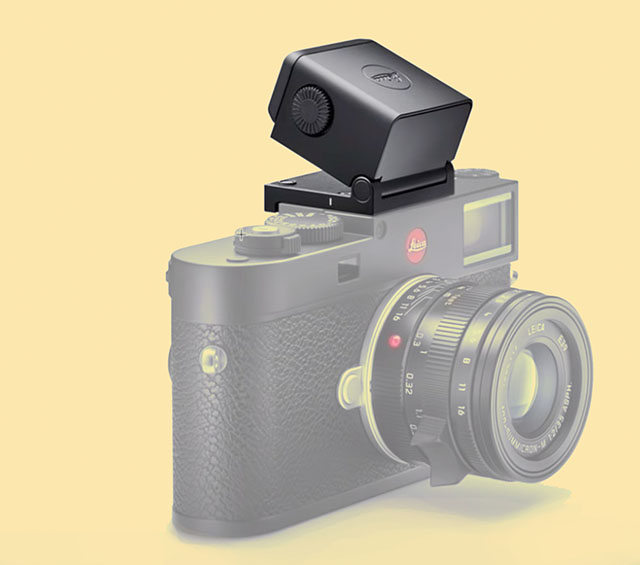
The Visoflex 2 electronic viewfinder on the Leica M11.
EXIF =Exchangeable Image File, a file generated in camera and enclosed in the image file that contains recording information on the image such as shutter speed, exposure compensation, what metering system was used, aperture setting, ISO setting, date and time the image was taken, whitebalance, which lens was used, camera model and serial number. Some images may even store GPS information so you can see where the image were taken. The data from the EXIF file continues to follow any later editions of the image and can be read in photo editing software such as Capture One and Lightroom, as well as Photoshop (go to the menu File > File Info). There is also software available that can read EXIF data from any file, like Exifdata.com.
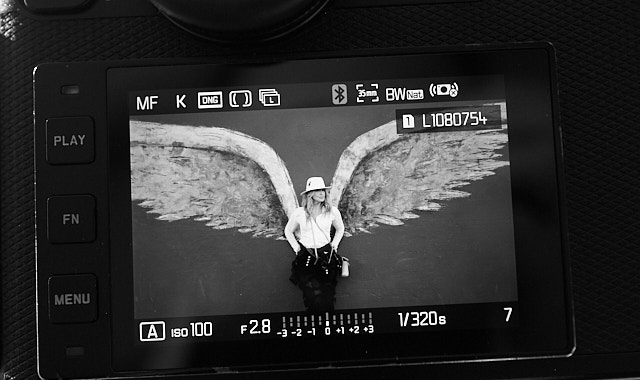
The EXIF data is all the information about shutter speed, metering method, ISO, etc. - and then some more that you don't see on the screen (such as camera model, serial number, lens used, etc).
Exposure Bracketing = The possibility to set the camera to automatically record a series of images where the exposure is above and below what the camera measures. The idea is that at least one of the images will be correctly exposed.
f/ (f-stop, also known as aperture).
f- (focal length). Often given in mm, for example 90mm. In the past they were often given in cm or inch, for example 9.5 cm or 3.2 inch.
f/1.25 is the size of the "hole through" the lens, the aperture. f/1.25 means focal length divided with 1.25. In the Leica 75mm NoctiluxM ASPH f/1.25, the "hole through" the lens at f/1.25 is 60mm in diameter. At f/1.4 the "the hole through" is 53.5mm in diameter. At f/4 the "hole through" is 18.75mm in diameter.
Each step smaller from f/1.4 to f/2.0 to f/2.8 to f/4.0 and son on is a reduction ofthe light to half for each step. The Noctilux f/1.25 therefore lets 50% more light in through the lens than a 75/1.4 Summilux.
f-stop = the ratio of the focal length (for example 50mm) of a camera lens to the diameter of the aperture being used for a particular shot. (E.g., f/8, indicating that the focal length is eight times the diameter of the aperture hole: 50mm/8 = 6,25 mm); or the other way around, the hole is the focal length divided with 8).
ORIGIN early 20th cent.: from f (denoting the focal length) and number.
One f-stop is a doubling or halving of the light going through the lens to the film, by adjusting the aperture riing. Adjusting the f-setting from f 1.4 to f.2.0 is halving the light that goes through the lens. Most Leica lenses has half f-stops to enable the photographer to adjust the light more precicely.
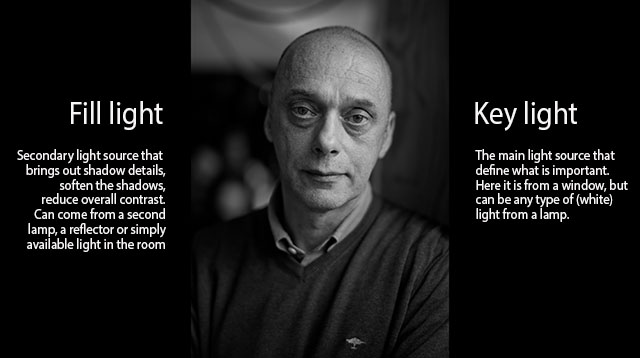
Fill Light and Key Light. © Thorsten Overgaard.
Fill light = A supplementary light used in photography or filming that lightens and softens shadows, bring shadow details out and decrease overall contrast. It can be an additional light source that is less strong than the key light (see “Key Light” further down) or a reflector made of silver, gold or white board throwing back a reflection of light from the key light, or from a wall or window that happens to reflect a lesser amount back onto the scene than the key light. Reflectors can almost always be placed to pick up light from a source and throw it onto the subject, much like a mirror.
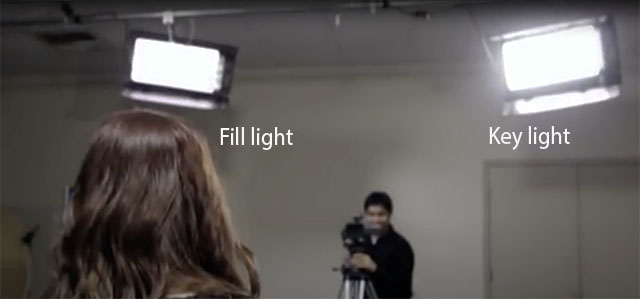
Key Light (strongest light source, also called the main light) and Fill Light (less strong light source to soften shadows) is a basic concept of light for still, film, theatre and movie. See Fill Light and Key Light definitions for more.
Filters = Glass filters you put in front of the lens. A much used filter is the claer UV filter that is supposed to protects the front of the lens. Other filters are color filters that add effects to black and white photography by changing the color balance. Other filters are ND (Neutral Density) filters that reduce the amount of light coming through (used for for example video recordings as video is usuallu filmed at 1/50th second shutter speed and thus most lenses are too bright wide open. Or they are used for long exposure photography in order to record for example stars movements over the sky. Other filters are filters that create star effects, or blur the view, and almost any effect you can think of.
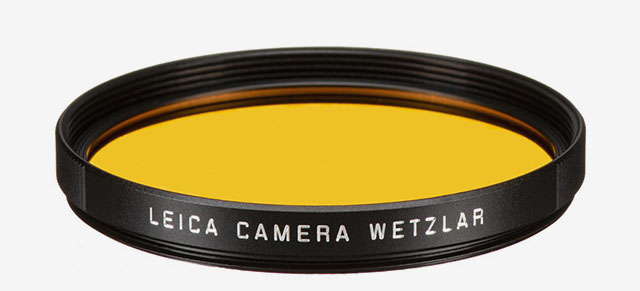
A traditional Yellow filter in 49mm diameter to screw onto the front of the lens. The yellow filter is used for black and white photography where it slightly darkens skies, helps to cut through haze, and improves overall contrast. Yellows and reds within the scene are also lightened.
Flag = A 'flag shaped' device used in lighting for motion picture and still photography to block light. It this sense it is black and not see-through as it can be used to cast a shadow, provide negative fill, or protect the lens from a flare. A flag is also often seen as a 'schrim' which means it is a 'flag-shaped' but carries a light white textile that reduces light or diffuses light.
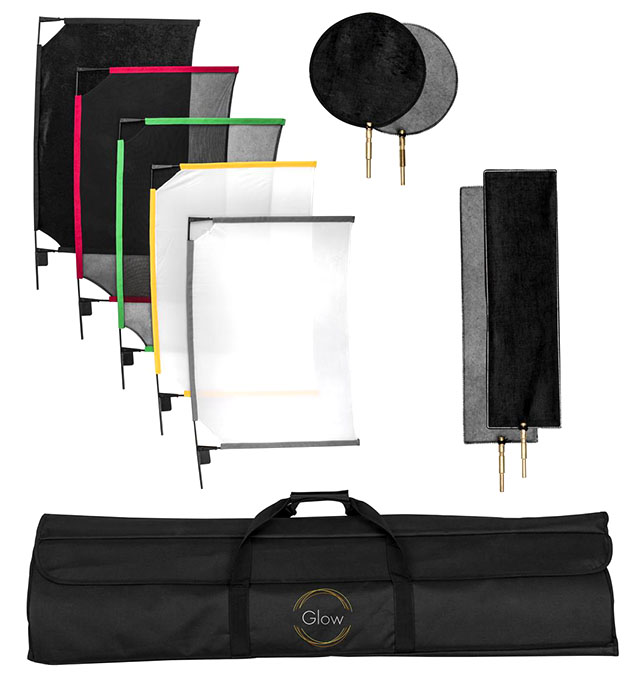
Flags and scrims kit (with 24x36" frames) with carrying bag.
Flare = Burst of light. Internal reflections between (and within) lens elements inside a lens. Mostly, flare has a characteristic "space travel" look to it, making it cool. Particularly in older lenses with less or no coating of the glass surfaces to suppress this, it can be a really cool effect. In newer lens designs, the coatings and overall design try to suppress flare and any reflections to a degree, so that there is seldom any flare to be picked up (moving the lens to pick up a strong sunbeam), but instead a "milking out" (or "ghosting") of a circular area of the frame; meaning simply overexposed without any flare-looking flares.
 |
|
 |
Sunlight creating (fairly supressed) flare in the bottom right quadrant of the image of a modern lens. |
|
The camera moved slightly to avoid the flare. |
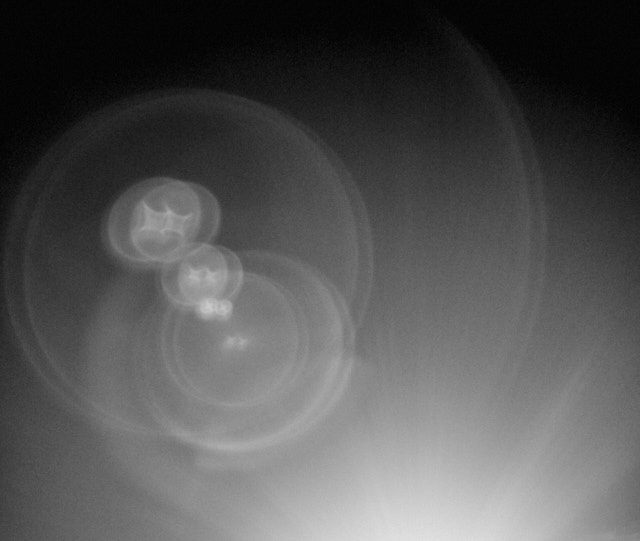
Older lenses with less coating, or without coating, are known to create flare that can look like this (Leica 50mm Summicron-M f/2.0 II Rigid model from the 1960's). © Thorsten Overgaard.
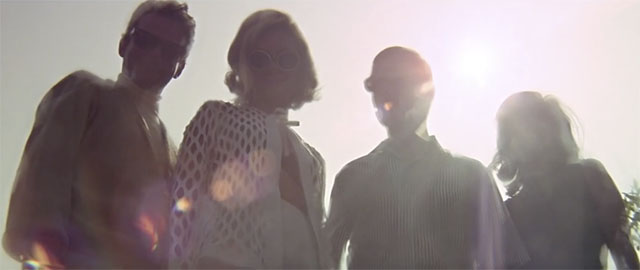
Lens flare in the movie, The Graduate (1967).
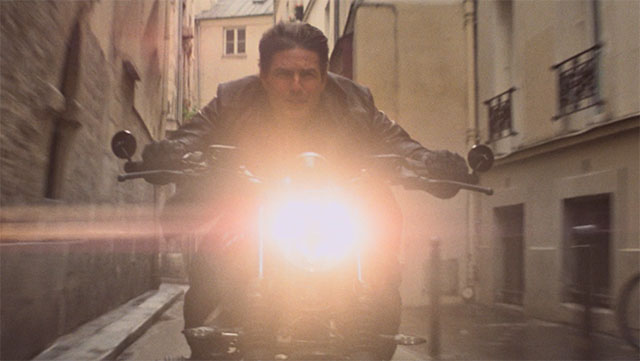
Lens flare in Mission Impossible Fallout (2019)
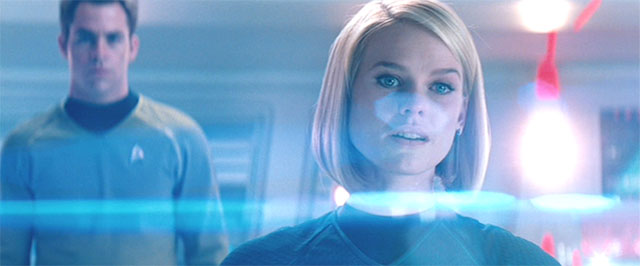
Lens Flare in Star Trek (2013). JJ Abrams famously said, "I know there's too much lens flare ... I just love it so much. But I think admitting you're an addict is the first step towards recovery (ha ha)"
|
FLE = See "Floating Elements"
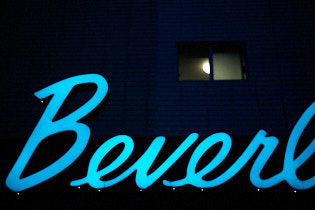
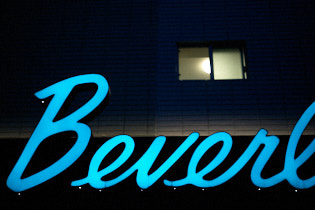
Flickering = blinking light. This may result in "banding like" horizontal stripes in an image, or simply that the light you see isn't in the picture, or it looks different. For example, you take a photo in light, and the result you get is darker. You take another, and now it is all right. The reason is that some light blinks. Here's the difference within one second (notice how the light in the room, the wall light and the sign light all flicker):
 |
|
 |
| |
|
|
 |
|
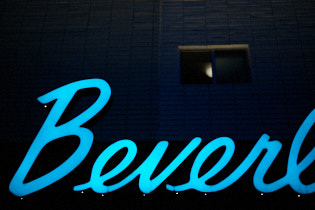 |
Flickering light causing different result in each frame becasuse the light blinks faster than the eye sees, but slow enough to be caught on camera. Here at shutter time 1/1500 sec, four pictures within a second.
Often you will see that you take a portrait indoor in an office, and from frame to frame the person has shade on one side of the face in one photo, but not the next. |
| |
|
|
Flickering ligh is a new challenge that photographers face, which is flicering light that looks good to the eye, but result in different results in a photo. Through cinema and photography history, the three standard high-quality light soruces have been daylight (from the sun), daylight HMI (5400 Kelvin Hydrargyrum medium-arc iodide lamps) and tungsten lamps (3200 Kelvin). When I say high-quality, it's because those are the light types that ensure high color quality (see the definition of CRI - Color Rendering Index in my "Leica and Photography Definitions page") and how quality light traditionally has a score above 90 CRI).
In recent years we have seen "light that flickers" because it has a pulse, such as stage light, photo lamps, video lights and of course indoor and outdoor late night lamps using LED (Light-emitting diode), compact fluorescent lightbulp-shaped lamps and other low-energy lamps (such as halogen). These light also generally have lower CRI (Color Rendering Index) below 90, and even lamps that are stated to have 90 CRI or higher, may mis out on the important red and blue tones, which will make it impossible to get the colors right, espoecially skin tones). If a stage has one or more low-quality lights (which they thend to have), these will pollute the colors of the scene to some degree.
| |
 |
| |
Banding as result of electronic shutter, and often also if the ISO is high. |
Flickering horizontal stripes (or "banding"-looking stripes) may appear when you use electronic shutter, and you are photographing with one or more light sources that flickers.
When the electronic shutter is on, you are usually at higher shutter speeds than 1/2000, which means there it would be possible to go down to a lower ISO, and to activater the mechanical shutter. (In some cameras you can choose to use electronic shutter throughout the entire range, which would make the camera completely silent; and this alone may cause horizontal stripes/banding if one or more lights in the room flickers).
Flickering in the EVF is very normal and will apear often without the vertical lines you see in the EVF will be in the picture.
| |
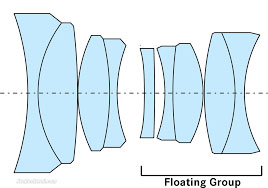 |
| |
Floating elements (a group of lenses or can also be s aingle lens element). . |
Floating Elements (FLE) = Near focus correction in a lens by having a single lens or a group of lenses floating independently of the other lenses. Most lenses are born with poor performance at their closest focusing distance. Center sharpness may be good, but aberrations and corner softness increase when you’re shooting closeups. Floating elements are lens elements outside of the primary focus group that change position when the lens is focused on a close object, correcting aberrations and improving close up performance.
Floating Elements originally was coined by Canon in the 1960's and quickly became the general term for this feature. Other brands came up with new names for the same thing, Minolta called it Floating Focusing, Nikon used the term Close-Range Correction (CRC), Leica call it FLE/Floating Elements.
Floating elements are for close-focus improvement of image quality and not for reducing "focus shift". Floating elements by themselves cannot reduce focus shift, but by reducing the impact of focus distance on performance, they give the designers more freedom in other areas - which could include minimising focus shift.
(As a side-note, when a lens "rattler when moved, it is not the floating elements "floating around" but can be the IS (Image Stabilization) elements for elense that has that, AF elements for auto focus lenses, or the aperture cage that rattles (as in the case of the Leica 35mm Summilux-M f/1.4 FLE - if you stop down the Summilux to f/16, the sound is usually not there).
Fn = Short for Function. It's a function button or wheel on a camera that you can program (focus zoom, turning acessories on/off, one-click to set white balance, one-click to call up a particular menu setting).
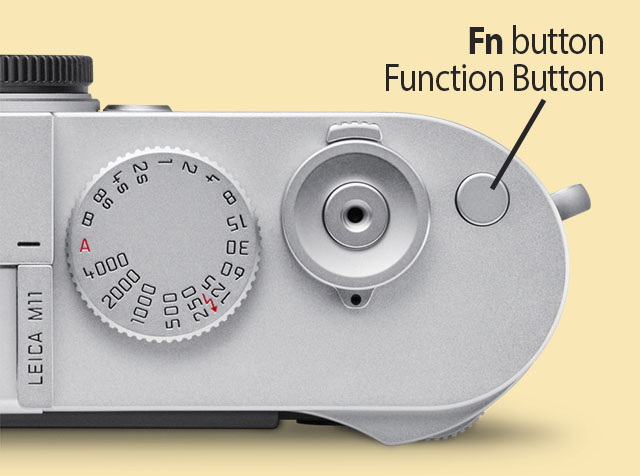
The Leica M11 has a Fn button on top.
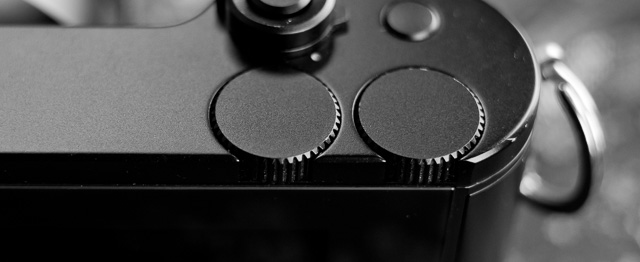
The Leica TL2 and Leica CL has two Fn wheels (wheels you can program to different functions after your likings).
| |
 |
| |
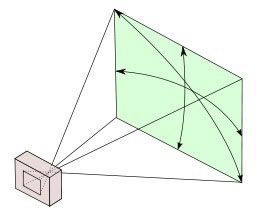
A 28 mm lens has a 74° viewing angle |
| |
|
Focal length = Originally focal length referred to the distance from the sensor (or film in older days) to the center of focus inside the lens (28mm, 50mm, 400mm, etc). Today one call it effective focal length (EFL) as a 400mm lens is not nessesarily 400mm long due to optical constructions that can make it shorter. The 35-420mm zoom on the Leica V-Lux 1 is for example only ca. 135 mm long. Nobody uses that measurement, except those who construct lenses! For users of lenses, focal length refers to how wide the lens sees. The viewing angle, which is often given in for example 90° viewing angle for a 21mm lens, 74° viewing angle for a 28mm lens, 6° viewing angle for a 400mm lens, etc.
Each human eye individually has anywhere from a 120° to 200° angle of view, but focus only in the center.
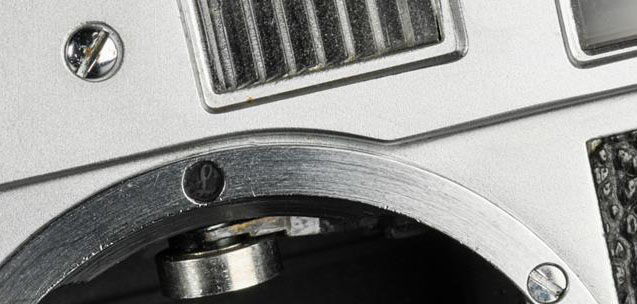
A Leica with a small "L" impressed in wax over the fifth screw of the M bayonet.
L-seal - A small L impressed in black wax, covering the top screw in the bayonet of a Leica camea. Rumor is that this shows that the camera hasn't beem repaired, which is not true. Any of several authorized repair facilities would impress their symbol after repair. This goes for older Leica camers such as Leica M3 and Leica M4. L stands for Leitz (in Wetzlar, Germany), but each authorized repair facility has their own seal. Here is the list of symboles or seals as of 1963:
|
|
|
|
|
|
|
Nordisk Optisk, Copenhavn
|
|
|
|
|
|
|
|
|
|
|
|
|
|
|
|
|
|
Luz Ferrando, Buenos Aires
|
|
|
|
|
|
|
|
|
|
|
|
|
|
|
|
|
|
|
|
Microtecnica, Rio de Janeiro
|
|
|
|
|
|
Camera Service Center, Hollywood
|
|
Pablo Ferrando, Montevideo
|
|
|
|
|
|
Professional Camera Repair, New York
|
|
|
|
Rocky Mountain Camera Repair, Denver
|
|
|
|
|
|
|
|
|
|
|
|
|
|
|
|
|
|
|
|
Diamon Damera Company, Houston
|
|
Commercial Ultramar, mexico
|
|
|
|
|
|
|
|
|
|
|
|
|
|
|
|
|
|
|
|
|
|
|
|
|
|
|
|
|
|
|
|
|
|
|
|
|
|
|
|
|
|
|
|
|
|
|
Leitz Focomat = Darkroom enlargers made by Leica from 1937 to 1958. As you may recall, the concept of the Leica was "small camera, large print". The enlarger is the key to make the small negative into a large print.
| Model |
Year |
Format |
Baseboard
|
Head |
Focusing |
AF |
| Focomat Ia |
1937-1949 |
|
|
|
|
|
| Focomat Ib |
1946-1950 |
40x40mm |
n/a |
Single condenser |
Bellows |
Yes |
Focomat Ic,
Ic Color |
1950-1977 |
35mm |
16x21" |
Single condenser |
Helical |
Yes |
Focomat IIa,
IIa Color |
Late 1940s |
2-¼ x 3-½" |
20-½ x 27" |
Double condenser |
Bellows |
Yes |
| Focomat IIc |
1974-1983 |
2-¼ x 3-½" |
20-½ x 27" |
Double condenser |
Bellows |
Yes |
| Focomat V35 |
1979 |
35mm |
21-¼ x 27-½" |
Diffusion |
unknown |
Yes |
| Valoy II |
1958 |
35mm |
15-½ x 17-¾" |
Single condenser |
Helical |
No |
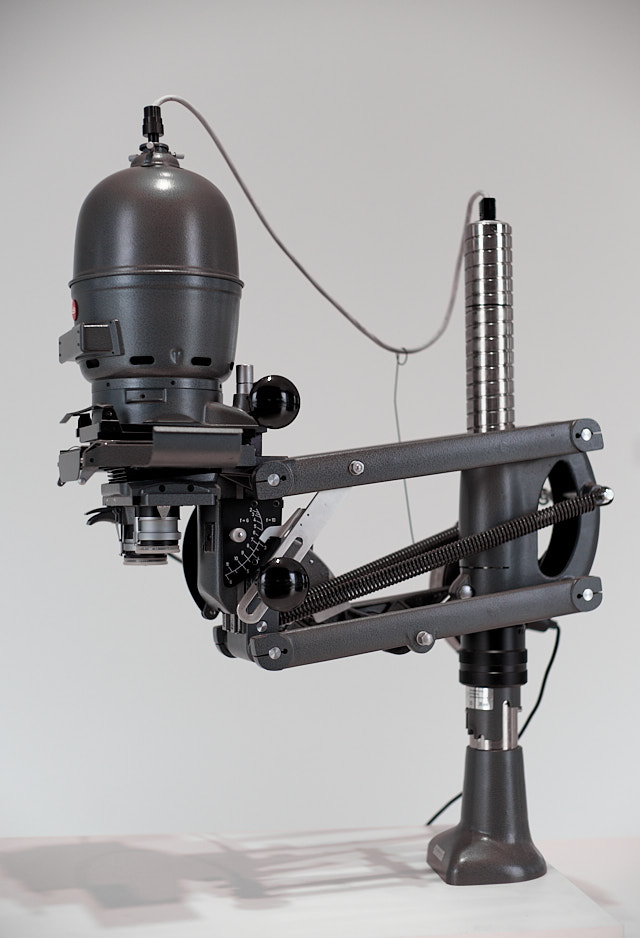
A fully restored Leitz Focomat II at the factory in Wetzlar, Germany 2021.
It was in production 1956 - 1983 and is widely considered the most cool enlarger. This one with Focotar 60mm f/4.5 for small format and a V-Elmar 100mm f/4.5 for medium format. © Thorsten Overgaard.
Focus, in - Sharp and clear in appearance. Focus - “The burning point (of a lens or mirror)”. In Latin the word focus meant fireplace or hearth. The word was probably first employed outside of its Latin literal use as “the burning point of a lens or mirror” in optics, and then came to mean any central point. The German astronomer Johannes Kepler first recorded the word in this sense in 1604.
Focus shift = That the focus of a lens shifts as the aperture changes. For example, if one focus a 50mm lens at f/2.0 and then stop the aperture down to f/8, the focus may change, especially noticeable in close focusing. Modern lenses with floating elements (FLE) where the floating elements adjust for image quality in close-focusing may also help avoid focus shift.
Four Thirds - Also known as "4/3" - The Four Thirds System is a standard created by Olympus and Kodak for digital SLR camera design and development.
The system provides a standard which, with digital cameras and lenses available from multiple manufacturers, allows for the interchange of lenses and bodies from different manufacturers. Companies developing 4:3 cameras and/or lenses are Fuji, Kodak, Leica, Olympus, Panasonic, Sanyo, Sigma. See www.4-3system.com
A further development in this was Micro Four Thirds Systems.
Frame lines = the lines inside a viwfinder that indicates the edger of the frame. In a Leica M, the viewfinder always is as wide view as 24-28mm. A mechanical contach on the lens (triggers the camreas frame selector) so the viewfinder shows the frame line of that lens. In the Leica M, the frame lines comes in sets, so there are alwaus twop sets of frame lines shown at any time (see illustration below).
(This is different than in most cameras where you only see what the lens captures: SLR cameras was the evolution in 1940's where the image from the lens was displayed directly onto a matte screen inside the camera via a mirror.
Later mirrorless cameras, the viewfinder shows the exact picture that the sensor sees through the lens).
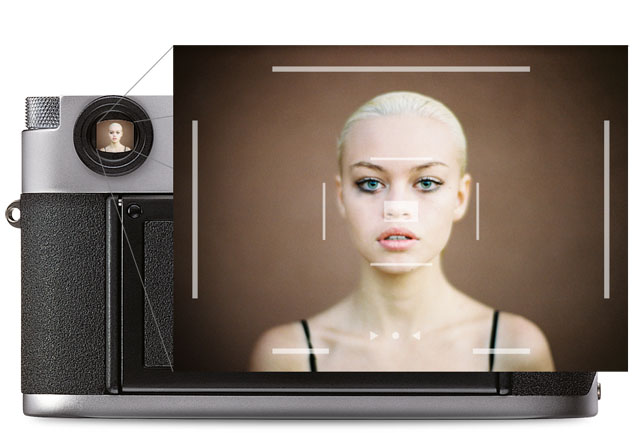
Frame lines of the Leica M, here showing the set of 35mm and 90mm framelines.
Fresnel lamp - Lamp with glass on front that bends light. Usually the light source behind the glass can be moved (or the fresnel glass can), which allow you to narrow or broaden the beam of light. Named after Augustin Jean Fresnel (1788–1827) taht said that light moves in a wave-like motion.
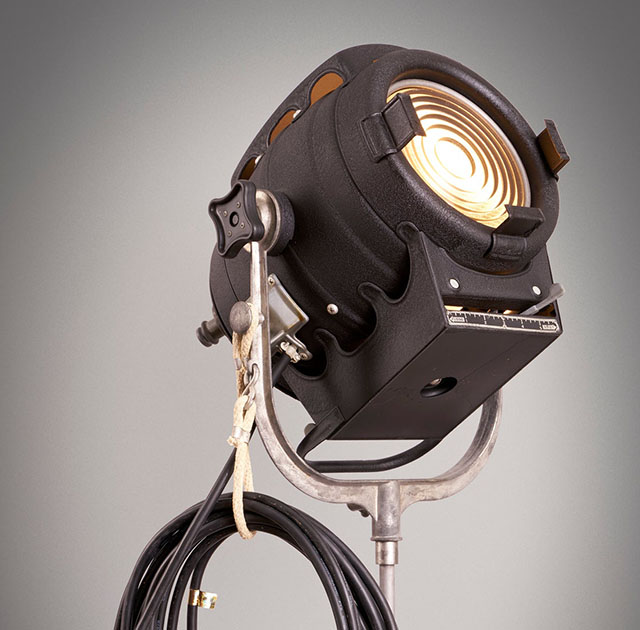
A fresnel lamp is a spotlight with a flass in front to spread/center the light. Here's a 1950's Bardwell & McAlister movie lamp, though it is still a lamp type in production and use, from 150W to 24K lamps!
| |
 |
| |
Full Frame is "king of photography" |
| |
|
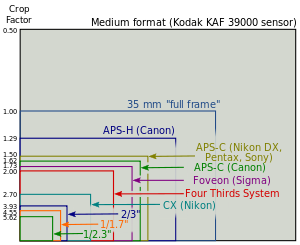
Full Frame (FF) = The size of the sensor is 24 x 36mm which is the format Oskar Barnack and Leica Camera AG invented with the first Leica that was introduced in 1925. Many other formats invented since, such as APS, APS-C and all usually refer to Full Frame ratio, by which it means what size they have compared to Full Frame. The "full frame" technically deifinition thouhg is a sensor that camtures the full frame in one go (as the early sensors as in Leica S1 scanned the image/senor over a period of time).
The 24 x 36mm Full Frame format is so "king of photography" that it has continued to be the ideal for all cameras. Besides this, there exists Large Format cameras such as 4x5" (100 x 125 mm) and Medium Format 6x6 (60 x 60mm amongst other sizes in that area).
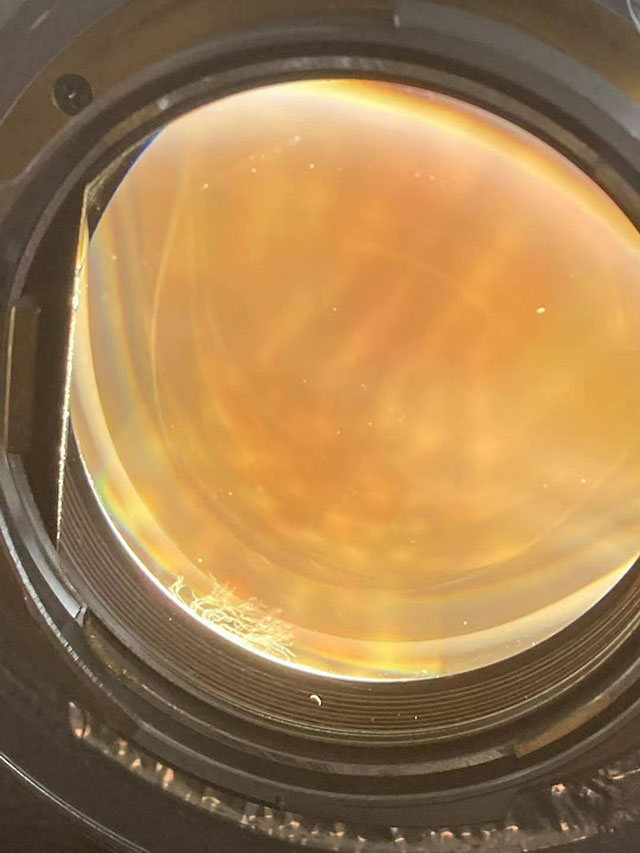
A small area of Fungus in the edge of a 50mm Canon f/0.95 lens. While it doesn't affect the image in that edge-position, having it around can spread the fungus to (cameras and) other lenses.
Fungus - Is a living organism that attacks and eat glass in lenses. Usually humid and dark conditions can cultivate it. Lenses and camreas are therefore often kept in dryboxes in Hong Kong, Philippines and similar place, whereas the hot and humid climate of Florida in USA doesn't seem to creaate fungus. Lenses kept in a leather camera bag in a humid attic or wet basement for years, that's also a place that can cultivate fungus. I have occasionally warned against keeping Leica lenses in the leather pouches that are supplied with the lenses. I might be right or not, but I wouldn't keep them in those. Not that I think fungus will develop in normal conditions, but if wetness enters for some reason, the lens is in perfect conditions for cultivating fungus.
When you send a lens to Leica Customer Service at the factory in Wetzlar, they inspect for fungus and doesn't allow lenses with fungus inside the repair department. Sometimes they offer to send the lens to a facility in Hamburg that can kill the fungus, but that is for lenes with very little signs of fungus.
The fungus "eats" the glass, so once it starts, it create lines, and it continue to spread across the lens surfaces. In short, don't buy lenses with fungus, if you live in areas where fungus is normal to occur, store your equipment in dry box. And if youalready own a lens and discover fungus, see what you might be able to do with experts in the matter.
When you use Leica lenses, you use lenses that have no eexpiry for use. Lenses from 1930's are still being sold and used. So any Leica lens has the potential to be used for many years, which is a good reason to make sure you don't get fungus in them. There is an article here at PetaPixel on do-it-yourself fungus removal.
Gel = A transparent colored material used to modify lights for photography, cinematography video and theatre. They can be used to make tungsten light (3200 Kelvin) into daylight white (5400 Kelvin) by using a CTB gel (color temperature blue), or the other way around with a CTO (color temperature orange, which converts daylight to tungsten). Or they can be for color effects or light effects. A number of non-color gels exist to create special light effects. Gels exist to create diffusion effects on the light. Other effects include opal, skylight, star-effect and various softening filters and light effect filters.
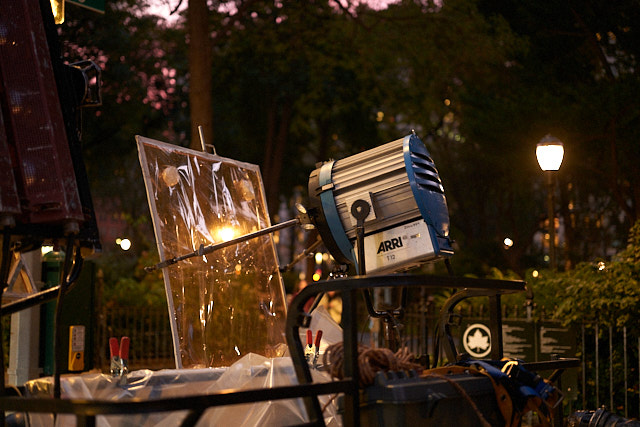
An ARRI daylight lamp on a movie set with a gel in front. © Thorsten Overgaard.
Ghosting (light) = Secondary light or image from internal reflections between (and within) lens elements inside a lens. The reflected light may not always be in focus, so overall it looks like a "milked out" image. A subject in focus has brightened patches in front of it that come from reflections inside the lens. the most elementary look of ghosting is when you look in a rear-view mirror in a car at night and you see doubles of the headlights behind you (a strong one and a weaker one), because the headlights are reflected in a layer of clear glass on top of the mirror glass.
 |
|
 |
|
 |
| Degrees of ghosting from strong sunlight entering from outside the frame. To the right the outside light has been shielded with a shade. |
Ghosting (HDR) = When several image has been stitched together as part of HDR (High Dynamic Range), you can have shapes that are repeated, and that is called "ghosting".
Global shutter = An image sensor which expose and read the data from the sensor all at the same time as opposed to traditional sequential reads of CMOS sensors. Because the entire sensor operates simultaneously, rolling shutter and distortion of fast-moving subjects are eliminated.
Hair light = Portrait light for edge. Also called Edge light and Rim light. See "Edge light" for examples.
| |
 |
| |
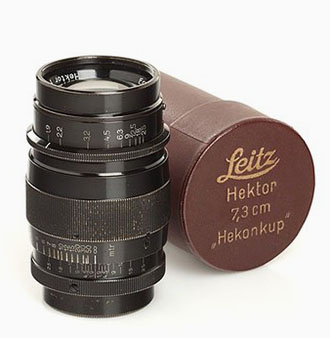
The Hektor 73mm f/1.9 of 1930-1931 sells at $900 - $6,000 these days. |
| |
|
Hektor - Refers to the maximum lens aperture - usually f2.5 (whihc at the time of development in the 1930's was considered very light-strong lenses). The name was apparently taken from the name of lens designer, Professor Max Berek's dog, Hektor. He also had another favorite dog, Rex, which may have inspired the lens name Summarex.
But ...
there is also another possibility, which is that Hektor (the lens and/or the dog) was inspired by Hektor, the oldest son of the Trojan king Priamos, who is listed in the history books as being the most couragerous defender of his home city, Troy. (Max Berek knew of this because Greek history had been required during his high school education).
In any case, the first 50mm Hektor f/2.5 was designed by Max Berek in 1931 for the Leica I Model A, and the - for that time - extremely light-strong 73mm Hektor f/1.9 was designed in 1930-1931 in preparation of the modular Leica system.
Hot light = Light used in television and movie production. It can be small or large hot lights. Most people would call them spotlights.
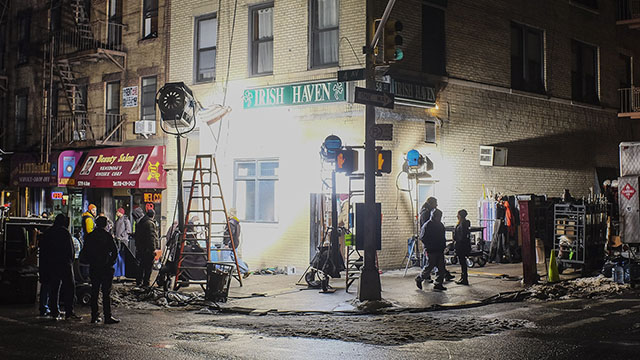
Hot lights on the set of Gotham.
Hue = A color or shade depending on the dominant wavelength of red, green or blue. The word Hue comes from Swedish hy which is "skin complexion". It is independent of intensity, so often (in computer editing programs for example), Hue is an adjustment along Saturation (which is intensity of color as compared to white)
Hybrid camera = "Mirrorless" digital camera. A digital camera that accepts different lenses and can do so bedcuase it does not use a mirror to reflect the image into a prism viewfinder and does not need mechanical or electronic connections between lens and camera to activate a mirror. A mirrorless camera, in theory, can accept any lens via adapter; and some adapters manage to include signals from the lens to the camera (about f-stop, model of lens, etc) and signals from the camera to the lens (auto focus control, aperture control, etc).
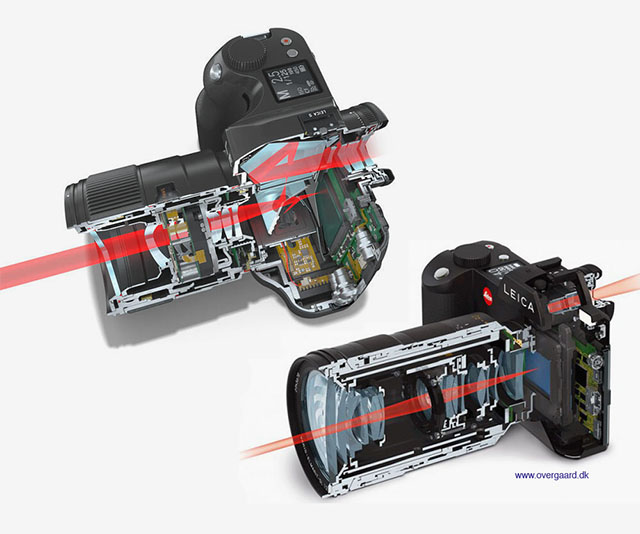
The Leica S3 on top is a medium format dSLR camera where the image reflected 90 degree up into a prism and then can be seen through the viewfinder (the photographer see throught the lens). The Leica SL on bottom is a hybrid mirrorless camere that does not habe a mirror: The image is read directly by the sensor and displayed on a small screen inside the viewfinder (the camera see through the lens). © Thorsten Overgaard.
iAF is "Intelligent Auto Focus," and when on, the camera supposedly uses AFs (Auto Focus Single) until it detects that the subject moves, at which point it switches to AFc (Auto Focus Continuous). Generally, with any camera, I would either manually focus or use AFs, where the autofocus locks onto what I've decided it should focus on (remains stable and does not change). This way, I have a clear understanding of what the camera is doing. With iAF, I don't know when or why the camera changes its focus. After all, I am the one taking the photos, not the camera.
AFc (Continuous) means that the autofocus constantly checks if the focus has moved, triggering a continuous movement of the autofocus mechanism in the camera. This movement is accompanied by vibration, which can be felt and sometimes heard. At the same time, the preview in the viewfinder or on the screen constantly 'vibrates' or 'breathes.'
AFs (Single) is where 1) you point the focusing spot onto a subject or detail or the subject, and 2) when you touch the shutter release, the camera quickly focus on that spot, and 3) as long as you hold the shutter release half down, the focus is locked on that distance no matter where you move the camera (to recompose for example, or to wait for the right moment), and then 4) when you press the shutter release down, the camera takes that photo without delay (as the focus ia already set). When you move your finger away from the the shutter release, the AF is ready to a new cycle of 1, 2, 3, 4.
IBIS = In-Body Image Stabilization. A method where the sensor can move and adjust to counter for camera and lens movements, making it possible to have sharper photos and less of the type of motion blur that comes from the camera's movement (does not help if the subject being photographed is moving). The alternative is IS (Image Stabilization) where the counter-movement is in the lens itself.
Incident light meter = A light meter that measures the reflections off of something. Incident means “falling on something”, from Latin incidere ‘to fall’ and in- ‘upon’. Most cameras have an incident light meter, and what is does is that it measures how much light reflects off a white, dark red, or mixed landscape; and then adjust it to be midddle tone. Thus, if you photograph snow, the images will usually be under-esposed as the meter wants the white snow to be middle tone (50% black), and if you photograph in a dark restaurant, the image will be overexposed because the light meter wants the scene to be middle tone (50% black). For a normal scene in a city with whites, blue sky, people, cars and all, the ligth meter usually gets it right. Thus, as a user of the camera you have to be aware that the light meter doesn't know what you are photographing, so you must do the adjustments in those instances where the scene is not a mix of tones making up middle tone. This is also the portrait of a person with lots of light behind the person, her you must adjust the exposure so the face is corectly exposed and not the overall frame of bright light from behind and the face 'in shadow'.
IS = Image Stabilization. The idea of an image being adjusted and stabilized through counter-movement in the camera lens. The alternative is IBIS, which is In-Body Image Stabilization where he sensor counter-moves).
ISO = Light sensitivity of the camera sensor is given in ISO (International Organization for Standardization). It's a standard that was used in film and is now used in all digital cameras also. The base ISO for the Leica TL2 sensor is around 100-150 which means that this is what the sensor "sees". All other levels are computer algorithms calculating the effect as if the sensor could "see" more (hence noise at higher ISO levels).
ISO goes in steps of doubling: When the ISO is raised from 100 ISO to 200 ISO, the camera only need half the amount of light to make the same picture. For each step in ISO to 400, 800, 1600, 3200, etc. the light sensitivity is doubled for the sensor (and the camera sensor only need half the light of the previous ISO to record the same image).
Also see Base ISO in this list.
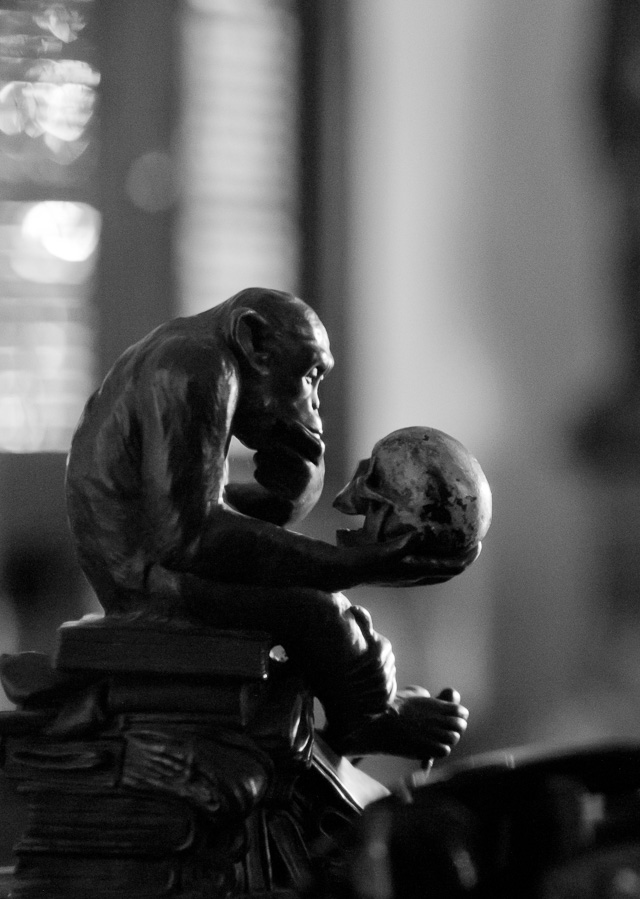
6400 ISO indoor photo. With modern cameras the ISO can go to 3200, 6400, 12,800 and even higher without loss of dynamic range and without digital noise. Leica M10 with Leica 50mm Noctilux-M ASPH f/0.95. © 2017 Thorsten Overgaard.
JPEG = A standard for picture format made in the 1990's by Joint Photographic Experts Group). Mostly referred to as JPG as in L1003455.JPG which would be the name for a JPG file from the camera.
Key Light (strongest light source, also called main light) and Fill Light (less strong light source to soften shadows) is a basic concept of light for still, film, theatre and movie. See Fill Light and Key Light definitions for more.
Key light = The main source of light in a photograph, film or theatre. Traditionally key light is white. In a portrait setting, the key light would come from front above the face or from the front one side of the face, but could also be simply a window in front of the face (behind the camera). The key light is what the camera exposed for so that the most lit part of the skin on the face is correctly exposed. In a concert or theatre setting the key light is traditionally white light coming from the front so the audience can see the persons on stage clearly and in correct colors. Other light sources such as red light from the front and yellow or blue from the back is for effect; and the white key light stays on so the audience (and video cameras and still cameras) can see the scene in correct light and colors. However, as LED lights become widely used and these can change colors from a remote control, one often see lighting without white key light, consisting solely of colored LED light (which makes details unclear to the eye and makes color photography sometimes impossible).
Fill Light and Key Light. © Thorsten Overgaard.
Kino Flo = (Cinema Fluorescent) = A brand of fluoroscent lamps are used in still photography, television and moviemaking. Often referred to as simply 'kinos'. The Kino Flo company was founded by gaffer (chief electrician in a motion-picture) Frieder Hochheim who designed these film lights based on the use of fluorescent light tubes as a more compact and less heat emitting light source for movies, television and stills. The Kino Flo lamps was used in the movie Barfly (1987) as one of the breakthroughs of using fluorescent light in movies. In the movie they work in smaller spaces and light the scenes so it looked like natural light. Today the majority of the Kino Flo lights are LED based, very well-controlled for color spectrum and often adjustable for the specific sensor used in a camera model. The first primitive Kino Flo was used by Wim Wenders and Robby Müller in The American Friend (1977) where Frieder Hochheim was faced with the challenge of lighting a cramped interior where traditional lights wouldn’t fit.
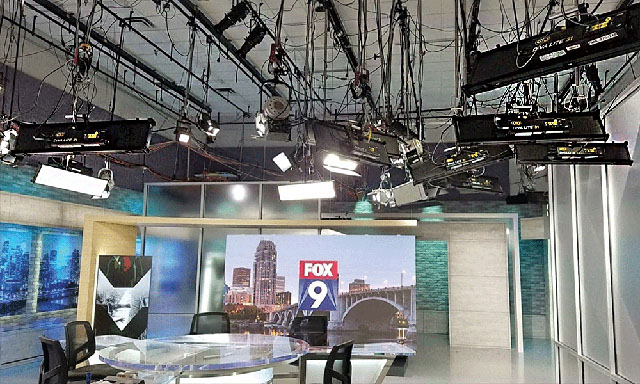 Kino Flo LED lamps in the Fox studio. Kino Flo LED lamps in the Fox studio.
Leica L-mount bayonet. |
L-mount = Lens bayonet mount introduced by Leica for the Leica T in 2014 and used for Leica TL, Leica CL and Leica SL. Since 2019 the L-mount has also been shared with Panasonic, Sigma and others who produce cameras and lenses that are compatible with Leica L cameras and lenses lenses, and vice versa.
The L-mount has a diameter of 51.6 millimeter which is big enough for any design we could wish to design, and at the same time compact enough for the L-mount to be used on compact cameras such as Leica TL and Leica CL with APS-C sensor sizes. Leica chief lens designer Peter Karbe spent years calculating this ideal size, large enouhg for any design, yet as compact as possible. Read my article "Small Camera, Large Print" (2019) with interview with lens designer Peter Karbe for more.
After Leica introduced this new bayonet mount in 2014, Nikon (Z-mount 55mm), Fuji (G-mount 65mm) and Canon (RF-mount 54mm) followed with similar new bayonet mounts, but with bigger diameter, making them less able to produce compact lenses.
Lantern slide (later known as a slide film, a transparency or a dia-positive). A transparent film or glass plate in positive, and mostly in color, that can be projected onto a wall or screen in large size by putting the slide into a slide projector ("magic lantern" as they were called back in the day) that sends light through the film and projects it to a wall or screen via a lens.
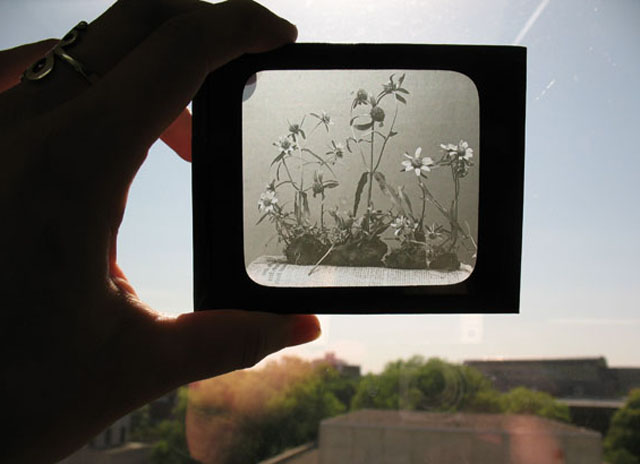
Lantern slide from early 1900's by Ada Hayden. (Later known as a slide film, a transparency or a dia-positive).
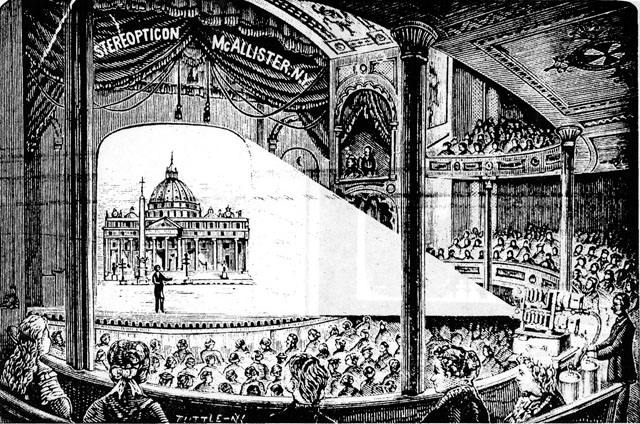
Lantern slideshow in 1897.
LCC = acronym for Lens Cast Correction, which is a tool in phtoo editing (Capture One) that can help correct common issues that arise when using wide angle lenses. The "cast" is typical color cast, meaning that the color goes in an unwanted direction; snow in a photo has too much blue, so you correct it to have less blue and look like white snow. In Copture One, one create an LCC master profile which contains adjustment of color cast, dust spot removal and more, and then that LCC file can be applied to any photo in a series (of for example landscapes or architecture photos).
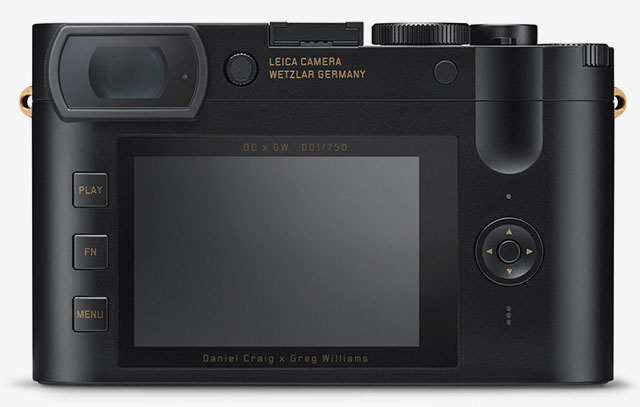
A screen on a camera is often referred to as "LCD Screen" for no particular reason (illustration is the back of the Leica Q2 special limited "James Bond/Daniel Craig & Greg Williams" version (2021).
LCD = Screen. LCD itself means liquid crystal display, which is slightly irrelevant (what it is made of) as the expression is mostly used to simply mean "screen".
| |
 |
| |
The LCoS display that sits inside the viewefinder of the Leica Q and Leica Q2 |
| |
|
LCOS (viewfinder screen in the Leica Q model 116 (2015) and Leica Q2 (2020)) = Liquid crystal on silicon is a high-quality method for near-eye displays, better than LCD (Liquid-crystal display). There are two broad categories of LCoS displays: Three-panel and single-panel. In three-panel designs, there is one display chip per color, and the images are combined optically. In single-panel designs, one display chip shows the red, green, and blue components in succession with the observer's eyes relied upon to combine the color stream.
LED light = Light source that found popularity in still photography, video and theatre stages from 2010 and onward, due to the lamps compactness, high output of light with little electricity and emitting no heat. LED lights are generally known to be very economical, though for photography and video you require high-quality LED lamps that output exact eklvin values and display a full color spectrum. Household LED lamps as used in restaurants, in street lamps, offices etc vary quite a bit in their color spectrum can result in very unexpected colors when used to light a scene. Manufactures of high-end LED lamps in controlled unites are Kino Flo, Aputure, ARRI and similar companies.
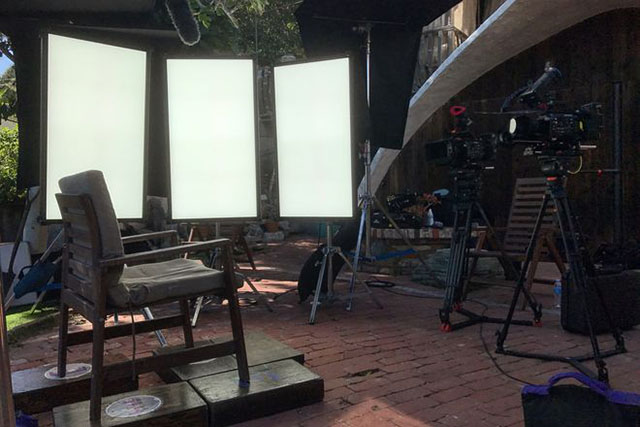
High-end LED light panels where the color output is software-controlled to meet exact color standards. In the photo it is three large Kino Flo "Celeb 850" LED lights set up on a movie set. The panels come in all sizes and the
Leica = A compound word derived from " (Lei)tz" and "(ca)mera". Apparently they were originally going to use "LECA", but another camera company already used a similar name in France, so they inserted the 'i' to prevent any confusion. The Leica name and logo is owned by Leica Microsystems GmbH.
Leicaflex was Leica's first single lens reflex (SLR) camera, released in 1964. It is a very solid, fully manual SLR with an exceptionally bright viewfinder. The Leicaflex SL and Leicaflex SL2 and Leicafles MOT (enabling attachment of motor winder) came after, and then Leica went onto Leica R3 that it developed with Minolta, then Leica R4, Leica R5, Leica R6.2, Leica R7, Leica R8, Leica R9.
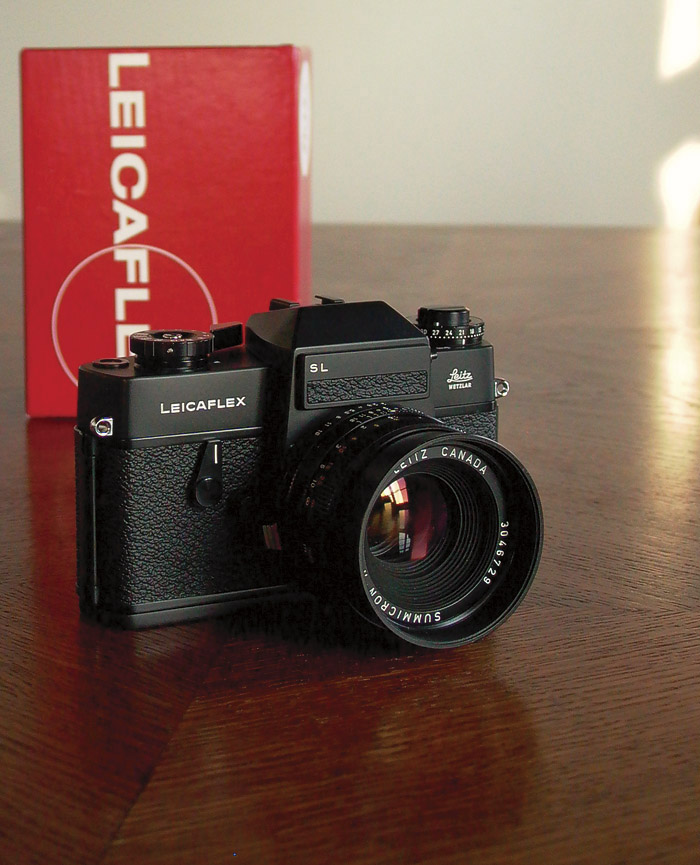
My Leitz Leicaflex SL (1973) film camera in black, here with 50 mm Summicron-R f/2.0 from Canada.
The word lens derives from lentil, because of the similar shape.
Lens - A piece of glass or similarly transparent material (like water or plastic) that has a shape so that it can direct light rays. The word “Lens” is used both for single piece of glass as well as a camera lens with several lenses that works together. From ‘lentil’ because similar in shape.
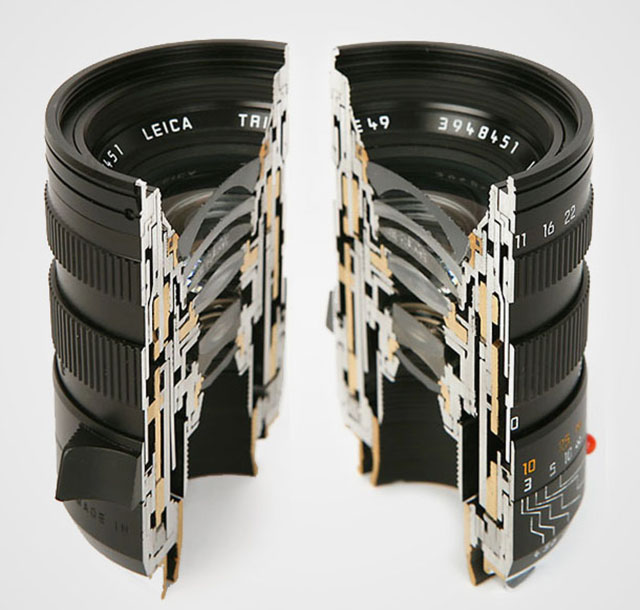
A camera lens consists of several shaped lens elements of glass. The lenses can also be made of simple cheap plastic as in "kit lenses" (sold with a camera as a kit to make a workable cheap package), but it is mostly very exotic glass (that can be heavy or light in weight, very hard or very soft in surface (esay to scratch or very resistant) with each optical glass recipe made to develop very specific qualities in how the glass and final lens treats light. As a general rule, high quality glass is soft, which is why some lenses has as their front and back element, a non-optical lens element that is there to protect the actual optical glass from scratches. As a side noite, Leica made their own glass laboraty, The Leitz Glass Laboratory, from 1949-1989, which deveopled 35 new glass types and took out more than 2,000 patents of glass recipes from more than 50,000 experimental melts of glass. These designs, or recipes, are still used today by the lens designers to obtain very specific optical results. Other lens manufacturers in the world of course have had their glass laboratories, and today one will find an interchange of glass patents amongst production facilities that service Leica, Nikon,, Fuji and so on with optical lens elements.
Lens hood = (also called a Lens shade or Ventilated Shade). A tube or ring attached to the front of a camera lens to prevent unwanted light from reaching the lens and sensor. In the past where lenses were not coated to prevent internal reflections inside the lens, the lens hood was often essential. These days where lenses are coated, the shade serves just as much as decoration and protection (bumper) as well.
ORIGIN Old English hod; related to Dutch hoed, German Hut 'hat,' also to hat.
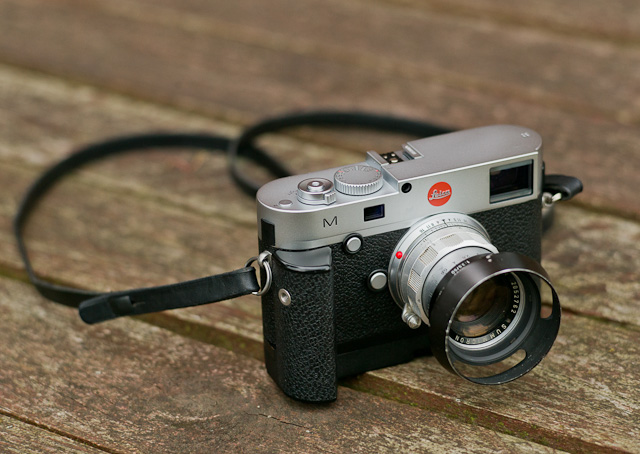
Lens hood or Lens shade or ventilated shade. In the picture is a ventilated shade with clip-on mount to a 50mm f/2.0 lens. Ventilated means it has openings that allow for view from the viewfinder.
Lens names of Leica distinguish which widest aperture the lens has:
| Noctilux |
f/0.95 - f/1.25 |
| Nocticron |
f/ 1.2 (Leica-designed Panasonic lens) |
| Summilux |
f/ 1.4 - f/1.7 |
| Summicron |
f/2.0 |
| Summarit |
f/2.4 - 2.5 |
| Hektor |
f/1.9 - f/6.3 (used 1930-1960 for screw mount lenses only) |
| Elmarit |
f/2.8 |
| Elmar |
f/2.8 - f/4.5 |
| Elmax |
f/3.5 (only used 1921-1925 for the 50mm Elmax f/3.5) |
| Telyt |
f/2.8 - f/6.8 (used for tele lenses) |
| |
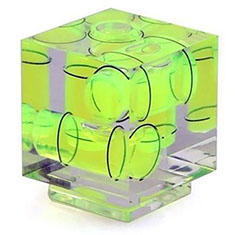 |
| |
Bubble Level Gauge to mount onto the flash shoe. |
| |
|
Level Gauge = This is a tool in the viewfinder to see if you hold the camera 100% horizontal and/or vertical. You can turn it on in the Menu > Photo Live View Setup > Level Gauge > On.
Before level gauge was integrated as a digitized feature in modern digital camers, it was a Bubble Level Gauge / Spirit Level you put on top of the camera.
The idea is to be able to get 100% vertical and horizontal lines (because if you tilt the camera slightly, the horizon will not be horizontal, and of you tilt the camera forward or backwards, the lines of for example vertical buildings will not be vertical.
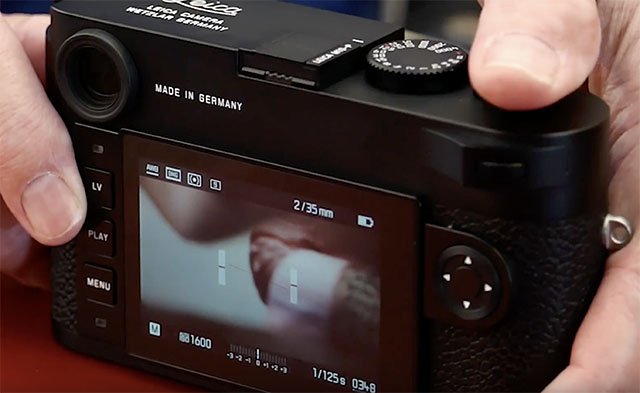 Digitized level gauge in a Leica M10-P. You tilt the camera up and down (front/back and left/right) till the level is completely straight. Digitized level gauge in a Leica M10-P. You tilt the camera up and down (front/back and left/right) till the level is completely straight.
Light = Tiny particles called photons that behaves like both waves and particles. Light makes objects visible by reflecting off of them, and in photography that reflecting off of subjects is what creates textures, shapes, colors and luminance. Light in its natural form (emanating from the sun) also gives life to plants and living things, and makes (most) people happier. So far, nobody has been able to determine exactly what light is. The word photography means “writing with light” (photo = light, -graphy = writing). Read more about light in my book Finding the Magic of Light.
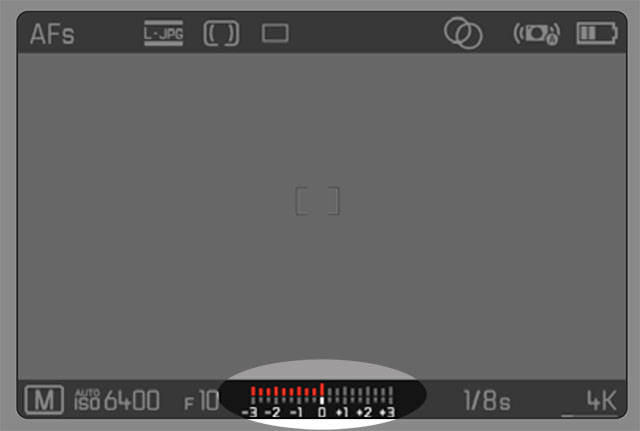
The "light balance" scale in the camera menu.
Light Balance = That the amount of light is correct, or is under-exposed or over-exposed. Not a common expression, but is used in camera manuals for the scale that shows how the exposure compensation is set, or indicates a scale that shows what the camera thinks the exposure should be adjusted to.
Live View = This is the ability to see the image the sensor see, live, via the screen on the back of the camera, or via an electronic viewfinder (EVF).
LMT - Leica Thread-Mount: Also known as M39, is the screw mounted lenses for Leica cameras. It’s a simple as that; you screw on the lens, and back in 1932, the possibility to change the lens was the big news hwen introduced by Leica on the Leica III. The M39 system was updated with the M Bayonet from 1954 for the Leica M3. The M bayonet is a quick way to change lenses and is the current mount for Leica M digital rangefinders.
M (as in "M3", "M6", "M7" etc.)
A) The M originally stands for "Messsucher", which is German "Meßsucher" for "Rangefinder". The "3" in M3 was chosen because of the three bright line finders for the 50, 90 and 135 mm lenses. Later the numbers of the M cameras were more or less chosen to follow each other.
M-body evolution in chronologic order:
M3 - MP - M2 - M1 - MD - MDA - M4 - M5 - CL - MD-2 - M4-2 - M4-P - M6 - M6 TTL - M7 - MP - M8 - M8.2 - M9 - M9-P - MM (black and white sensor) - ME (Type 220) - Leica M (Type 240) - Leica M-P 240 - Leica M 246 Monochrom - Leica M-A (type 127, film camera) - Leica M 262 - Leica M-D 262 (without a screen) - Leica M10 - Leica M10-P, Leica M10-D, Leica M10 Monochrom, Leica M10-R, Leica M11.
B) M also refer to M-mount as the M bayonet that couple the Leica M lenses to the Leica M camera. Before the M bayonet the coupling between the camera and lens was screwmount.
C)
M nowadays refer to the Leica M line of cameras rather than the "Messsucher". (
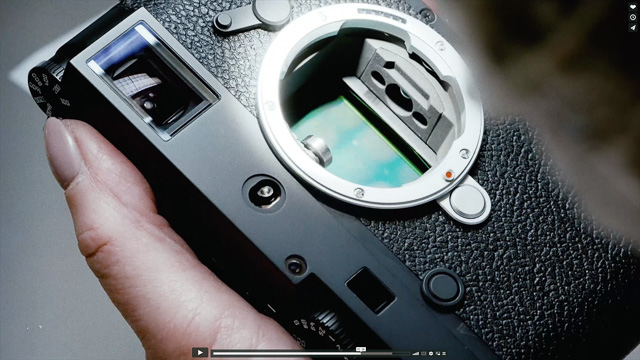
The Leica M bayonet on the Leica M10.
- M-mount: The Leica M-mount is a bayonet that was introduced with the Leica M3 camera in 1954 and has been used on all subsequent Leica M cameras, as well as on the Epson R-D1, Konica Hexar RF, Minolta CLE, Ricoh GXR, Rollei 35RF, Voigtländer Bessa, and Zeiss Ikon cameras (2019).
Compared to the previous screw mount (M39), the M
mount requires a quick turn of the lens, and ithe lens is mounted. The patent for the M-bayonet ("Bajonettvorrichtung für die lösbare Verbindung zweier Kamerateile") was registered by Ernst Leitz GmbH 10 February 1950 (patent number DE853384). Hugo Wehrenfennig was credited with the invention.
-
- M1 = Leica M1, introduced in 1959 as a lower end model of Leica M2.
M2 = Leica M2, introduced in 1957 as a lower end model of Leica M3.
M3= The Leica M3 model introduced in 1954, the first camera with a Messsucher and 3 set of framelines in the viewfinder. It was the first M model, and once you know why it was called M3, it make sense that the Leiac M2 and M1 was introduced after this brakthrough camera.
M4 - Leica M4, introduced in 1967 with 4 framelines, and from here the numbering of M cameras start to make sense as a sequence.
M5 = Leica M5, intoduced in 1971 as the firwst Leica M with built-in light meter.
M6 - Leica M6, introduced in 1984 with 6 framelines and in production untilå 2003. Then put back into production in 2022.
M7 = Leica M7, introduced in 2002.
M8 = Leiac M8, introduced in 2006 as the first Leica digital M.
M8.2 = Leica M8.2, an updated model to Leica M8 introduced in 2008.
-
- M9 = Leica M9 is a model name for the Leica M9 that was introduced on September 9, 2009 (as the first full-frame digital Leica M). It was to be the latest model designation using the M and a number. From their next model, Leica Camera AG introduced a new model system so each camera would simply be a Leica M but then with a model designation like Typ 240, Typ 246, Typ M-D 262 and so on. The idea was inspired from Apple who name their computers for example MacBook Pro and then it has a sub- model number designation which model it is (and which would define speed of processor, etc). They later changed their mind, and the next cameras were the Leica M10 (2017) and the Leica M11 (2022).
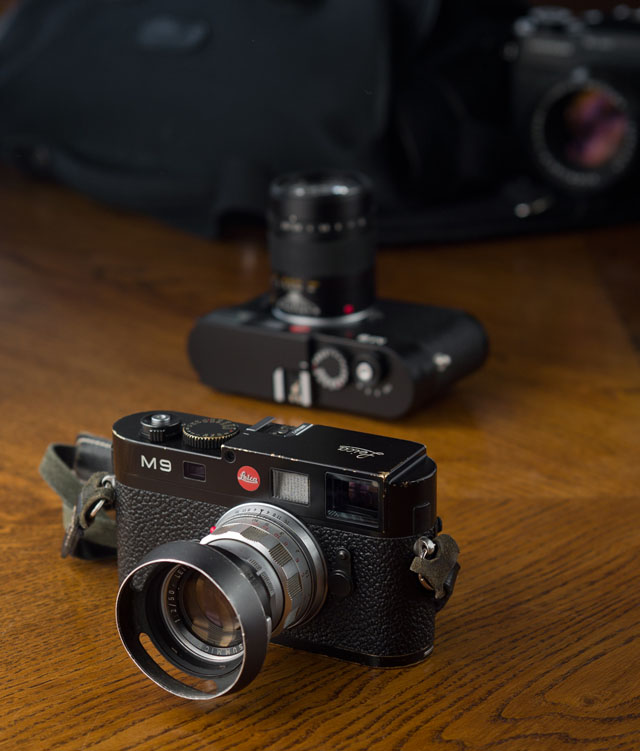
Leica M9 digital rangefinder (2009). © Thorsten Overgaard.
Macbeth ColorChecker. A chart with key colors that you photograph (or record on film/digital video) and use to compare and adjust light sources, development, editing, etc so as to obtain the correct key colors. The top left colors on the Macbeth are skin tones, which traditionally are the most sensitive or difficult, to get right. The original Macbeth Color Checker i still available (about 20x25 cm in size).
Macbeth is a brand name and was bought by X-Rite who sells the "smaller version" of it, the X-Rite ColorChecker.
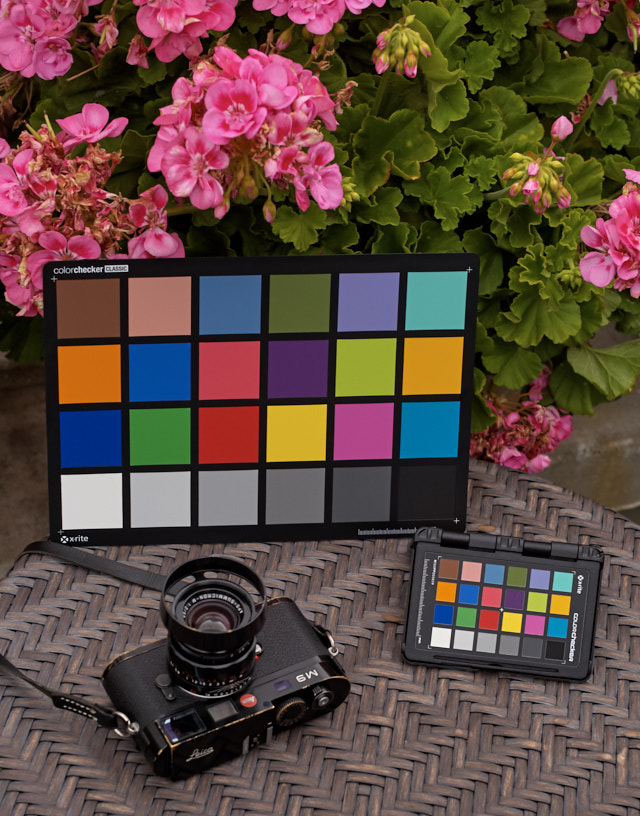
The original Macbeth Color Checker and the newer pocket version X-Rite ColorChecker.
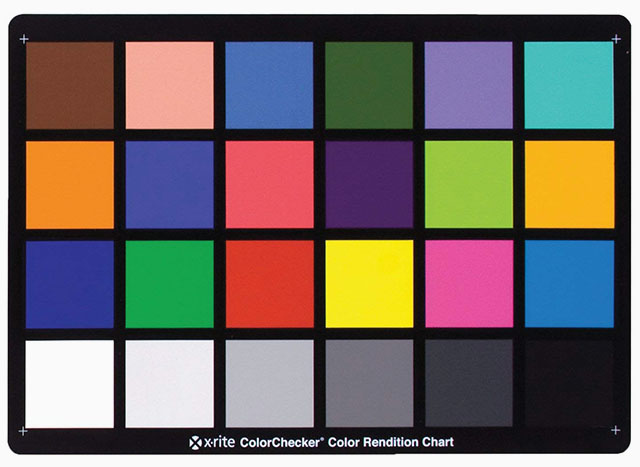
The original Macbeth Color Checker chart.
MACRO = Macro lens. The Leica 60mm APO-Elmarit-Macro-R ASPH f/2.8 is a 60mm lens for portraits, landscapes, etc. as well as a near focus macro lens. The Leica Q lens can be turned to Macro which enables you to go close so as to enlarge smaller subjects. The Leica M cameras becomes Macro when you add a Macro ring "Oufro" or "Leica Macro M Adapter" that increases the lens' distance to the sensor. The word macro comes from Greek makros ‘long, large.’

The word macro comes from Greek makros ‘long, large.’ The Leica 60mm APO-Elmarit-Macro ASPH f/2.8 is both a 60mm lens for portraits, landscapes, etc. as well as a near focus macro. © Thorsten Overgaard.
Maestro II - A processor developed first as Maestro for the Leica S2 and upgraded to Maestro II for the Leica S (Typ 007). The Leica Q has a Mestro II (Leica Q edition) processor developed by SocioNext Inc. based on Fujitsu's Mibeault architecture. Leica M10 also has a Maestro II processor, but seemingly developed further for this model.
Magic Lantern - Later known as a slide projector. Leica came out with their first projectors in the 1930's (see a list of projectors and acessories here). It's a device with a strong lamp behind a transparent picture (slide) that is projected to a wall or screen via a lens. Today we use LCD projectors which is simply a digital image on a small screen inside the projector house that is projected to a wall or screen by a lens. Early models of LCD projectors had three lenses so as to projet each channel of red, green and blue onto the wall or screen.
Mandler, Dr. Walter (1922 - 2005)
Legendary Leica lens designer and CEO of Ernst Leitz Canada (ELCAN) 1952-1985. Read more in Leica History.
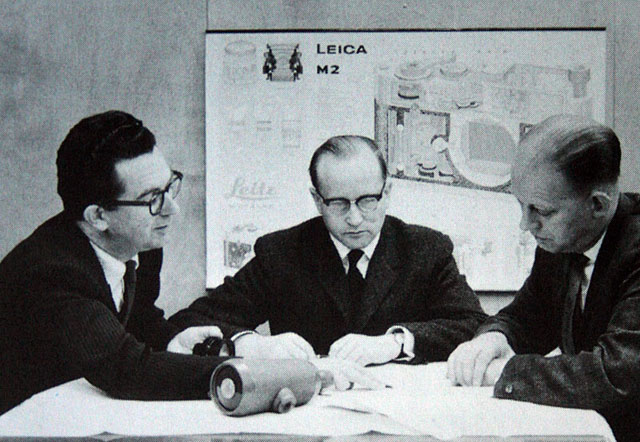
Dr. Walter Mandler (center) at the Ernst Leitz Camera factory.
Megapixel (or MP) - Millions of pixels. See pixel further down. How many units of RGB is recorded by a given sensor by taking height x widt. A Leica M10 delivers a 5952 x 3968 pixel file = 23,617,536 piexls. On a screen the resolution you choose determines the size of the image. Say you have a 5000 pixel wide file and your screen is set for 8000 pixels wide. Then the image will fill only the 5000 pixels fo the 8000 and the rest will be empty, If you then change the screen resolution to 5000 wide, the image would be able to fill out the whole screen.
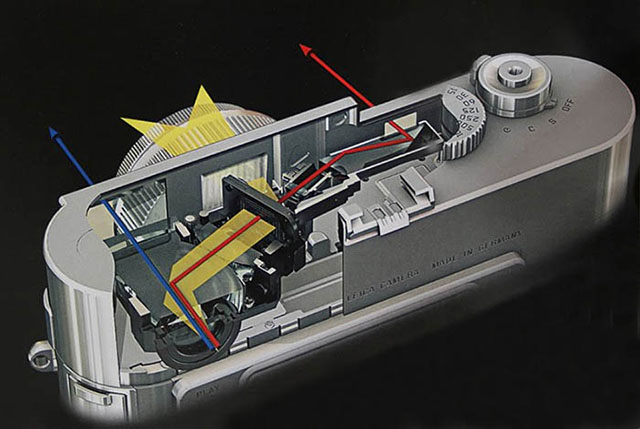
What makes a Meßsucher (rangefinder) exactly a Meßsucher, is the fact that the distance finder (red line) is integrated in the viewfinder (blue line) by sending the view of the distance finder into the wiewfinder via mirros and prisms. Here a cut-through of the Leica M9 (2009).
Meßsucher = (rangefinder or distance finder) = Mess = range, sucher = finder. It is always correctly written with the "ß". There are technically not three "s", rather the "ß" and one "s" because it is a word constructed by the combining of two precise words. Correctly, the Messsucher is not a distance finder, but a distance finder integrated in a viewfinder. This started with the Leica M3 (1954) as the first Leica camera where the distance finder and the viewfinder was not two separate oculars on the camera. The Leica M3 was named M3 becuse it was Messsucher and had 3 frame lines inside the viewfinder. The previous models had a separate viewfinder (called a Entfernungsmesser, a range finder). As we can tell, the German words cover more precisely these concepts, whereas the English translation of both "Messsucher" and "Entfernungsmesser", ends up being "rangefinder" camera.
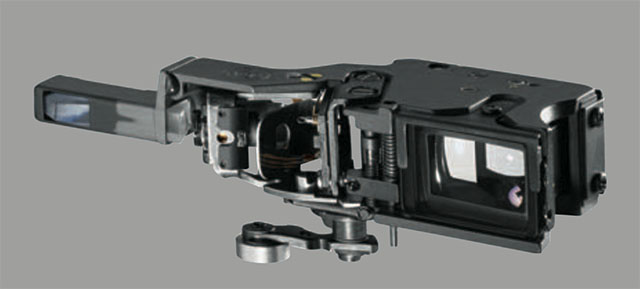
The Messsucher mechanism in a Leica M above. The viewfinder is the large window to the right
that you see through, and prisms and mirrors reflect the same image via the small window to the left onto the viewfinder so you can adjust the focus.
MF (Medium Format), as in the Leica S System.
MF (Manual Focus) for lenses that are focused by hands, as opposed to Auto Focus.
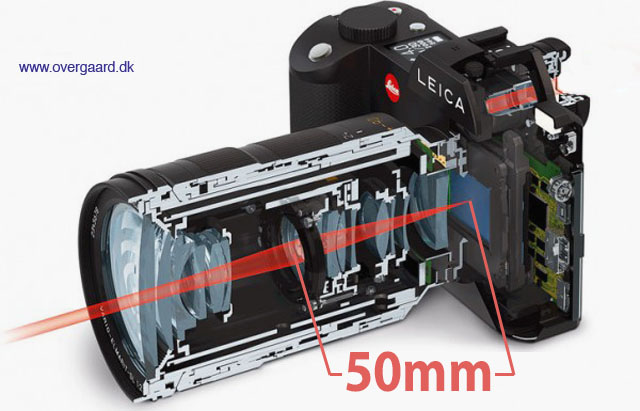
Focal length is determined by the distance from focus inside the lens to sensor surface to, and is given in milliemeters (mm). © Thorsten Overgaard.
mm = millimeter(s), as in a 50mm lens. (Earlier in lens history lenses focal length was given in cm = centimeters; as in a 5 cm lens). For anyone used to centimeters and millimeters, it’s no wonder. But if you grew up with inches, feet and yards, you may have had a hard time grasping what a 50mm lens was. But as lenses were designed first in Europe, the metric system with centimeters and millimeters was used to describe lenses.
(Leica and others made lenses for a while with either meter scale or feet scale; but then eventually started including meter and feet on all the lenses (two scales, usually distinguished with different colors). However, the lens' focal length remained always 50mm, 75mm and so on).
The reason a 50mm lens is a 50mm lens is that there is 50mm from the focus plane (the film or sensor surface) to the center of focus inside the lens. When photography was a young subject, it was engineers who made it all, and the users were expected to understand. The engineers were so into the making of the lenses, that it apparently never dawned upon them that today’s users would think of a 21mm lens as a wide angle lens rather than a lens where there is 21mm from the sensor to the center of focus inside the optics.
MOT = Cameras that has been prepared (under the baseplate) to be fitted with a motor winder to forward the film.
For example the "Leicaflex SL mot" that is can be fitte with a motor winder.
MP
a) Stands for Mechanical Perfection, as in the Leica MP (2003 film camera) and Leica M9-P (2011 digital rangefinder). The first original Leica MP (1956-1957, model IMOOP) was meant as professional/press.
b) Megapixels (millions of pixels).
c) Megaphotosites (millions of photosites).
ND = Neutral Density filters are gray filters, they function as 'sunglasses' for lenses. They simply block the light so that a lens can work at for example f/0.95 or f/2.0 in sunshine.
If a camera is set to 200 ISO and the maximum shutter speed is 1/4.000, this will usually result that the lens has to be at f/2.8 or smaller aperture in sunshine. Else the image will over-exposed. So in order til stay within the maximum shutter speed of 1/4.000 and still use a lightstrong lens wide open, one mount a ND-filter that reduce the light with 3 stops (8X) or 6 stops (64x).
For video ND-filters are used quite a lot (as the shutter speed for video is 1/60), and ND-filters are also used to reduce the light for really long multi-exposures at night (stop-motion video and stills).
| |
 |
| |
Graduated ND filter |
ND-filters also exist as variable ND-filters so one can adjust the amount of light going through from for example 1 stop (2X) to 6 stops (64X).
ND-filters also exist as graduated ND-filters where the top of the filter is dark and then gradually tone over in no filter (so as to reduce the skylight in a landscape for example).
The ND filters are called Neutral because it is a neutral filter. It doesn't change colors, only the amount of light.
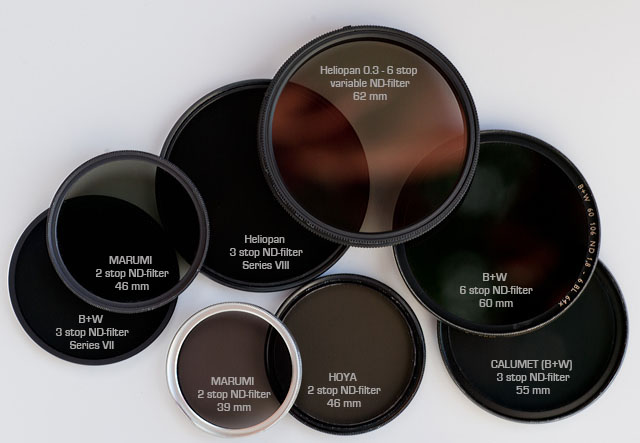
Some of my ND-filters for different lenses. I find that the brand does not matter much.
Night lights = For movies and still photo, a large light to light up a street or location at night. In the picture below, it's a Bebe Night Light with with a bank of 15 strong lights.
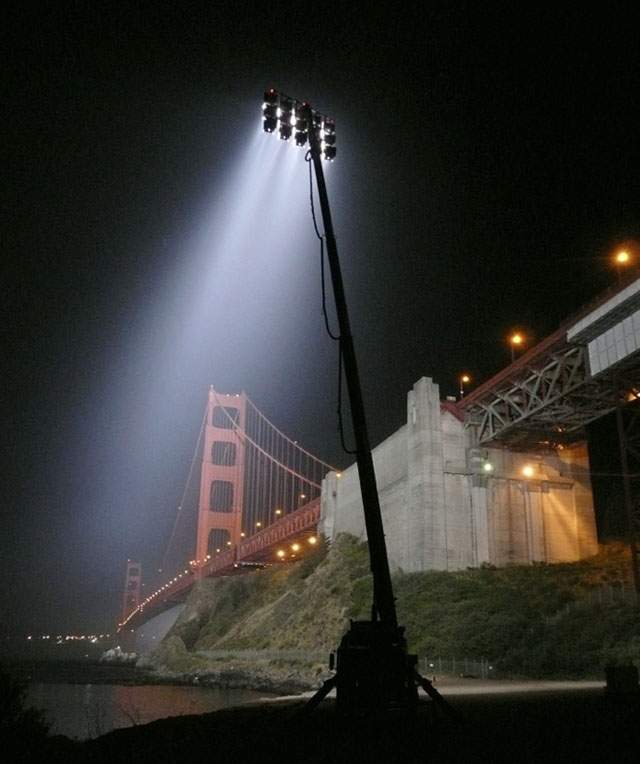
Bebe Night Light with with a bank of 15 strong lights for location lights at night.
For this photo of Bruce Willis and Kirstin Dunst on Sunset Blvd and Verdugo in Los Angeles, photographer Annie Leibovitz used a Bebe Night Light with a bank of eight spots to light up the scene behind them.
© 2007 Annie Leibovitz.
"Niner"
The nick-name for the 90mm f/2.5 Leica lens in the 30's when it first came out.
Noctilux = Also known as "King of the Night" because "Nocti" means Night and "Lux" means Light. The f/1.0 lenes from Leica are named "Noctilux". The first Leica Noctilux lens was the 50mm Noctilux f/1.2 which shortly after it's introduction was improved to the 50mm Noctilux f/1.0. In the current model the f-stop has been improved further to f/0.95.
"Noctilux" refers to the maximum lens aperture - here f1.0 . "Nocti" for nocturnal (occurring or happening at night; ORIGIN late 15th cent.: from late Latin nocturnalis, from Latin nocturnus ‘of the night,’ from nox, noct- ‘night.), "lux" for light. The Leica Noctilux 50mm f1.0 is famous for enabling the photographer to take photos even there is only candleligts to lit the scene. See the article "Leica Noctilux - King of the Night"
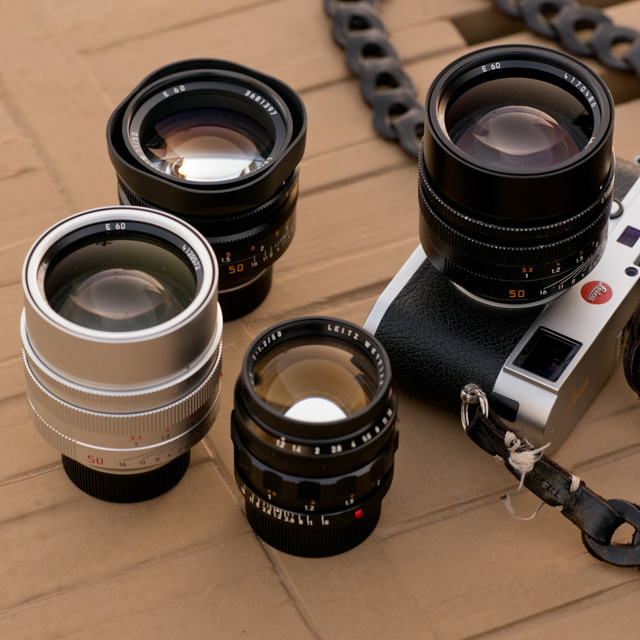
The Noctilux "King of the Night" lens. From left the f/0.95 in silver (same on the camera, in black), the f/1.0 in the back and the rare and expensive first model, the f/1.2 in the front.
No.
Number, on this site Leica catalog numbers or order numbers. Some the numbers changed depending on the number of cams in the lens: The Elmarit-R f2.8/135mm started life as No. 11 111, however when fitted with 2 cams for the SL became No. 11 211, yet another No. for the 3 cams lens and a fourth number for 3 cam only at the end of its life. Number changes also applied to M lenses depending on whether they were screw-thread, bayonet or for M3 with “spectacles”. Thus the No. in the Thorsten Overgaard Leica Lens Compendium list is a guideline but not a comlete list of existing catalog numbers.
OIS = Optical Image Stabilization. This is used in tele lenses where blurring motion of the camera from inevitable vibrations are adjusted by the lens. At low shutter speeds and/or with long lenses, any slight movement would result in a picture with "motion blur" unsharpness. The Leica TL2 supports optical image stabilization when A) OIS is turned on in the camera menu, and B) when you use lenses with OIS (the Leica SL longer lenses has OIS). An alternative is EIS = Electronic Image Stabilization, which the Leica T has. Here the problem of "motion blur" is corrected electronically after, which might lead to image degradation. However, the larger the sensor resolution, the less one will notice small 'degradation'.
"Open Box" = See "U" (Leica Type "U" further down, which is is a term used by Leica Camera and Leica dealers (internally) that means "lightly used" or "used and refurbished". Usually sold with 10-15% discount of new prices,a nd with one year warranty only.
Optic = Eye or vision. From French optique or medieval Latin opticus, from Greek optikos, from optos ‘seen.’
OSPDAF (sensor type) = On Sensor Phase Detect Autofocus, which is a digital sensor where the main imaging sensor has "focus pixels" added in a layer on top of the traditional image pixels that are used for autofocus. First introduced in 2010 by Fujifilm on F300EXR and used in the first smartphone in 2014, Samsung Galaxy S5.
Oubio
Visoflex II /Visoflex III adapter (produced 1959-1983 as part no. 16466) for lens heads:
F = 12.5 cm 1:2.5 Hektor - EF = 1.3 x
Elmar f= 13.5 cm 1:4.5 - EF = 1.2 x
Hektor f= 13.5 cm 1:4.5 - EF = 1.2 x
F = 20 cm 1:4 Telyt - EF = 1.3 x
F = 20 cm 1:4.5 Telyt - EF = 1.2 x
1:4.8 / 280 Telyt I - EF = 1.1 x
1:4.8 / 280 Telyt II - EF = 1.3 x
F = 40 cm 1:5 Telyt I - EF = 1 x
F = 40 cm 1:5 Telyt II - EF = 1 x
1:6.8 / 400 Telyt - EF = 1.5 x
1:6.8 / 560 Telyt - EF = 1.5 x
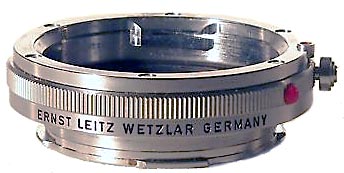
Oufro (model 16469Y)
An original Leitz Extension Ring (produced 1959-1983 as part no. 16469). Used with Oubio for all the longer (125mm+) Visoflex lenses and without OUBIO for 35/50mm. OUFRO can be stacked for greater magnification and will work on the Leica M Type 240 as macro for all lenses (including the Noctilux, 90mm APO-Summicron and even 21mm lenses).
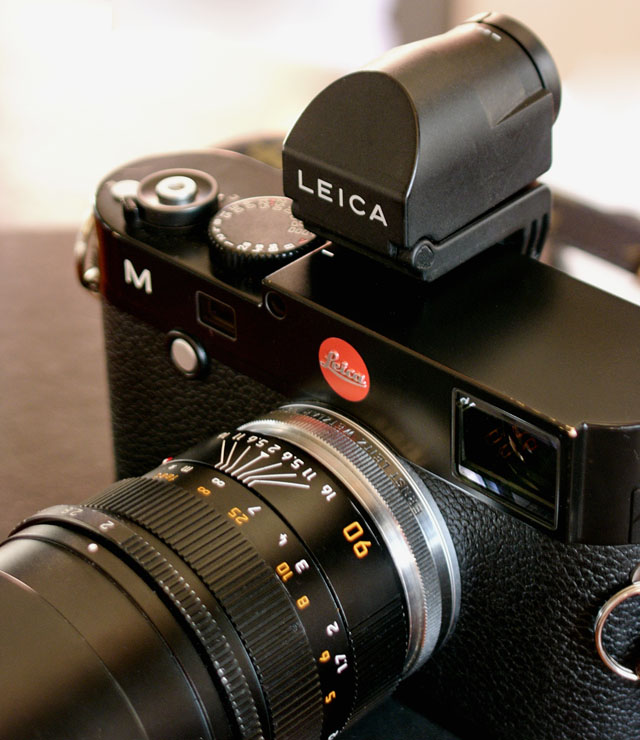 The OUFTO on Leica M Type 240 with Leica 90mm APO-Summicron-M ASPH f/2.0. The OUFTO on Leica M Type 240 with Leica 90mm APO-Summicron-M ASPH f/2.0.
| |
 |
| |
PASM on a cameras 'program wheel' |
| |
|
PASM = is short for P = Program Mode / A = Aperture Priority Mode / S = Shutter Priority Mode / M = Manual Control Mode. On some cameras, these P, A, S and M are choices on a wheel on top of the camera, or in the menu.
PDAF = Phase Detect Autofocus. Used in canon EOS 5D Mark IV in 2016 where a dSLR camera use mirrors to reflect copies of the main sensor’s light at a dedicated phase detection sensor. Compact cameras and smartphone cameras has the AF sensors built on to he sensor itself so as to be more compact (OSPDAF = On sensor Phase Detect Autofocus). The alternative to PDAF is CDAF (Contrast Detection Auto-Focus).
Perspective = The way objects appear to the eye; their relative position and distance. Also, selective focus (foreground and background out of focus) can change the perception of perspective (also see Three-dimensional). A wide angle "widens" the perspective and makes objects further away appear smaller than they are to the eye; and objects closer, relatively larger than they are to the eye. A tele lens will "flatten" the perspective and often objects further away will appear relatively larger than close objects than they are in real life. A 50mm lens is the one closest to the perspective and enlargement ratio of the human eye.
The word Perspective comes from the latin word for optics (perspicere, per- ‘through’ + specere ‘to look’), and so-called Renaissance painting is simply painting done within the framework of optics and the linear perspective it presents.
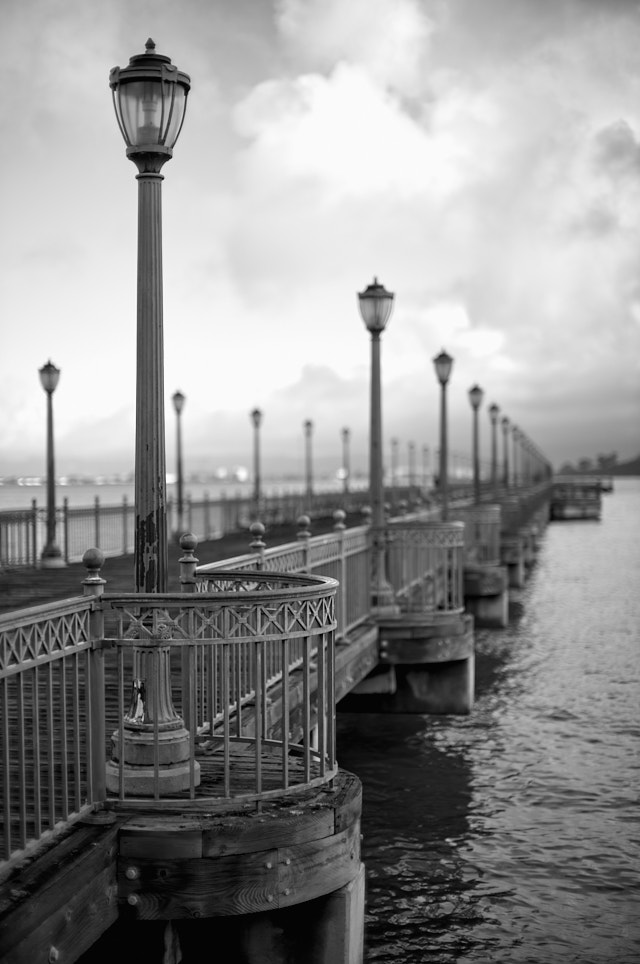
Perspective is relative position and distance. The objects nearby are larger than objects far away. This is how the eye and the mind calculate distance. The eye and the camera automatically captures perspective. In darwing and painting one would see "stupid" two-dimensional drawings 500 years B.C where elements were thrown into the mix without considering that a an object far away must be smaller than if close to the viewer. The word "perspective" comes from "to look through (optics)". Pier 7 in San Francisco by Thorsten Overgaard. Leica M11 with Leica 50mm Noctilux-M ASPH f/0.95.
| |
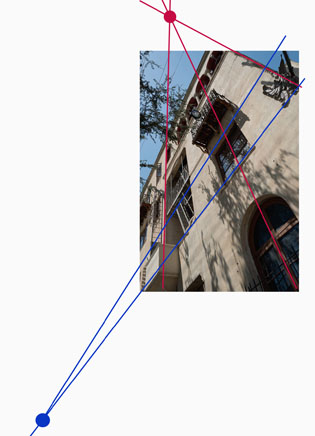 |
| |
Vanishing points are the points where lines meet. This is how you make perspective in paintings and drawings (and some times make movie sets or theatre stages appear more three-dimensional than they are) |
| |
|
Painters works with vanishing points, which is where the lines meet, so as to create an illusion of perspective and three-dimensional effect on a two-dimensional painting or drawing.
The human eye corrects for perspective to an extreme degree. We always see vertical lines vertical and horisontal lines horisontal: The eye has a angle of view equivalent to an 8mm wide angle lens, a size ratio equivalent to a 50mm lens and we focus on relatively small area of the viewing field - one at the time. Three things happens that are worth paying attention to:
1) We compile areas of our view that we focus on, to one conceptual image that "we see". Ansel Adams, the great American landscape photographer pointed out that a large camera used for landscape photography capture every detail in focus and sharp so you can view it in detail after; but the eye does not see everything in focus when you try to compose the landscape photography, the eye scans only one part at a time and stitch the idea together. This makes composing or prevision of a landscape photography challenging.
2) We compile areas of our view that we individually adjust the exposure of. A camera adjust the exposure of the whole image frame to one exposure. That's why what looks like a nice picture to the eye of houses in sunshine with a blue sky above, becomes a photograph of darker buildings with a bright white sky: The camera simply can't take one picture that compare to what we "compiled" with our eyes, adjusting for each type of light.
3) Objects (on a table, for example) in the bottom of our viewing field will appear 100% perspective corrected - to a degree that it is impossible to correct in optics, with or without software correction. A wide angle lens, even with little distortion, will exaggerate the proportions of the closet part so it - to the eye - looks wrong.
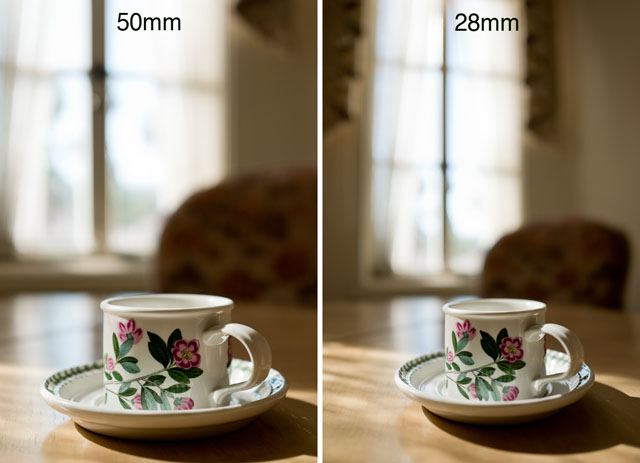
Perspective distortion: Comparing these two photographs you can see how the cup stretches in the 28mm wide angle photograph compared to the 50mm photograph. Both actually has a little stretch because both the cup is in the edge of the frame in both photographs. © Thorsten Overgaard.
Perspective correction - In software like Adobe Lightroom and Capture One Pro there is often a feature to correct perspective (and distortion) like seen below. You can change perspective this way, or at least make believe: If you correct a tall building on teh vertical lines, you will notice that the height of the windows doesn't match the perspective. If the building is with straight lines, the windows should all be of the same size. But a tall building seen from below and corrected with software will have taller windows (closer to camera) in the bottom than in the top (further away from the camera originally).
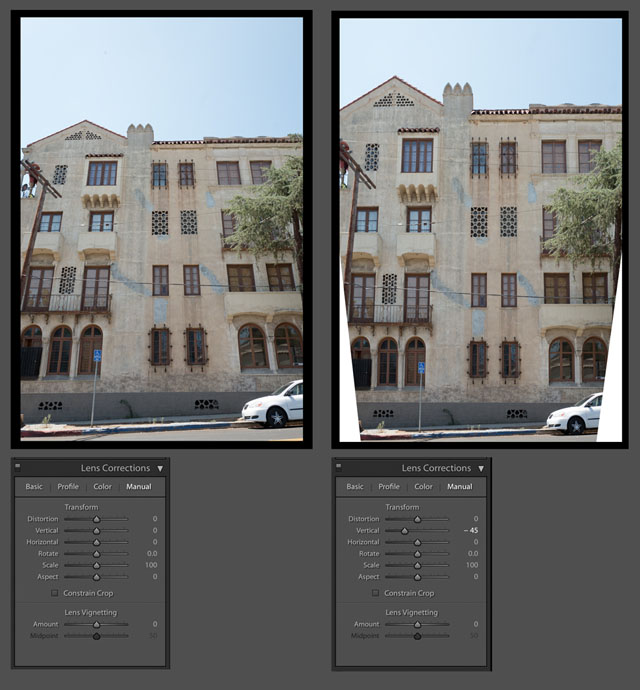
Perspective correction in Adobe Lightroom. © 2017 Thorsten Overgaard.
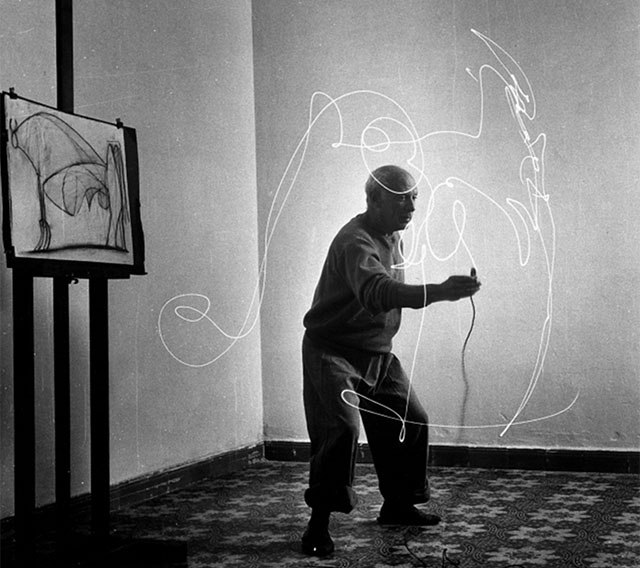
Picasso painting with light in a photogtraph from 1949.
Photography - "Writing with light" in that photo is light, graphy is writing. Also often said as "Painting with light".
Photogenic - That you are able to look good in photos, or said about someone that they do well in photos. Comes from "eminating light".
| |
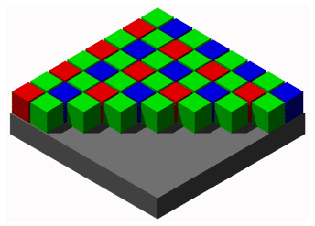 |
| |
A graphic illustration of the typical Bayer Color Filter Array on an RGB sensor. It's called a Bayer filter because Bryce Bayer of Eastman Kodak invented the technology of filtering incoming light into RGB and distribute it into the the photosites that each read just one color (R/G/G/B). |
| |
|
Photosite - The unit in a digital camera sensor that records intensity of either red, green or blue. Unlike the output of a sensor, measured in pixels (and where each pixel contains RGB), the photosite records only one color each, and it's intensity (how bright it is). A photosite can not distinguish colors, which is why there is a Color Filter Array (basically a prism) above them to filter the colors and send information to the photosite if 's a R, G og B color. See illustration below. In a monochrome sensor (as in the Leica M Monochrom and the Phase One Achromatic), all photosites are recording intensity of light only as there is no concern which color it is, and there is no color filter.
The ratio of photosites to pixels is not a given. Each block of 4 contiguous photosites contains one photosite sensitive to low wavelengths (blue), one photosite sensitive to high wavelengths (red), and two identical photosites sensitive to medium wavelengths (green). So four photosites would be the minimum to create one 'full-color' pixel. Apart from that, depends on the sensor specifications, which is different from brand to brand. Sometimes four photosites (two Green, one Red and one Blue) makes up one pixel, at other times it's more photosites to one pixel; and there is also pixels sampled from photosites across (sort of overlapping patterns).
Catch light = See pin light, a reflection in the eyes of a person which brings life to the portrait.
Pin light = (also known as catch light) is the highlight reflected in the eyes from a strong light source in front of the person, like a spotlight, a window, reflector or similar. It brings life to the eyes, just as it was used by for example Walt Disney in cartoons, adding life to the cahracter.
| |
|
|
 |
|
 |
| Donald Duck with black eyes without pin light. |
|
Disney added pin light to the eyes for life. |
My portrait of Kelly Preston has pin light iin her eyes (catch light from the main light source, the key light, a 300W spot). The portrait also has edge light from a 150W spot placed outside the frame to the left behind her. The left side of her face is fill light from a gold reflecor reflecting the key light (two spotlights and a reflector was used for this photograph). © Thorsten Overgaard.

Portrait with pin light from a large window in front of the face, behind the photographer (the only ligth source is windows behind the photographer). © Thorsten Overgaard.
Pixel - Made up word from Pix (picture) and el (element). A pixel is the smallest full-color (RGB) element in a digital imaging device. The physical size of a pixel depends on how you've set the resolution for the display screen. The color and tonal intensity of a pixel are variable, meaning that each pixel contains RGB. This is different from a camera sensor's small eyes (photosite) that are an intensity of either red, green or blue. You could say that the digital sensor's photosite (where each unit collects just one color; red, green or blue) is the input technology, whereas the pixels on a screen (where each pixel contains red, green and blue) is the output device. So while sensors are measured in megapixels (mega = million), it's their output unit of pixels, and not the input unit of photosites that is measured and stated. See illustration below.
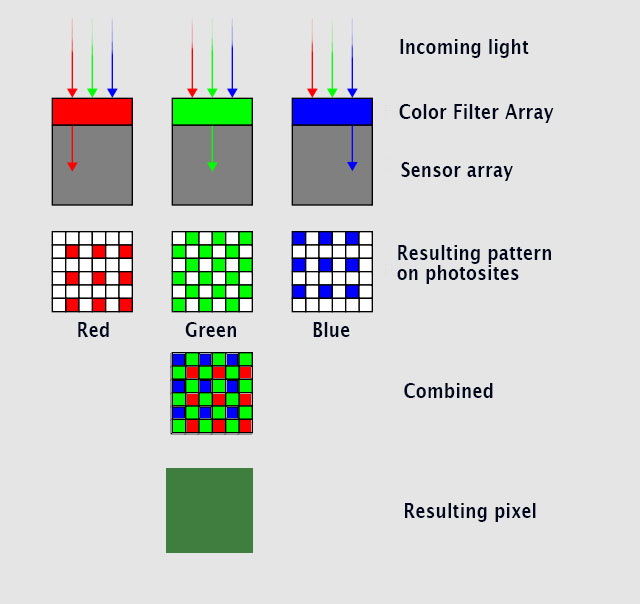
Here's an illustration of how light goes through a color filter that enables the underlying photosites to each record if it';s an R, G or B color - combined - makes up one pixel containing RGB. © Thorsten Overgaard.
| |
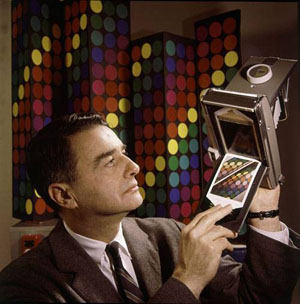 |
| |
Edwin Land with his Land Camera and Polaroid |
| |
|
Polaroid = Instant film presented in 1948 (as the Land Camera and later named Polaroid) at a point in time where film had to be developed, then printed on light-sensitive paper. The Polaroid camera and concept made a print directly on photo-sensitive paper, and when the paper ejected from the camera, a pocket of chemicals was released that would develop the photo in a few minutes.
Edwin Land (1909-1991) invented polarizing glass for sunglasses (used in 3D glasses and an component in all LCD screens, and more), and then the instant camera concept, which was named the Land Camera and later known as the Polaroid camera. The peak revenue of the Polaroid company was $3 billion in 1991. Edwin Land was awarded the Presidential Medal of Freedom in 1963, for his work in optics.
Q - The Leica Q model was released in 2015 as a full-frame 24MP digital compact camera featuring a fixed auto-focus and 28mm f/1.7 lens with macro, amd upgraded with a larger 51MP sensor (same concept) Leica Q2 in 2019. See my article Compact Leica Cameras for more.
Leica Q (2015) in the hands of a young girl. © Thorsten Overgarad.
R = Resolution, in the name Leica M10-R camera model (2020).
R - Reflex: The Leica R cameras (2009) is the SLR cameras from Leica. The first Leicaflex (1964) feels like a Leica M, built as a tank, and with reflex and fits Leica R lenses. Over the production time of the Leica R system, a number of magic lenses from fisheye to 800mm were made for this system (as well as a made-to-order 1600mm lens for a prince in Qatar). Also a number of zoom lenses was made for the Leica R system. Many of the lenses are being used for cinema in their next life, especially the wide angle and the 50/1.4, but also the 280mm APO f/2.8 tele lens was retrofitted with a PL mount and used for the Joker movie in 2019.
The Leicaflex series (1964 - 1976) was modernized with the Leica R3 (1976) that was made together with Minolta , and then Leica went on with Leica R4, Leica R5, Leica 6.2, Leica R7, Leica R8 and Leica R9. The latter two models got a digital 10MP back made as an accessory in 2004 (CCD-sensor made with Imacon and Kodak). You simply took off the film back and mounted a digital back (and could change back to film if you wanted to). See my Leica DMR article. The Leica R system was retired in 2009 when the production of new lenses stopped. Leica Camera AG said then that the plans fot the R10 camera had been retired as it was not feasible to maintain an SLR system. Though, in 2016 Leica opresented the Leica SL system which is a SLR camera without reflex and instead is mirrorless cameras, and with a new series of L-mount lenses. The Leica SL (and Leica M) can use Leica R lenses via adapter.
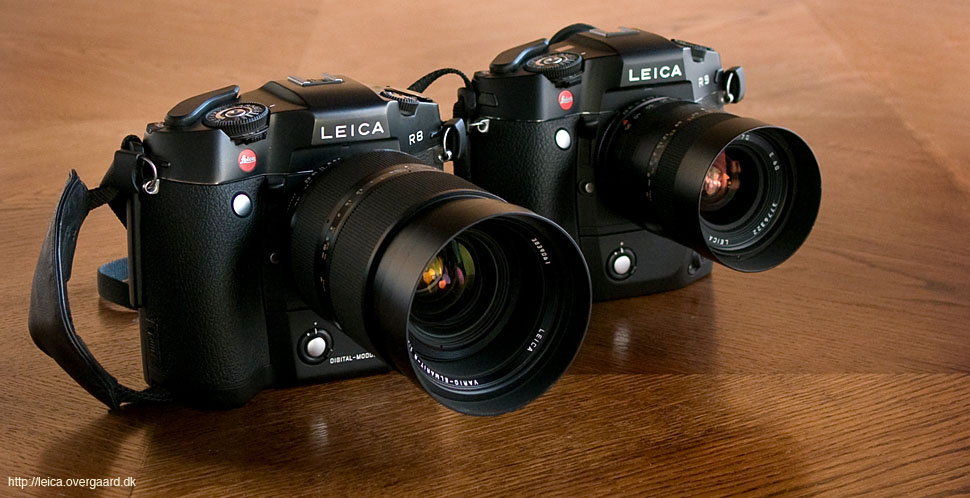
Leica R8 with DMR digital back and 35-70/2.8 zoom, and Leica R9 with film winder and 35-70/4.0 zoom. © Thorsten Overgaard.
| |
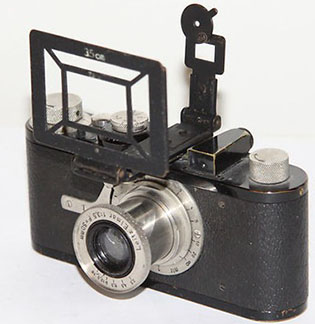 |
| |
RASUK - Sports Range Finder (1933) |
| |
|
RASUK - Sports Range Finder (1933) to mount in the hotshoe for the camera that shoved the frame for 35mm, 50mm, 73mm and 90mm. Was usef for example for photographing race cars where one would frame the car as it came, usually with a 90mm lens.
"Rattle" = Noise from something moving around inside a lens when moved or shaken, as if something is loose: When a lens "rattle" when moved, it is not the floating elements "floating around" but can be the IS (Image Stabilization) elements for elense that has that, AF elements for auto focus lenses, or the aperture cage that rattles (as in the case of the Leica 35mm Summilux-M f/1.4 FLE - if you stop down the Summilux to f/16, the sound is usually not there).
Readout time (for electronic shutter) = The time it takes for a sensor that use electronic shutter to capture the entire imager from top to bottom of the sensor. A CMOS sensor reads a line at the time from the top to the botton. While the shutter speed can be 1/640th of a second, the sensor or shutter reads slower, which causes small movements of a handheld camera to show as warped shapes, misplacement of things, rolling shutter issues, tilted lines and more. The Leica M11 has a sensor readout time of 1/10th second, the Hasselblad X1D has a readout time of 1/3 second. Nikon Z9 (2021) manages to almost eliminate the warping due to a 1/270 readout speed of a stacked sensor, the Canon R3 has a readout time of 1/180th second on a stacked sensor. The handling for slow readout time is to use a tripod or mechanical shutter - or wait for "stacked sensors" to be the norm.
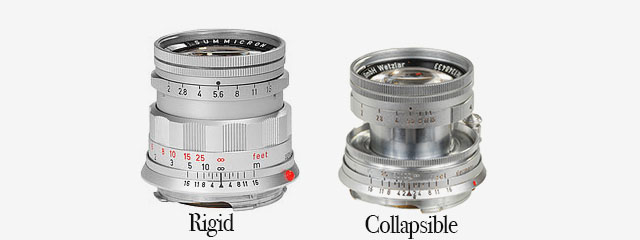
Rigid - Refers usually to the Leica 50mm Summicron-M f/2.0 "Rigid" of 1956.
It is called "Rigid" because, unlike the 50mm Collapsible, this one is not able to be changed.
Rigid means stiff, uable to be forced out of shape. Not able to be changed. From Latin rigere, "be stiff".
The name is a little confusion nowadays as all or most lenses are rigid today, but back in 1925-1956, many lenses were collapsible so the camera was compact when not in use. Just like compact cameras today often has a lens that extrudes when the camera is turned on, and collaps into the camera body when the camera is turned off.
Rim light = Portrait light for edge. Also called Edge light and Hair light. See "Edge light" for examples.
RF
(R)ange (F)inder - the mechano-optical mechanism which allows M Leicas to focus.
Alternative meaning - RF is also shorthand for Hexar RF , Konica's motorised "M-lens-compatible" rangefinder camera released in 2000.
ROM = Read-Only Memory contacts on the Leica R lenses (1996-2009) with information about lens model and calibration of aperture (each lens was finetuned at the factory and the exact data stored in the ROM of the lens).
The Leica R8 and Leica R9 featured electronic contacts in the cameras bayonet mount that could take advantage of lens-specific information to correct for lens vignetting, adjust the zoom reflector on flash according to lens focal length, or to correctly display aperture information. The ROM chip came with all newly sold lenses since 1996, but could also be retrofitted by Leica to older lenses. The lenses with ROM contact could be used on older Leica R cameras such as the Leica R3 - Leica R7 cameras, but not on the plder Leicaflex cameras.
The later Leica L mount system (2013) features a Leica L bayonet with contact strip for communication between lens, which looks very much like the ROM contracts. In the Leica L system, this strip of contacts share information to the camera about aperture, focal length and focusing distance (which in the Leica TL and Leica SL is used to calculate and display depth of field calculations inside the electronic viewfinder). But the contact strip goes both ways, so here comes power and control from the camera to perform auto focus, control the aperture and more.
|
|
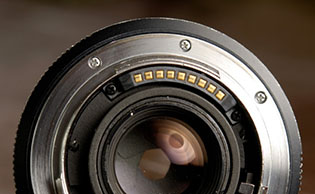
ROM contacts on an Leica R lens |
| |
Leica L-mount lenses with control strip that looks like ROM contacts. |
| |
Contacts inside the Leica SL that connects with the control strip of the lens. |
| |
|
|
S = Single image. When the ring by the shutter release on top of the camera (or in the menu of a digital camera in case it does not have this ring on the ourside) is moved from OFF to S, the camera takes only one photo at the time (Single). The other possibility is Continuous where the camera takes pictures continiously as long as the shutter release button is helt down. (see above).
S = Leica S medium format dSLR camera model and Leica S auto focus lenses (2008-2023). The Leica S2 (2008) with 37MP CCD sensor, Leica S Typ 006 (2012), Leica S Typ 007 (2014) with CMOS sensor and Leica S3 (2018). As if October 2023, Leica announced the end of the Leica S lines, which will be replaced by a new hybrid mirrorless offering.
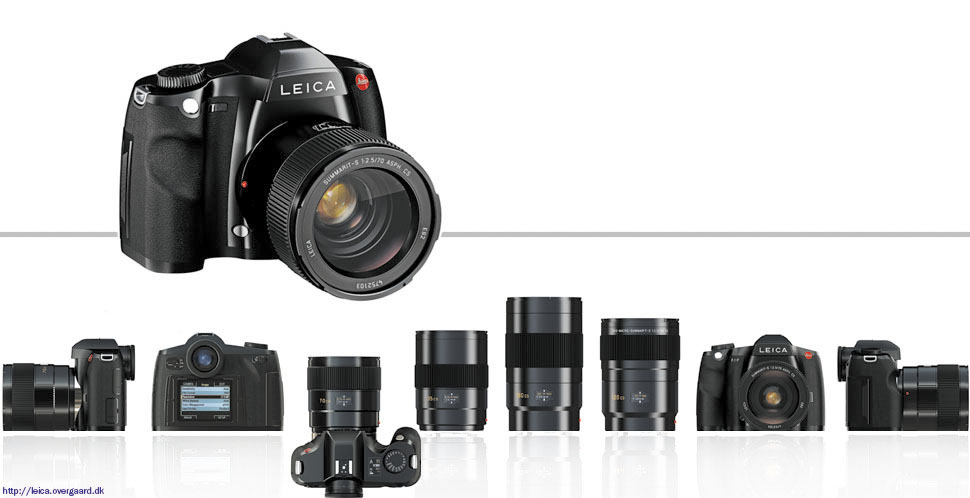
The Leica S system as it was introduced in 2008 with four lenses to begin with.
S1 = Leica S1 (1996-2001) scanner camera for stationary studio use with Leica R lenses, Leica M, Hasselblad, Mamiya, Canon, etc. on a 36x36mm sensor. The camera could perform a 18-185 seconds scan and output a 75mp image (Pro model) or 24MP (Alpha model), or a 16MP (High Speed model). Price was around $30,000 for the body alone and less than 500 were produced and delivered to museums, professional studios, etc.
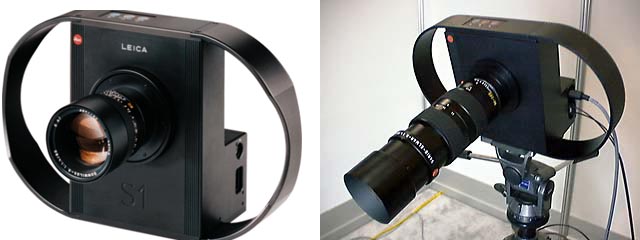
Leica S scanner camera (1996-2001). Read more here.
Saturation: How colorful, intense or pure the color is. Less saturation would be less colorful, more saturation would be more colorful. In today’s photography, de-saturating a photo on the computer will gradually make it less and less colorful; and full de-saturation would make it into a black and white photo.
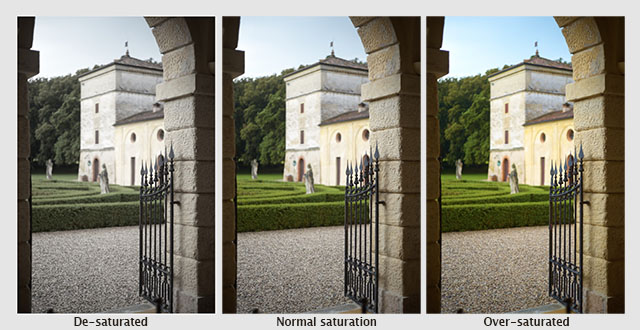
A photo from Verona, Italy de-saturated, normal saturated and over-saturated. © Thorsten Overgaard.
Sensor = A device that detects a physical property (like light) and records it. A camera sensor is a plane plate with thousands of small “eyes” with (photosites) a lens in front of each (CFA, Color Filter Array), which each individually records the amount of red, green and blue light rays that comes through the lens. Together, Red, Green and Blue form all colors of the spectrum, which becomes a pixel. Sensor comes from Latin sens- ‘perceived’.
Sensor, multimodal senor - Is a new technology for cameras (and machine imagining for AI) in 2025-2030 where nanostructured components image sensors can gather more information about incoming light, like a built-in spectometer in the camerea sensor and the pixel funcamentally will be sensitive to the incident angle: The sensor closest to the light sends the strongest current, and by comparing the strongest and weakest currents from both, the angle of the incoming light waves can be determined. Where a normal sensor detects intensity of light, the multimodal sensor detects intensity of light, spectrum, angle and phase.
SDC = Software Distortion Correction. A correction of lens distortion (not straight lines) applied in the camera and which is part of the DNG or RAW file. In Lightroom or Capture One Pro the SDC of the camera file is applied automatically (and cannot be removed), in software like AccuRaw one can open the DNG file without the SDC correction. Sean Reid Reviews have written a good article on what SDC is and does in "Software Distortion Correction".
SDC (Software Distortion Correction): In Lightroom the correction profile for the Fujinon 23mm is applied automatically and cannot be turned off. If you go into Develop mode in Lightroom and look under Lens Correction > Profile, you will see a message in the bottom with an exclamation mark. When you click on that, you get the message above.
Sharpness - See “Focus”
Shoulder Stock
A Leitz mechanism attached to the (tele-) lens and held against one's shoulder when photographing, so as to stabilize a tele lens when using handheld without a tripod or monopod. The shoulder stock is attached to the lens same way as a tripod or monopod.
Shutter speed dial - The dial on top of the Leica M where you can set the shutter speed manually. It can also be set to A which stands for Aperture Priority (where the camera suggests a shutter speed; or when you move the dial away from A, the camera will show arrows in the viewfinder, suggesting which direction to change the Aperture to, to get the correct exposure).
The number on the dial refers to the shutter speeds. "4000" is 1/4000th of a second (one second divided with 4,000).
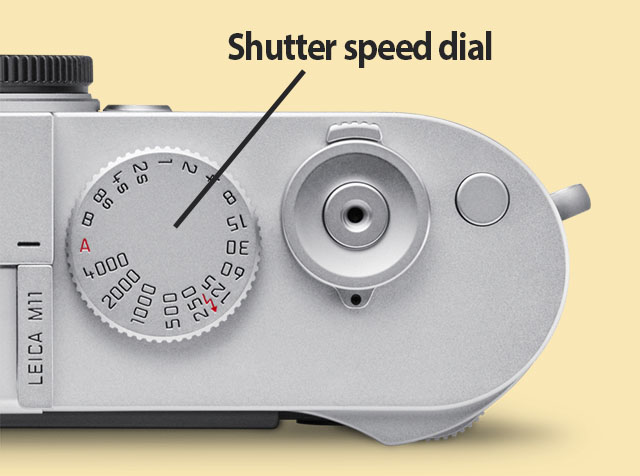
Shutter speed dial set to A (Aperture priority where the camera automatically suggest an shutter speed based on the aperture of the lens). The other settings are manual shutter time settings. "B" is short for Bulb where the shutter is open for as long as the shutter release is pressed (max 60 minutes in the Leica M11). The little "thunder symbol" between number 250 and 135 is a symbol indicating that this is the flash synchronizing setting (1/180th of s a second).
| |
 |
| |
The 6-bit code on the flange of the lens is read by the sensor on the Leica M bayonet of all digital Leica M cameras since 2006. © Thorsten Overgaard. |
| |
|
Six-bit code (6-bit code) - An engraving on the flange of M-lenses that makes it possible for digital M-cameras to recognize the lens that has been mounted. The camera can include information on the attached lens and its focal length in EXIF data and make digital corrections for lens-specific flaws, such as color-cast or vignetting. Six-bit coding was introduced for all M-lenses sold since 2006, but many older lenses can be retrofitted with the code at Leica Camera AG in Wetzlar.
Slide - Short for slide film, also known as a transparency or a dia-positive (or a lantern slide as they were called in the 1800's). A transparent film in positive, and mostly in color, that can be projected onto a wall or screen in large size by putting the slide into a slide projector ("magic lantern" as they were called back in the day) that sends light through the film and projects it to a wall or screen via a lens.
In the 1930's and 1940's Walther Benser traveled the world with a slideshow of pictures made with the Leica. In the period long before the television he managed to fill large theatres with hundres and often thousands of people who were amazed by the large pictures from the "small camera" as the Leica was also known as back then.
Slide projector - Also known as "magic lantern" back in the day. Leica came out with their first projectors in the 1930's (see a list of projectors and acessories here). It's a device with a strong lamp behind a transparent picture (slide) that is projected to a wall or screen via a lens. Today we use LCD projectors which is simply a digital image on a small screen inside the projector house that is projected to a wall or screen by a lens. Early models of LCD projectors had three lenses so as to projet each channel of red, green and blue onto the wall or screen.
SL = Abbreviation for Single Lens (used by Leica for theeir Leica SL (2015) digital cameras. The point is that there is no Reflex mirror (See SLR in the list).
SLR = Abbreviation for Single-Lens Reflex; the lens that forms the image on the film/sensor also provides the image in the viewfinder via a mirror. Newer camera models has aen EVF (Electronic Viewfinder) that displays in the viewfinder what the sensor sees in real-time.
SSI = Spectral Similarity Index. A standard for measuring color rendering started in 2017 that takes into the account the human spectrum, a digital still camera's senor spectrum, the telvision camera's digital sensor spectrum, a movie camera's digital sensor spectrum, and analog film's spectrum: Further SSI takes into account the different models and brands of sensors/cameas/film. The aim is to predict how different types of ditgital recording mediums will render colors using different light sources.
Daylight is the optimum light source, but if one use other ligth soruces in a studio or on a film set, the SSI becomes valuable as it will give possibility to find the best quality light sources (amongst LED, Tungsten, daylight lamps, etc), or (for mainly film sets) correct light sources present (street lamps for example) with gels (colored filters put in front of a light source to change the light). It's implied in the SSI measuring method, that a higher SSI value could also be obtained by matching light and recording device to obtain the best possible colors.
SSI is based on sampling 24 color samples to an average value between 1 SSI and 100 SSI. (SSI 100 indicates perfect match. Values above SSI 90 should be very good. SSI 80-90 should be good, and below SSI is likely to have color rendering issues (to say it mildly).
One could say that the SSI is expanded version of the previous method to measure a light source for its color quality, CRI (Color rendering Index) which used 8 color samples measure and give an average value between 1 Ra and 100 Ra (Rendering Average). Not only does the SSI use 24 instead of 8 color samples, it also takes into account many other perceptions than the human eye. While the SSI is based on the Macbeth ColorChecker chart (with 24 colors), it also used other color charts with up to 190 color patches. Read more at oscars.org.
The Sekonic C-800 color meter launched in March 2019 measures SSI and CRI values (whereas the previous model, Sekonic C-700) only measured CRI).
Stacked sensor = A sensor technology introduced 2021 in Nikon Z9 (sensor readout time of 1/270 second) and Canon R3 which has a faster readout time than traditional CMOS sensors. Readout time basically means how fast or slow the sensor records the light that hits the sensor. The Leica M11 (2022) has a readout time of 1/10 second). So far CMOS sensors have caused 'rolling shutter' effects because the sensor has been too slow to make an "instant pictue", so you get warped still pictures.
| |
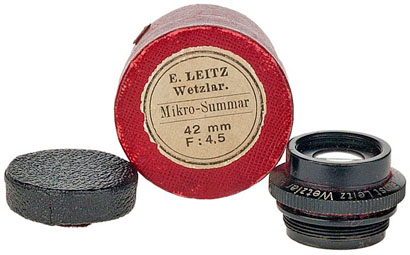 |
| |
Leitz Wetzlar Mikro-Summar 42mm f/4.5 lens anno 1910 might be the first lens carrying the name Summar. |
Summar - (or a story of name development)
The 1933 lens 50mm f2.0 Summar: It started out as Summar(f2.0), then the Summitar (f2.0 in 1939), then the Summarex(f1.5 in 1948), then the Summaron(35mm f.2.8 in 1948, then later f2.0, f3.5 and f5.6 lenses), then the Summarit (f1.5 in 1949 and used again for the 40mm f2.4 on the Leica Minilux in 1995, then again for the 35mm, 50mm, 75mm and 90mm Summarit f2.5 in 2007) then the Summicron(f2.0 in 1953 for the collabsible 50mm) and finally the Summilux(50mm f1.4 in 1959).
ORIGIN of Summar is unknown.
Summarex
The great thing about being a lens designer is that you get to name the lens. Dr. Max Berek who worked for Leitz from 1912 till his death in 1949 named lenses after his two favorite dogs. One was Sumamrex named after his dog Rex, the other Hektor named after his dog Hektor.
Summarit
Refers to the maximum lens aperture - here f/1.5. The name Summarit is a deviation of the name summar (like Elmar > Elmarit).
Summicron = Refers to the maximum lens aperture - here f/2.0 . There are many guesses how this name came about, a popular one being that the "summi" came from "summit" (summit means the highest point of a hill or mountain; the highest attainable level of achievement) while the "cron" came from "chroma" (ie. for colour). Not so: The name (Summi)cron was used because the lens used Crown glass lak9 for the first time, which Leitz bought from Chance Brothers in England. The first batch of lenses were named Summikron (Crown = Krone in Deutsch). The Summi(cron) is a development from the orignal Summar (the 50mm f2.0 lens anno 1933). Vario-Summicron, Vario-Elmarit is Leica Camera AG's name for zoom lenses, for example the Vario-Summicron f/2.0 as the one that is on the Leica Digilux 2.
Summilux = Refers to the maximum lens aperture - here f/1.4 , "-lux" added for "light" (ie. the enhanced light gathering abilities). In Leica terminology a Summilux is always a f/1.4 lens and a Summicron is a f/2.0 lens.
Telyt = Lens nomenclature - short-hand for " telephoto " (tele- is a combining form, meaning to or at a distance) and used in names of instruments for operating over long distances : telemeter. The name has been used for a number of tele lenses from Leica.
ORIGIN: from Greek tele- ‘far off.’
Telecron = The first name for the 1200 mm and 800mm Telecron f/6.3 lens that Leica presented at Photokina in 1970. The 800mm was made available in 1972 as the 800mm Telyt-S f/6.3, a 8.2 kg tele lens. A Leitz Telecron 1200mm f/6.3 was made in 1971 (as prototypes) and one was sold for €93,750 in 2023 at the Wetzlar Camera Auctions. The largest Leica tele lens made is a 1600mm Telyt-R APO f/5.6 made for Al Thani in 2006 (one for Al Thani and one for the factory exhibition).
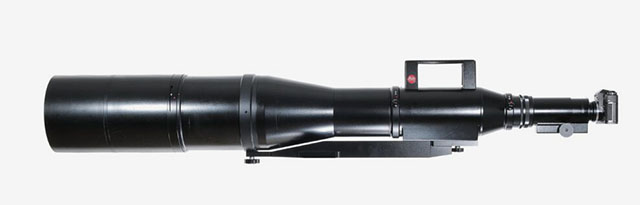
The Leitz 1200mm Telecron f/6.3 was sold for €93,750 in 2023 at the Wetzlar Camera Auctions. To give an idea of the size, it's a Leica R camera mounted at the end to the right.
Televit = rapid-focus device from Leitz that was made from 1966 through 1973, in both R and VisoflexIt was originally designed for use with the 400mm f5.6 Telyt and 560mm f5.6 Telyt. Beginning in 1970 (with serial 2340953) the Televit could also be used with the 280mm f4.8 Telyt-V by using adapter 14138.
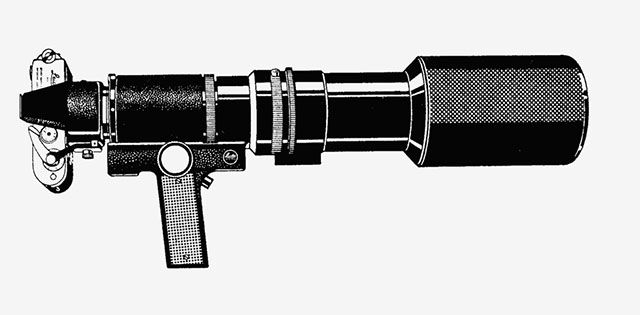
The Leitz Televit with 560mm Telyt
Thambar
Leitz Thambar 90mm f.2.2. At most about 3000 were made, originally, probably in eight batches, starting with 226xxx (built in 1934) and going through 283xxx, 311xxx, 375xxx, 416xxx, 472xxx, 511xxx, and 540xxx (about 1939/1940).
But then the Thambar was re-launched in 2018, exactly the same lens, and is now available from Leica Stores for $7,195.00, which is int he same range as an original second-hand 1930's model in good condition.
Today the original versions are staggeringly rare and can be extremely expensive for a perfect condition Thambar with all accessories (center spot filter, shade, cap and box). The lens has been rumored to be slightly radioactive due to the process of producing the glass.
Known to be a legendary soft-focus portrait lens that 'make a woman look 10 years younger.' A glass filter with a black spot in the middle, about 13mm (1/2”) in diameter cuts out the central (sharpest) part of the image and makes everything even softer.
Here are some advice from a Thambar user, Theodor Heinrichsohn, who have used it mainly for portraits using an Leica M5 and Leica M6:
1. The results are more or less unpredictable. Best practice is to shoot many times and pick the one you like best.
2. Shots against the light are generally more effective than with the light behind you.
3. The most pleasing results to my taste were with center filter at medium apertures. With luck portraits took on the "dreamy" look that the lens is famous for.
4. I never used the Thambar for anything except portraits.
Read my article "How to get the Leica Thambar to work - feat. Milan Swolfs."
Origin of the name is currently unknown. Suggestions has been made that the name Thambar was derived from Greek, meaning “something that inspires wonder”, or greek thambos which means “blurred” or ”not sharp”.
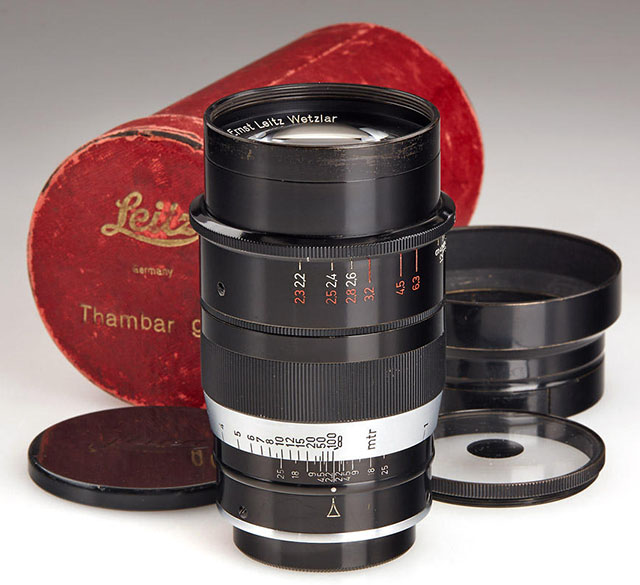
A complete set of a Leitz 90mm Thambar f/2.2 consist of the original red box, lens cap, lens shade and the special soft focus filter with a black dot in the middle. They exist in both a Meter and a Feet edition (the focusing scale). Only 3,500 or less were made from 1934-1940, from serial number 226001 to 540500. Read my article on Leica 90mm lenses.

New Thambar 90mm f/2.2 with Leica M Monochrom. © 2018 Milan Swolfs.
Thick / Thin
The first 90mm Elmar that came out in 1930 was called "Thick" of "Fat" When the smaller Elmar came out in January 1933 it was called "Thin".
Three-dimensional = Having the three dimensions of height, width and depth. In photography and lens design, three-dimensional effect is also the perception of even small micro-details; the texture of skin can appear flat and dead or three-dimensional and alive. Also, selective focus (foreground and background out of focus) can change the perception of depth. Also see Perspective.
Three-dimensional = Having the three dimensions of height, width and depth. Melrose Avenue in Los Angeles. Leica TL2 with Leica 35mm Summilux-TL ASPH f/1.4. © 2017 Thorsten Overgaard.
Leica T is the compact camera developed by Leica Camera in 2014 as a touch-screen operated camera that can take the Leica L mount lenses made for this camera and the Leica SL and Leica CL. This camera series was names Leica TL later. See my article Compact Leica Cameras for more.
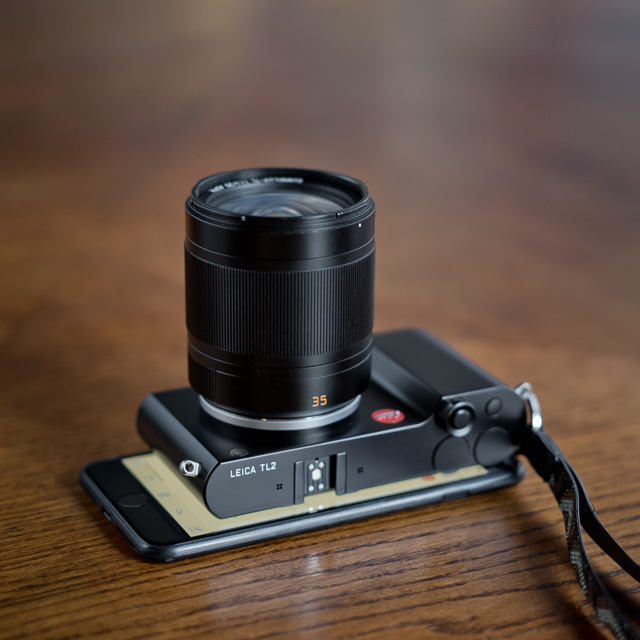
The Leica TL2 (2017) with a Leica 35mm Summilux-L f/1.4 lens, compared with the Apple iPhone Plus. © Thorsten Overgaard.
TTL
(T)hrough (T)he (L)ens light metering, usually WRT the flash metering capabilities built into the R6.2, R8, R9, M7 & M6TTL cameras.
"U" = Leica Type "U" is a term used by Leica Camera and Leica dealers (internally) that means "lightly used" or "used and refurbished". Usually sold with 10-15% discount of new prices and only one year warranty. This is a lens or camera where the box has been opened, and whoever opened it didn't intent to keep using it. So that can be demo in store, a customer returned it after opening it, or a brand new camera that had to go back to Leica for correcting something mechanical or firmware - and now it is put back in circulation as "Type U". It can have phsycal marks, or it can be as brand new. In many ways the same as "Open Box" which is a softer term implying that the box was opened but the lens or camera wasn't used.
V-Lux is a series of compact SLR-like digital cameras by Leica Camera AG developed with Panasonic since 2006, starting with the Leica V-Lux 1 (2006), V-Lux 2 (2010), V-Lux 3 (2011), V-Lux 4 (2012), V-Lux Typ 114 (2014), V-Lux 5 (2018). See my article "Compact Digital Leica Cameras".
To add confusion, Leica also made a Leica V-Lux 20 in 2010, V-Lux 30 in 2011 and a Leica V-Lux 40 in 2012 that was a temporarily renaming of the Leica C-Lux series.
Vario- is the Leica Camera AG name for zoom lenses. Vario-Elmarit, Vario-Elmar and Vario-Summicron and so on.
The Leica 35-70mm Vario-Elmarit-R f/2.8 ASPH (left) and the Leica 35-70mm Vario-Elmar-R ASPH f/4.0 (right)
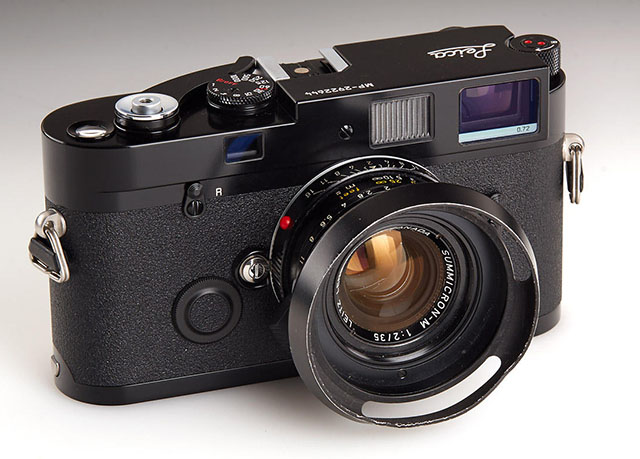
Ventilated shade on a 35mm of Elliott Erwitt's Leica MP camera.
Ventilated Shade - A shade is a hood in front of a lens that provides shade from light going straight onto the lens from outside what you are photographing, which could cause internal reflections like flare, which would make the picture less contrasty.
The ventilated shade has holes so it doesn't obstructs the view from the viewfinder. In many of today’s mirrorless cameras where there is no viewfinder looking ver the lens, so there is no actual need for a ventilated shade; but they are considered classic or vintage looking and are still in high demand. It makes no difference for the purpose of the shade (to create shadow) if it is ventilated or not.
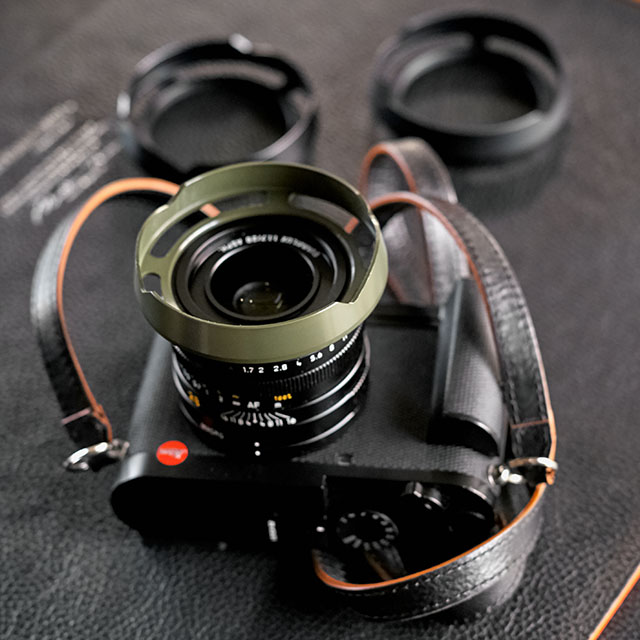
Ventilated Shade for the Leica Q. I make ventilated shades for most lenses and sell them from here.
Viewfinder a device on a camera showing the field of view of the lens. Also known as the German word "Messucher" (or Meßsucher).
1) A built-in viewfinder in a camera that simply show the frame you get when you look through the viewfinder.
2) A rangefinder viewfinder which is also used to focus the lens. In Leica M cameras two pictures has to meet and lay 'on top of each other' for the picture to be in focus.
3) An external viewfinder, usually on top of the camera in the flash shoe, so as to show the field of view of lenses vider than what the built-in viewfinder can show (15mm, 21mm, 24mm, 28mm etc viewfinders exist)
4) Very simple "aiming-devices" on top of a camera that is simply a metal frame without any optics. Just a frame, as for example very old cameras (the original Leica), or when using cameras in diving where you can't look through the camera.
5) A Electronic Viewfinder (EVF) that shows what the sensor sees "live".
Visoflex
A device mounted between the Leica M camera and a lens, containing a mirror mechanism like in a SLR camera, thus allowing the M user to 'preview' a picture using a tele lens larger than 135mm which is the maximum covered by the framelines in the Leica viewfinder. In 2012 Leica made the electronic Visoflex for the Leica M240, which is an electronic viewfinder (see EVF in this list).
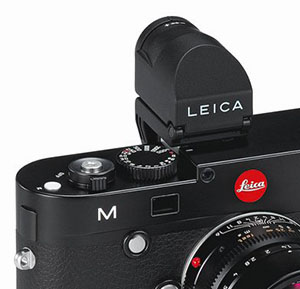
|
|
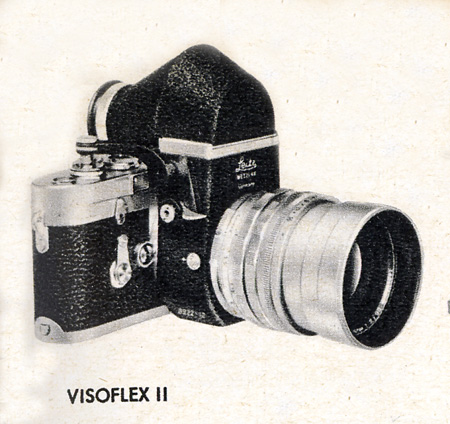 |
Leica Visoflex EVF2 electronic viewfinder.
You can also use the Olympus VF-2 which essentially is the same. |
|
The Leitz VisoFlex came out in 1951 as a way to implement a mirror on a Leica M. The first version exist for screw mount lenses and M mount lenses. |
Vulcanite
The black rubberized, textured material used to cover Leica camera bodies prior to the 1980s. It actually was made of vulcanised rubber (hence the name) and was and remains much loved by professionals because of its solid, sure grip.
Warped = (becoming bent or twisted out of shape). In photography, the effect of slow readout time of a digital sensor recording a photo or video in "live mode". The sensor reads the pixels of the sensor in lines, much like you read a text in a book. Even the shutter speed is 1/640th of a second, the sensor reads the lines slower: The image exposure is correctly 1/640th of a second, but the readout time might be 1/10th of a second, meaning that the shape of things is recorded slower. Thus creating an warped image of things, faces, etc.
One could avoid this by not using CMOS sensors, by using mechanical shutter, or with stacked sensors that are coming out after 2020 with faster readout speeds (Nikon Z9 (2021) manages to almost eliminate the warping due to a 1/270 readout speed of a stacked sensor, the Canon R3 has a readout time of 1/180th second).
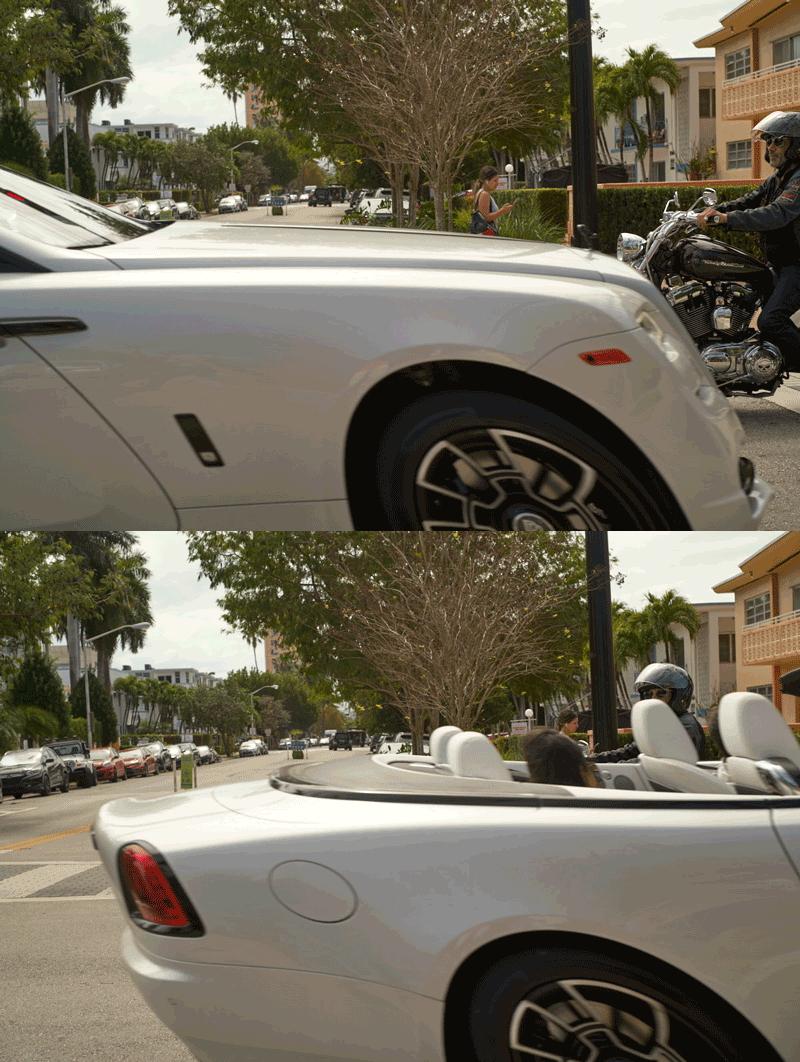
Warped effect in a still image using the Leica M11 electronic shutter at 1/640th second using electronic shutter. A Rolls Royce rolling by, which would have been frozen by a mechanical shutter, but with the "slow" readout time of the M11 electronic shutter causes the image to be warped. © Thorsten Overgaard.
WB = Short for White Balance:
White Balance = (often referred to as WB) in camera menus. See my aticle "Adjusting the White Balance in Photoraphy" for explanation, illustrations and examples.
WLAN = German short for WiFi. In camera menus, Leica may refer to WLAN, which is simply German for WiFi, (and for some reason they refuse to believe that the rest of the world doesn't call it for WLAN like they do). WLAN stands for wireless local area network.
X1 - The Leica X1 was released in September 2009, the Leica X2 in 2012, and Leica X Typ 113 was released in September 2014, all with a fixed 23mm f/1.7 lens. Leica X Vario Typ 107 and Leica X-E Typ 102 was released later. A Leica X-U underwater edition was released in 2026. See my article Compact Leica Cameras for more.
XML = Stands for extensible markup language, which is a way enclose information to a document about how to format it, and more.
XMP = Stands for extensible markup platform (also known as XMP sidecar) and is a standard developed by Adobe and standardized by the International Organization for Standardization ISO. XMP is a 'sidecar' to an image that contains the EXIF data (camera settings) as well as other data about the image recording and editing that would norally be in proprietary formats (only readable by certain software). XMP in short is a container enclosed with the image as a 'sidecar' that contains all available information (EXIF data about settings, IPTC data (who took the photo, copyright info, image captions, etc), but most noteable, the XMP allow you to include information about the editing that was performed to the raw or DNG file, so that when you open the image file in another editing software, the raw data, as well as information about the crop, exposure compensation and other editing you did to the photo, is included).
In Adobe Lightroom Classic, one should make sure to select that editing information is written to the XMP file of each image (go to Lightroom > Catalog Settings > Metadata and then click "Automatically write changes into XMP").
Zone Focusing = Working with the expectancy that a zone will be within acceptable focus so doesn't have to focus precisely before aiming and taking the photo. In smaller cameras one would see different symbols to select from: A mountain, a tree, a person, because the camera had to be set to infinity focusing, not-that-far-away, and close focusing in the near area. This is possible because a lens has a depth-of-focus determined by the f-stop. In such a simple camera, if for example a 40mm lens with widest aperture of f/5.6, then a large area will be in acceptable focus, why the focus mechanism can be reduced to three possible steps.
In street photography zone focusing can be used with any lens in that one can see the depth-of-field scale on the lens and from that determine that if one sets the lens to for example f/8.0, a certain area (zone) in front of the lens will be in acceptable focus. A 50mm f/1.4 lens set to f/8.0 and a distance of 3 meters focal distance, the zone from m to 2.5 meter to 4 meter will be within acceptable focus. In street photography the idea is that one then can react fast, without having to focus, and doesn't even have to lift the camera to the eye, as long as the main subject in inside the zone of 1.5 meter acceptable focus.
Zone System -A system of 11 greytones. Ansel Adams worked out the Zone System in the 1940's with Fred Archer. It may look as simply a grey scale (and it is) but it's the use that has troubled many. If you use a normal external light meter, it will give you the exact amount of light and you can expose your photograph based on that and it will be correct. 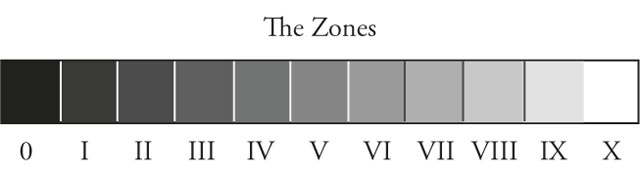
What Ansel Adams basically did was that he studied (by measuring with a spot meter), what the exact grey tones were of the sky, the clouds, the sand, the water, the skin and so on at different times of the day.
You could say that he built up a conceptual understanding of how different materials of different colors and reflective surface would look in black and white at different times of day (or different light conditions). He also realized that a tone changes for the human eye depending on it's size and in which context of other tones it is seen.
In short, you could say that the Zone System is know how something would look in black and white when looking at a scenery. Some who have struggled with the Zone System have done so because they think it is a rule. It is not.
| How Ansel Adams made New Mexico look: |
|
How most people see New Mexico: |
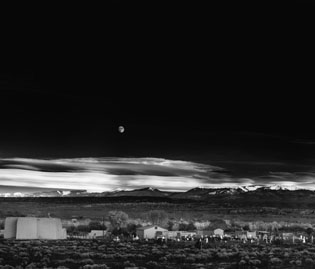 |
|
 |
| The artistic use of the Zone System. |
Ansel Adams developed the Zone System to understand light for himself, but also as a fundament for teaching the light, exposure and making the final photograph. How will it look if you do the usual, and what will it look like if you manipulate it. But most interstingly; how do you work with light, cameras and photographic materials to achieve the look you envision.
The Zone System is meant as a basis on which to create your own aesthetic style and communication. Photography is painting with light. The greyscale is our palette. Ideally we should have a conceptual understanding of the tones and be able to use them intuitive. That was his vision for us all.
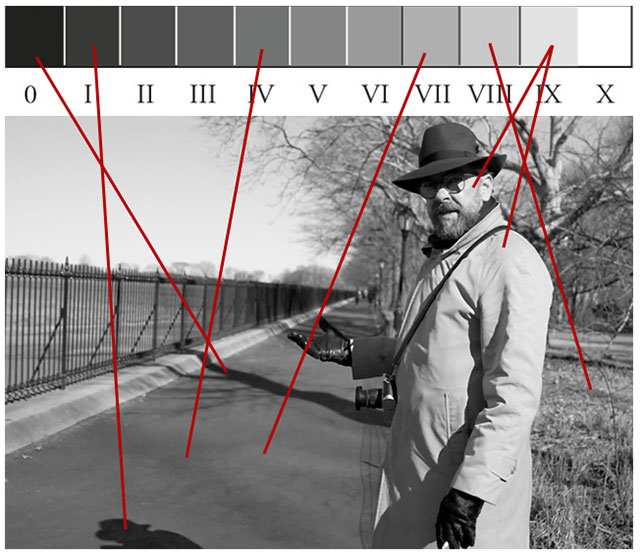
Thorsten Overgaard in New York, explaining the Zone System in his "Street Photography Masterclass".
Ø - Diameter. As in Ø49 for example which means that the filter diameter is 49mm for this lens (or if a filter is Ø49, it is 49mm in diameter and fits that Ø49 lens). Leica uses E to express their filters sizes, as in E49 for a 49mm filter size.
|