|
| Code |
No. |
Housing / Gehäuse |
Int. |
Fin. |
Weight |
Lightmeter |
AF |
Pcs. produced |
Info |
|
|
Leica rangefinder with fixed lens
Rangefinder-like cameras with fastened lens / Befestigte Linse [serial numbers vs. production years may be found here]
|
|
|
Leica I prototype |
1923 |
1923 |
|
|
|
31 |
100-130 |
|
| LEICA |
|
Leica I Anastigmat |
1925 |
1925 |
|
|
|
870 |
131-1000 |
|
| LEICA |
|
Leica I Elmax |
1925 |
1925 |
|
|
|
|
|
|
| LENEU |
|
Leica I < 10,000 |
1926 |
1927 |
|
|
|
|
|
|
| LECUR |
|
Leica I Compur (dial) |
1926 |
1929 |
|
|
|
601 |
5700-6300 |
|
| LEICA |
|
Leica I Elmar close-focus |
1926 |
1936 |
|
|
|
|
|
|
| LENEU |
|
Leica I > 10,000 |
1927 |
1936 |
|
|
|
|
|
|
| LECUR |
|
Leica I Compur (ring) |
1928 |
1941 |
|
|
|
|
|
|
| LENEU |
|
Leica I Luxus |
1929 |
1931 |
|
|
|
|
|
|
| LENEU |
|
Leica I Kalb Leder |
1929 |
1931 |
|
|
|
|
|
|
|
|
Leica Minilux (chrome) black leather |
1996 |
2006 |
|
|
x |
|
40mm f/2.4 ASPH |
|
|
|
Leica Minilux Zoom (chrome) |
1996 |
2006 |
|
|
x |
|
35-70mm f/3.5-6.5 ASPH |
|
|
|
Leica Minilux (chrome) snake skin |
2005 |
|
|
x |
|
40mm f/2.4 ASPH |
|
|
18 009 |
Leica Minilux (black) |
1996 |
1996 |
|
|
x |
|
40mm f/2.4 ASPH |
|
|
|
Leica CM (chrome) |
2005 |
2007 |
|
|
x |
|
40mm f/2.4 ASPH |
|
|
|
Leica CM Zoom (chrome) |
2005 |
2007 |
|
|
x |
|
35-70mm f/3.5-6.5 ASPH |
|
|
Leica screw-mount film rangefinder cameras
Rangefinder cameras with Screw mount lens / Schraubgewinde [serial numbers vs. production years may be found here]
|
| LENEU |
|
Leica (non-standard) |
1930 |
1931 |
|
|
|
|
|
|
| LENEU |
|
Leica (standard mount) |
1931 |
1933 |
|
|
|
|
|
|
| LYCAN |
|
Leica II (nickel early) |
1932 |
1948 |
|
|
|
|
|
|
| ALVOO |
|
Leica Standard (black) |
1932 |
1950 |
|
|
|
|
|
|
| LOOMY |
|
Leica 250FF |
1933 |
1934 |
|
|
|
|
|
|
| AFOOV |
|
Leica III (black / chrome) |
1933 |
1939 |
|
|
|
|
|
|
| LOOMY |
|
Leica 250GG |
1934 |
1943 |
|
|
|
|
|
|
| AGNOO |
|
Leica IIIa |
1935 |
1948 |
|
|
|
|
|
|
| ATOOH |
|
Leica IIIb |
1938 |
1941 |
|
|
|
|
|
|
| LOOHW |
|
Leica IIIc < serial 400,000 |
1940 |
1945 |
|
|
|
|
|
|
| LOOTP |
|
Leica IIId |
1940 |
1947 |
|
|
|
|
|
|
| LOOHW |
|
Leica IIIc (e) > serial 400,000 |
1946 |
1951 |
|
|
|
|
|
|
| LOOSE |
|
Leica IIc (e) |
1948 |
1951 |
|
|
|
|
|
|
| OEGIO |
|
Leica Ic (e) |
1949 |
1952 |
|
|
|
|
|
|
| LOOHN |
|
Leica IIIf |
1950 |
1952 |
|
|
|
|
|
|
| OEFGO |
|
Leica If 1/500 |
1952 |
1952 |
|
|
|
|
|
|
| LOOHN |
|
Leica IIIf |
1952 |
1953 |
|
|
|
|
|
|
| LUOON |
|
Leica IIf 1/500 |
1952 |
1954 |
|
|
|
|
|
|
| OEFGO |
|
Leica If 1/1000 |
1952 |
1957 |
|
|
|
|
|
|
| LUOON |
|
Leica IIf 1/1000 |
1954 |
1956 |
|
|
|
|
|
|
| LOOHN |
|
Leica IIIf D/A |
1954 |
1957 |
|
|
|
|
|
|
| GOOEF |
|
Leica IIIg |
1957 |
1960 |
|
|
|
|
|
|
| OCEGO |
|
Leica Ig |
1957 |
1963 |
|
|
|
|
|
|
|
Leica M film rangefinder with M bayonet
Leica M Rangefinder cameras with Bajonet [serial numbers vs. production years may be found here and here]
|
Advertisment:
 |
|
| IGEMO |
|
Leica M3 < 700,600 |
1954 |
1954 |
|
|
|
|
|
|
| IGEMO |
|
Leica M3 |
1954 |
1967 |
|
|
|
|
|
|
| |
|
Leica MP prototype ( Leica M3E / Leica M3D) |
1955 |
1955 |
|
|
|
Few |
|
|
| IMOOP |
|
Leica MP chrome |
1956 |
1957 |
|
|
|
|
|
|
| IMOOP |
|
Leica MP black |
1957 |
1957 |
|
|
|
(400?) |
|
|
| |
|
Leica MP Betriebsk black paint
"works camera" used internally by Leitz company employees. |
1957 |
1957 |
|
|
|
25 - 50 |
|
|
| KOOHE |
|
Leica M2 |
1957 |
1968 |
|
|
|
|
|
|
| |
|
Leica MP2 modified Leica M2 to accept an electric motordrive.
Serial 935001 – 935512 in 1958
Serial 952001 – 952015 in 1959 |
1958 |
1959 |
|
|
|
27 |
|
|
| KOOCT |
10 125 |
Leica M1 |
1959 |
1964 |
|
|
|
|
|
|
|
10 101 |
Leica MD |
1963 |
1966 |
|
|
|
|
|
|
|
10 400 |
Leica M4 |
1967 |
1975 |
|
|
|
|
|
|
|
|
Leica M4 MOT |
1967 |
1975 |
|
|
|
|
|
|
|
10 103 |
Leica MDa |
1967 |
1976 |
|
|
|
|
|
|
|
10 835 |
Leica M2R |
1969 |
1970 |
|
|
|
|
|
|
|
10 501 |
Leica M5 |
1971 |
1975 |
|
|
|
|
|
|
|
10 700 |
Leica CL |
1973 |
1976 |
|
|
|
|
|
|
|
10 105 |
Leica MD-2 |
1977 |
1987 |
|
|
|
|
|
|
|
10 410 |
Leica M4-2 |
1978 |
1980 |
|
|
|
|
|
|
|
|
Leica M4-P |
1981 |
1987 |
|
|
|
|
|
|
|
|
Leica M6 Classic "Made in Wetzlar"
With "Leitz" logo |
1984 |
1988 |
|
x |
|
|
Link: Article
Link: PDF manual |
|
|
|
Leica M6 Classic "Made in Solms"
With "Leica " logo |
1988 |
1998 |
|
x |
|
|
Link: Article
Link: PDF manual |
|
|
|
Leica M6J Limited edition with 50mm Elmar-M f/2.8 Collapsible. Design exterior as Leica M3, interior as Leica M6.
1640 pcs. produced.
|
1994 |
1994 |
|
x |
|
1640 pcs |
|
|
|
10 475 |
Leica M6 TTL 0.58 black chrome |
1998 |
2003 |
|
x |
|
|
Link: Article
Link: PDF manual |
|
|
|
Leica M6 TTL 0.72 black |
1998 |
2003 |
|
x |
|
|
Link: Article
Link: PDF manual |
|
|
|
Leica M6 Nullseries silver chrome prototype |
2002 |
2002 |
|
x |
|
11 pcs |
|
|
|
10 311 |
Leica MP 6 black Paint
for Japanese market only. Later versions in the series has an Leica M6 ISO dial. |
2002 |
2002 |
|
x |
|
250 pcs |
|
|
|
10 503 |
Leica M7 silver chrome |
2002 |
- |
|
x |
|
|
|
|
|
10 504 |
Leica M7 black |
2002 |
- |
|
x |
|
|
|
|
|
|
Leica M7 Chrome Hermès Limited Edition
with Rapidwinder and chrome 35mm/1.4
100 pcs. Orange leather made
100 pcs. Etoupe (brown) made |
2009 |
2009 |
|
x |
|
2 x 100 |
Link: PDF maual |
|
|
|
Leica M7 á la carte (tailor made) |
2006 |
- |
|
x |
|
|
|
|
|
10 301 |
Leica MP (II) silver chrome 0.72 |
2003 |
- |
|
x |
|
|
|
|
|
10 302 |
Leica MP (II) black paint 0.72 |
2003 |
- |
|
x |
|
|
|
|
|
10 302 |
Leica MP (II) á la carte (tailor made) |
2003 |
- |
|
x |
|
|
|
|
|
10 302 |
Leica MP Betriebsk black paint 0.72 |
2003 |
2003 |
|
x |
|
25 pcs |
|
|
|
10 303 |
Leica MP (II) silver chrome 0.58 |
2003 |
- |
|
x |
|
|
|
|
|
10 304 |
Leica MP (II) black paint 0.58 |
2003 |
- |
|
x |
|
|
|
|
|
10 305 |
Leica MP (II) silver chrome 0.85 |
2003 |
- |
|
x |
|
|
|
|
|
10 306 |
Leica MP (II) black paint 0.85 |
2003 |
- |
|
x |
|
|
|
|
|
10 307 |
Leica MP Hermes silver chrome 0.72
Barenia calfskin leather covering and strap. With 35mm Summicron-M ASPH f/2.0 |
2003 |
2003 |
|
x |
|
500 |
|
|
|
10 312 |
Leica MP Hammertone
LHSA Special Edition 1968-2003 to celebrate the LHSA 35th anniversary.
Barenia calfskin leather covering and strap. With 35mm Summicron-M ASPH f/2.0 lens in "retro-design" |
2003 |
2003 |
|
x |
|
1,000 |
|
|
|
10 316 |
Leica MP Anthracite for Japanese market.
With 35mm Summicron-M ASPH f/2.0 chrome (Model 11 617, only 400 of thes). |
2004 |
2004 |
|
x |
|
600 |
|
|
|
10 317 |
Leica MP Classic black paint camera with 50mm f/2.0 black paint lens. Specifically produced for leica asian distributor Schmidt Marketing in 2004 to commemorate 50th anniversary of the original Leica MP in 1954. |
2004 |
2004 |
|
x |
|
500 pcs made |
|
|
|
10 317 |
Leica MP Ralph Gibson edition 0.85
With dark red leather covering and matte black anodized finish. No frameline selector. |
2004 |
2004 |
|
x |
|
50 pcs made |
|
|
|
10 318 |
Leica MP3 LHSA set black paint camera with 50mm f/1.4 black paint lens and black paint Leicavit.
10320 Black Paint Body / 11627 Black Paint Lens / 14460 Black Paint Leicavit MP |
2005 |
2005 |
|
x |
|
500 pcs made |
|
|
|
10 319 |
Leica MP3 LHSA set chrome camera with 50mm f/1.4 chrome lens and chrome Leicavit.
10321 Chrome Body / 11628 Chrome Lens / 14461 Chrome Leicavit MP |
2005 |
2005 |
|
x |
|
500 pcs made |
|
|
|
10 326 |
Leica MP3 Leica Store Vienna edition (Leica M3-P) with 50mm f/0.95 chrome Noctilux . |
2005 |
2005 |
|
x |
|
20 pcs made |
|
|
|
|
Leica M-A stainless steel
"Leica M Edition 100"
(ltd 100 sets) |
2014 |
- |
|
x |
|
|
Link: PDF maual |
|
|
10 370 |
Leica M-A Type 127 Black
Film rangefinder
Film camera without lightmeter
Kodak Tri-X 400 included
Announced at Photokina 2014 |
2014 |
- |
|
x |
|
|
|
|
|
10 371 |
Leica M-A Type 127 Chrome
Film rangefinder
Film camera without lightmeter
Kodak Tri-X 400 included
Announced at Photokina 2014 |
2014 |
- |
|
x |
|
|
|
|
|
10 557 |
Leica M6 Black 0.72 with "Leitz" logo
The classic film rangefinder reborn
Announced October 2022, first deliveries November 6, 2022. |
2022 |
- |
|
x |
|
|
|
|
|
Leica underwater cameras
Underwater Leica M camera (ELCAN)
|
|
|
ELCAN Leica UW underwater housing with fixed Elcan-M 28mm f/2.8 lens, for use with Leica M bajonet cameras
|
1965 |
1965 |
|
|
|
10 |
|
|
|
Leica digital rangefinder cameras with M mount
Digital Leica M cameras with interchangable Bajonet lenses (same bajonet as Leica M cameras above)
|
|
|
Leica M8 crop-frame digital camera series (2006-2009)
Leica M8 Firmware downloads: Version 2.014 |
|
|
|
Leica M8 silver or black red dot |
2006 |
2009 |
10 MP CCD |
x |
|
|
|
|
|
|
Leica M8u
(M8 a la carte update to M8.2:
New silent shutter / Sapphire glass on display / Bright line frames changed to 2 meter accuracy instead of 0,7 meter).
("S"napshot mode, auto-ISO and SDHC-support are in a free firmware release). |
2008 |
- |
10 MP CCD |
x |
|
|
|
|
|
|
Leica M8.2
silver red dot or
black paint black dot |
2008 |
2009 |
10 MP CCD |
x |
|
|
|
|
| |
|
Leica M9 full-frame digital camera series (2009-2013)
Leica M9 Firmware downloads: Version 1.176 / Version 1.202 / Version 1.210 / Version 1.210 / Version 1.216 / Instruction PDF
Guide on how to find the shutter count of Leica M9
Guide on how to see which sensor is in your Leica M9/Leica M Monochrom
|
|
|
|
Leica M9
Released September 9, 2009
Metal-gray paint red dot or
black paint red dot. Comes with a full Lightroom licence. |
2009 |
2013 |
18 MP CCD |
x |
|
|
|
|
|
|
Leica M9 Titanium limited edition
Presented at Photokina 2010.
Set with 35mm Summilux-M ASPH f/1.4 titanium lens, limited edition book, leather straps and lens shade. Design by Walter de'Silva. (Price for the set in Nov. 2010: 22,000 Euro, all delivered Dec 2010]. Comes with a full Lightroom licence. |
2010 |
2010 |
18 MP CCD |
x |
|
500 |
|
|
|
|
Leica M9-P Hammer Tone Leica Ginza Anniversary Limited Edition
Released June 21, 2011 in Tokyo, Japan to celebrate the 5th year anniversary of the Leica Store Tokyo Ginza
Hammertone in MP-style (no red dot). As Leica M9-P below. With 28mm Elmarit-M ASPH f/2.8 set lens and hammertone lens shade. Sold out in few days. Comes with a full Lightroom licence. |
2011 |
2011 |
18 MP CCD |
x |
|
200 |
|
|
|
|
Leica M9-Professional
Released June 21, 2011 in Paris.
Silver or black in MP-style (no red dot). As Leica M9 but with sapphire glass on display and classic Leica engraving on top plate. Comes with a full Lightroom licence. |
2011 |
2012 |
18 MP CCD |
x |
|
|
|
|
|
|
Leica M9-Professional upgrade
(Leica M9 update to Leica M9-P:
New top plate without red dot but with classic Leica engraving on top plate / New bottom plate / Sapphire glass on display. |
2011 |
- |
18 MP CCD |
x |
|
|
|
|
|
|
Leica M9-P White Limited Edition Ginza
Celebrating the Leica Store Ginza Tokyo anniverary in March-July 2012 50 limited edition white Leica M9-P were made, with a Leica 50mm Noctilux-M ASPH f/.095 silver. Pricen around ¥2,620,000/$30,000 when released. |
2012 |
2012 |
18 MP CCD |
x |
|
50 |
|
|
|
|
Leica M9-P Hermes Limited Edition Jean-Louis Dumas with three lenses; 50mm Noctilux, 50mm Summilux and 28mm Summicron. Also with a limited edition Hermes Camera Bag.
Lens design by Peter Karbe, lens and camera body re-design by Walter de'Silva.
Price for the set at the release date May 10, 2012 - delivery July 2012- was € 40,000 / $50,000 for the set.
This is a redesign of the lens barrel texture, in anodized silver and with Hermes orange numbers. Body re-design in silver chrome finish with Veau Swift burnt tan calfskin leather.
Another 300 sets Leica M9-P Hermes Limited Edition with the Leica 50mm Summilux-M ASPH Hermes Limited Edition was released as well, price € 20,000 / 25,000$.
|
2012 |
2012 |
18 MP CCD |
x |
|
100 pcs. |
|
|
|
10 719 |
Leica M9-P Hermes Limited Edition with 50mm Summilux.
As the above edition.
Price € 20,000 / 25,000$.
|
2012 |
2012 |
18 MP CCD |
x |
|
300 pcs. |
|
|
|
|
Leica M Monochrom "Henri" black
Released May 10, 2012 in Berlin
(delivery from August 2012).
Leica M9-P based body with new black and white (monochrom) sensor. Base ISO 320 with ISO settings from (pull 160) to 10,000 ISO.
Shoots DNG but with possibility of shooting JPG at the same time (can be set to Normal b&w JPG, sepia, cold or selenium toning.
In many ways like the Leica M9-p but without the snapshot mode.
Delivered with free Adobe Lightroom 4 and Silver Efex Pro 2 software. |
2012 |
2015 |
18 MP CCD
13 stops of
dynamic range
|
x |
|
|
|
|
|
|
Leica M Monochrom "Henri" red dot
Black with red dot
Released 2014 as limited run with the red dot logo on front of the camera.
Price approx 10% more than the black Leica M Monochrom without logo (the one that ws released in 2012). |
2014 |
2014 |
18 MP CCD
13 stops of
dynamic range |
x |
|
|
|
|
|
|
Leica M Monochrom "Henri" silver
Released May 2014
A few silver versions had been custom made previously as a la carte versions for customers, but then came the offical silver version. |
2014 |
2015 |
18 MP CCD
13 stops of
dynamic range |
x |
|
|
|
|
|
|
Leica M-E
"Type 220" dark grey
Announced at Photokina in September 2012 as the new entry level camera, delivery started the day after.
Leica M9 based body with new dark grey paint body. Exactly as the Leica M9, but without the USB port and the frame selector, introduced with a price tag the same as the Leica M8.2
Delivered with free Adobe Lightroom 4. |
2012 |
2015 |
18 MP CCD |
x |
|
|
|
|
| |
|
Leica M 240 "typ 240" full-frame digital camera series (2013-2017)
Leica M240 Firmware downloads: Version 1.1.0.2 / Version 2.0.1.5 / Version 2.0.2.5 / Version 2.0.3.0 / Version 2.1.0.0
Leica M262 Firmware downloads: Version 262 1.0.0.4 / Version 262 1.0.0.7 /
Leica M246 Monochrom Firmware downloads: Version 1.0.1.0 / Version 1.0.2.0
|
|
| 10 770 |
|
Leica M
"Type 240" black
Announced at Photokina in September 2012, delivery started on March 2, 2013 |
2013 |
- |
24 MP CMOS |
x |
|
|
|
|
| 10 771 |
|
Leica M
"Type 240" silver
Announced at Photokina in September 2012, delivery started on March 2, 2013 |
2013 |
- |
24 MP CMOS |
x |
|
|
|
|
| |
|
Leica M
"Type 240" stainless steel
Limited edition along with a Leica M-A film camera and three Summilux lenses 28mm, 35mm, 50mm), all in stainless steel.
Announced at the opening of the new Leica Campus in Wetzlar in May, 2014.
Incl. Adobe Lightroom licence. |
2014 |
2014 |
24 MP CMOS |
x |
|
101 |
|
|
| |
|
Leica M-P
"Type 240" black
The Leica M 240 without red dot logo, and with 2GB buffer.
Delivery started in August, 2014.
Incl. Adobe Lightroom licence. |
2014 |
- |
24 MP CMOS |
x |
2GB buffer |
|
|
|
| |
|
Leica M-P digital rangefinder
"Type 240" silver
The Leica M 240 without red dot logo, and with 2GB buffer.
Delivery started in August, 2014.
Incl. Adobe Lightroom licence. |
2014 |
- |
24 MP CMOS |
x |
2GB buffer |
|
|
|
| 10 947 |
|
Leica M 262 digital rangefinder
This is a Leica M9 body with a Leica M 240 inside and the Leica M 240 screen, controls and thumb wheel on the back. It further has a 1GB buffer (a mix of the M-P 240's 2 GB and the M9's 0GB).
A interim model between the Leica M9 and the Leica M 241.
Delivery started in December 2015.
Incl. 90 days Adobe Cloud trial.
|
2015 |
- |
24 MP CMOS |
x |
1GB buffer |
|
|
|
|
|
Leica M-D 262 digital rangefinder
The same as Leica M 262 that was released in December 2015, but this time without a screen on the back.
Inspired by the success of the Leica M60 that was the first digital rangefinder without a screen. Delivery started June 2016.
Incl. 90 days Adobe Cloud trial. |
2016 |
- |
24 MP CMOS |
x |
1GB buffer |
|
|
|
| |
|
Leica M-P 240 Safari Limited Edition Digital rangefinder.
Set with silver 35mm Summicron-M ASPH f/2.0 and silver ventilated lens shade and leather strap.
Delivery started in April 2015 |
2015 |
2016 |
24 MP CMOS |
x |
2GB buffer |
|
|
|
| |
|
Leica M-P upgrade
The Leica M 240 can be upgraded to the Leica M-P 240 as far goes the screen and the look, but not as far as the 2GB buffer and frame selector goes. |
2014 |
- |
|
|
|
|
|
|
|
|
Leica M Edition 60 digital rangefinder
Announced at Photokina in September 2014. Basic filmlike version of the Leica M 240 digital rangefinder without screen and video. Celebrates the 60th year anniversary from the introduction of the Leica M3 in 1954. |
2014 |
2015 |
24 MP CMOS |
x |
2GB buffer |
|
|
|
| 10 930 |
|
Leica M Monochrom Type 246
Leica M Typ 246 "Elliott"
Released April 30, 2015.
Delivery started May 2015.
Based on the Leica M 240 body with CMOS monochrom sensor with no AA filter.
Delivered with free Adobe Lightroom 6 (Lightroom CC) and Silver Efex Pro 2 software.
|
2015 |
2020 |
24 MP CMOS
13.5 stops of
dynamic range |
x |
2GB buffer |
|
|
|
| |
|
Leica M10 full-frame digital camera series (2017-2022)
Leica M10 Firmware downloads: Version 1.3.4.0 / Version 1.7.4.0 / Version 1.9.4.0 / Version 2.4.5.0 / Version 2.6.5.0 / Instruction PDF / Version 3.22.23.38 /
Leica M10-P Firmware downloads: Version 2.6.5.1 / Version 3.21.5.0 / Version 4.22.23.34 /
Leica M10-P ASC Limited Edition Firmware downloads: Version 3.22.23.52 /
Leica M10 Monochrom Firmware downloads: Version 4.22.23.34
Leica M10-D Firmware downloads: Version 3.22.23.52
Leica M10-R Firmware downloads: Version 30.22.23.34
Guide on how to find the shutter count on Leica M10.
|
|
| |
|
Leica M10
Released 2017. Black or Silver.
Based on the Leica M 10-P with 24MP CMOS monochrom sensor with no AA filter.
Fitts the same EVF 020 as the Leica M240.
|
2017 |
2018 |
24 MP CMOS |
x |
|
|
|
|
20 021
20 022 |
|
Leica M10-P
Released 2018. Black (20021) or Silver (20022).
Based on the Leica M 10 but with silent shutter and without the red dot logo.
|
2018 |
2022 |
24 MP CMOS |
x |
|
|
|
|
| |
|
Leica M10-P Safari Green
Released 2018 as limited edition (1,500 pcs) in Safari Green color.
|
2018 |
2020 |
24 MP CMOS |
x |
|
1,500 |
|
|
| |
|
Leica M10-P White
Released 2018 as limited edition (350 pcs) in white.
|
2018 |
2020 |
24 MP CMOS |
x |
|
350 |
|
|
| |
|
Leica M10-P Ghost Edition for Hodinkee
Released 2018 as limited edition (350 pcs) in white.
|
2018 |
2020 |
24 MP CMOS |
x |
|
250 |
|
|
| 20 031 |
|
Leica M10-P "ASC 100 Eidtion"
Released 2018 as limited edition (100 pcs) for cinematographers with a PL mount adaptor in the kit, brass 35mm summilux and EVF. In the firmware, this camera has special cinematic looks for JPG files, as well as cine framelines.
|
2018 |
2020 |
24 MP CMOS |
x |
|
100 |
|
|
| 20 041 |
|
Leica M10-P "Reporter"
Released January 21, 2021.
Limited edition of the Leica M10-P with kevlar armor covering and scratch-resistant paint. Limited edition of 450 samles.
|
2021 |
2021 |
24 MP CMOS |
x |
|
450 |
|
|
20 002
20 003 |
|
Leica M10-R
Released 2020.
Black Chrome (20 002) or Silver (20 003)
The Leica M10-P model with upgraded sensor to 41MP.
|
2020 |
- |
41 MP CMOS |
x |
|
|
|
|
| 20 062 |
|
Leica M10-R Black Paint
Special edition in black paint with chrome ring around the shutter release (like the Leica MP film camera)
|
2021 |
2021 |
41 MP CMOS |
x |
|
|
|
|
| 20 050 |
|
Leica M10 Monochrom
Released January 2020. Black.
Based on the Leica M 10-P with CMOS monochrom sensor with no AA filter, but in 41MP size. Also now ISO goes as low as 160 ISO.
|
2020 |
- |
41 MP CMOS
14.5 stops of
dynamic range |
x |
|
|
|
|
| 20 061 |
|
Leica M10 Monochrom Leitz Wetzlar
Released February 2020
Limited run of 650 pcs worldwide)
Same as Leica M10 Monochrom that was released a few weeks before, but with engraving on top plate (Leica logo and "Wetzlar"). Released together with a similar limited run (500 pcs worldwide) of the 35mm FLE, likewise with an engraving on the front to distinguish it from the normal version).
|
2020 |
2021 |
41 MP CMOS
14.5 stops of
dynamic range |
x |
|
500 |
|
|
| |
|
Leica M11 full-frame digital camera series (2022 - )
Leica M11 Firmware downloads: Version 1.2.1.0 (Jan 28, 2022) / Version 1.22.10.68 / Version 1.22.20.21 / Version 1.3.0.0 (March 29, 2022) / Version 1.4.0.0 (May 25, 2022) / Version 1.5.0.1 (August 3, 2022) / Version 1.6.0.0 (Dec 13, 2022)
Leica M11-P Firmware downloads:
Leica M11-E Firmware downloads:
|
|
EU/US:
20 200
Japan:
20 202
Rest of world:
20 206 |
|
Leica M11 Black
Released Jan 13, 2022. With internal memory, electronic shutter to 1/16000 and scalable DNG files. Made of
magnesium and aluminum (530g)
|
2022 |
- |
60 MP CMOS |
64 GB memory |
3GB buffer |
530g |
|
|
EU/US:
20 201
Japan:
20 203
Rest of world:
20 207 |
|
Leica M11 Silver
Released Jan 13, 2022. With internal memory, electronic shutter to 1/16000 and scalable DNG files. Made of magnesium and brass (640g)
|
2022 |
- |
60 MP CMOS |
64 GB memory |
3GB buffer |
640g |
|
|
| 20 208 |
|
Leica M11 Monochrom Black Chrome.
Black and white 15-stop dynamic range edition of the Leica M11 camera, released April 13, 2023. With internal memory of 256GB, electronic shutter to 1/16000 and scalable DNG files. Made of
magnesium and aluminum. No red dot logo on front
|
2023 |
- |
60 MP CMOS
15 stops of
dynamic range |
256 GB memory |
3GB buffer |
530g |
|
|
| |
|
Leica M11-P
The "Professional" version of the Leica M11. No red dot on the front, and "Leica" engrave on the top plate.
|
2023 |
- |
60 MP CMOS |
|
3GB buffer |
|
|
|
|
|
Leica digital medium format cameras
Leica S digital cameras
|
|
|
Leica S1 digital scanner camera for Leica M and Leica R lenses, as well as other bayonets; scanned one of the three RGB main colors at the time, connected directly to a Mac with SilverFast software. Three versions (Pro, Alpha and Highspeed)
|
1996 |
2000 |
75 MP |
x |
|
146 |
|
|
|
|
Leica S2 digital medium-format digital camera for Leica S lenses and (via adapter) R lenses, Hasselblad lenses and more.
Equipped with both focal plane shutter (FPS) central shutter (CS) in one camera. Comes with a full Lightroom licence. |
2009 |
2013 |
37.5 MP |
x |
|
|
|
|
|
|
Leica S Type 006 (2012)
digital medium-format digital camera for The updated Leica S, now without the S2 or S3 but simply S.
Takes L eica S lenses and (via adapter) R lenses. Equipped with both focal plane shutter (FPS) central shutter (CS) in one camera. Comes with a full Lightroom licence. |
2012 |
2015 |
37.5 MP |
x |
|
|
|
|
|
|
Leica S-E Type 006 (2014)
The Leica S from 2012 re-launched in updated design at Photokina 2014 as the lower price entry-model model (with a large firmware update just prior to speed up the camera).
Comes with a full Lightroom licence. |
2014 |
- |
37.5 MP |
x |
|
2 GB buffer |
|
|
|
|
Leica S Type 007 (2015)
CMOS sensor and the Leica Maestro II image processor, 2 GB buffer and video.
With built-in GPS and WiFi (WLAN).
Available Autumn 2015.
Comes with a full Lightroom licence.
Extras: Leica S-Adapter H for Hasselblad H lenses and the Leica S-Adapter C for Contax 645, Leica R to S adapter. |
2015 |
2020 |
37.5 MP |
x |
|
2 GB buffer |
|
|
|
|
Leica S3 (2020)
CMOS sensor and the Leica Maestro II image processor |
2020 |
2023 |
64 MP |
x |
|
|
|
|
|
Leica SLR film cameras with R mount
Leica R cameras SLR (Single Lens Reflex) [serial numbers vs. production years may be found here and here]
|
|
10002 |
Leicaflex (I) silver chrome (battery on all time; has a 'pie-shaped' counter on top. |
1964 |
1968 |
|
x |
|
|
|
|
|
10002 |
Leicaflex (II) silver chrome (battery on only when rewind arm is outv; has a round counter on top. |
1964 |
1968 |
|
x |
|
|
|
|
|
10002 |
Leicaflex black Enamnel (type I and II) |
1964 |
1968 |
|
x |
|
200 |
|
|
|
10011 |
Leicaflex SL silver chrome
(most common color) |
1968 |
1974 |
|
x |
|
|
|
|
|
10011 |
Leicaflex SL black enamel |
1968 |
1974 |
|
x |
|
|
|
|
|
10011 |
Leicaflex SL black chrome |
1968 |
1974 |
|
x |
|
|
|
|
|
10013 |
Leicaflex SL MOT silver chrome
(for use with the Leicaflex motor) |
1972 |
1974 |
|
x |
|
|
|
|
|
10013 |
Leicaflex SL MOT black enamel or black chrome (for use with the Leicaflex motor)
|
1972 |
1974 |
|
x |
|
862 |
|
|
|
10022 |
Leicaflex SL2 silver chrome |
1974 |
1976 |
|
x |
|
|
|
|
|
10022 |
Leicaflex SL2 black (most common color) |
1974 |
1976 |
|
x |
|
|
|
|
|
10023 |
Leicaflex SL2 MOT black
(for use with the Leicaflex motor) |
1975 |
1976 |
|
x |
|
|
|
|
|
10031 |
Leica R3 Electronic (black chrome) |
1976 |
1979 |
780 g |
x |
|
|
|
|
|
10031 |
Leica R3 Electronic (silver chrome) |
1976 |
1979 |
780 g |
x |
|
|
|
|
|
|
Leica R3 Electronic Safari (olive-green) |
1976 |
1979 |
780 g |
x |
|
5,000 |
|
|
|
|
Leica R3 MOT (black) |
1978 |
1979 |
780 g |
x |
|
|
|
|
|
|
Leica R3 MOT (aztec special edition) |
1979 |
1979 |
780 g |
x |
|
100 |
|
|
|
|
Leica R3 MOT (gold special edition) |
1979 |
1979 |
780 g |
x |
|
1,000 |
|
|
|
10041 |
Leica R4 black (arliest editions were named R4 mot; but all R4 models were prepared for motor winder and motor drive) |
1980 |
1986 |
630 g |
x |
|
|
|
|
|
|
Leica R4 gold finish |
1980 |
1986 |
|
x |
|
1,000 |
|
|
|
|
Leica R4s black (R4 'light') |
1983 |
1985 |
630 g |
x |
|
|
|
|
|
|
Leica R4sP black
(aka Leica R4s Model 2 or R4s MOD 2) |
1985 |
1988 |
620 g |
x |
|
|
|
|
|
10 061 |
Leica R5 silver chrome |
1986 |
1992 |
625 g |
x |
|
|
|
|
|
10 061 |
Leica R5 black |
1986 |
1992 |
625 g |
x |
|
|
|
|
|
|
Leica R6 silver chrome |
1988 |
1992 |
625 g |
x |
|
|
|
|
|
|
Leica R6 black |
1988 |
1992 |
625 g |
x |
|
|
|
|
|
|
Leica R-E black (R5 'light') |
1990 |
1994 |
625 g |
x |
|
|
|
|
|
10 068 |
Leica R7 silver chrome |
1991 |
1996 |
670 g |
x |
|
|
|
|
|
10 068 |
Leica R7 black |
1991 |
1996 |
670 g |
x |
|
|
|
|
|
|
Leica R6.2 silver chrome |
1992 |
2002 |
625 g |
x |
|
|
|
|
|
|
Leica R6.2 black |
1992 |
2002 |
625 g |
x |
|
|
|
|
|
|
Leica R8 silver chrome |
1996 |
2002 |
890 g |
x |
|
|
|
|
|
|
Leica R8 black |
1996 |
2002 |
890 g |
x |
|
|
|
|
|
|
Leica R9 silver chrome |
2002 |
2009 |
790 g |
x |
|
|
|
|
|
|
Leica R9 black |
2002 |
2009 |
790 g |
x |
|
|
|
|
|
Digital Leica dSLR cameras with R mount
Digital Leica R cameras dSLR (digital Single Lens Reflex) with R bajonet
|
|
14 439 |
Leica Digital Module R (DMR) (2006) is a digital back for Leica R8 & Leica R9. In a matter of minutes yiu can change the film back into a digital back. |
2005 |
2007 |
10 MP |
|
|
5,000 |
|
|
|
|
Leica R10 dSLR for AF-R lenses and R lenses was planned and announced in 2008. But in July of 2009 Leica Camera AG announced that they wouldn't proceed with the development as their research had shown it wouldn't be feasible - or that if they build it, it would be so expensive few would want to buy one.
At the same time Leica Camera AG promised "some solution" for Leica R glasses in the future, which at Photokina 2012 became the Leica M that takes Leica R lenses and can be fitted with a electronic vievfinder to help focus the R lenses. |
- |
- |
(24 MP) |
|
|
|
|
|
|
Digital Leica dSLR cameras with SL mount
Digital Leica mirrorless cameras that takes Leica TL lenses as well as many other Leica lenses via bayonet adapter.
Leica SL2 Firmware downloads: Version 5.0 /
|
|
|
Leica SL full-frame cameras:
|
|
|
|
Leica SL Type 601 (2015)
Full-frame mirrorless auto-focus system introduced in September 2015 with a new range of lenses, as well as capability to take any Leica lens ever made. 4K video.
Delivery started on November 16, 2015 |
2015 |
2020 |
24 MP |
|
|
|
|
|
| 10 854 |
|
Leica SL2 black (2020)
Full-frame mirrorless auto-focus system, and upgrade of the 2015-released model Leica SL (typ 601) with improvements of design and larger sensor. 5K video. |
2020 |
- |
47 MP
5K video
|
|
|
|
|
|
| 10 896 |
|
Leica SL2 silver (2023)
Silver body version of the Leica SL2 |
2023 |
- |
47 MP
5K video
|
|
|
|
|
|
| 10 880 |
|
Leica SL2-S (2020)
A down-sized version of the Leica SL2 in that is has a 24MP sensor. 4K video. Basically a Leiac SL (typ 601) in a SL2 body. |
2020 |
- |
24 MP
4K video
|
|
|
|
|
|
| 10 891 |
|
Leica SL2-S reporter (2020)
Woven aramid fiber body cover amd green. Limited edition. |
2022 |
2022 |
24 MP
4K video
|
|
|
|
|
|
| |
|
Leica SL3
Full-frame mirrorless auto-focus system, and upgrade of the 2020-released model Leica SL2. |
- |
- |
|
|
|
|
|
|
|
|
Leica TL / T / SL adapters:
Leica M to SL adapter (2015) is essentially the same adapter as the one used for the Leica T.
Leica screwmount to M to SL adapter (2015) Usually you would buy a Leica or 3rd party screw mount adapter and often leave it on the screw mount Leica lens. Then it fits into the Leica M mount.
Leica R to SL adapter (2016).
Leica Cine Lens to SL adapter (2015).
Leica S to Leica SL adapter (2015)
|
2015 |
- |
|
|
|
|
|
|
|
|
Leica T/TL/CL series compact cameras with APS-C sensors:
|
|
|
|
Leica T (April 2014)
New APS-C format CMOS camea system with touch screen that takes Leica TL (Leica T and Leica SL) lenses.
|
2014 |
2016 |
12 MP |
|
|
|
|
|
|
|
Leica TL (Oct 2016)
APS-C format CMOS sensor
|
2016 |
2017 |
16 MP |
|
|
|
|
|
18 187
18 188 |
|
Leica TL2 (July 2017)
APS-C format CMOS sensor new model introduced July 2017 that takes Leica TL (Leica T and Leica SL) lenses. Black version (18187) and silver version (18188). |
2017 |
- |
24 MP |
|
|
|
|
|
| 19 330 |
|
Leica CL (Dec 2017)
APS-C format CMOS sensor camera system introduced Deccember 2017 that takes Leica TL (Leica T and Leica SL) lenses. |
2017 |
- |
24 MP |
|
|
|
|
|
|
|
Digital Leica dSLR cameras with 4:3 mount
Digital Leica D cameras dSLR (digial Single Lens Reflex) with Four Third Bajonet
|
|
|
Leica Digilux 3
(Also fits Leica R lenses via 3/4 - R adapter) |
2006 |
2009 |
7.5 MP |
x |
|
|
|
|
|
Small Leica digital cameras
Leica Digital cameras with fastened lens / Befestigte Linse |
|
|
Leica Digilux
|
|
2000 |
1.5 MP |
x |
|
|
|
|
|
|
Leica Digilux 1 |
2000 |
2005 |
4 MP |
x |
|
|
|
|
|
|
Leica Digilux 2 |
2003 |
2006 |
5 MP |
x |
|
28-90mm f/2.0
ASPH
|
|
|
|
|
Leica V-Lux compact cameras: |
|
|
|
|
Leica V-Lux 1 |
2006 |
2010 |
10.1 MP |
x |
|
28-400mm |
|
|
|
|
Leica V-Lux 2 with HD video |
2010 |
2012 |
14.1 MP |
x |
|
25-600mm |
|
|
|
|
Leica V-Lux 20 with HD video and GPS |
2010 |
2013 |
12.1 MP |
x |
|
25-300mm |
|
|
|
18 193 |
Leica V-Lux Type 114 |
2014 |
- |
20 MP |
x |
|
25-400mm
f/2-4.0 |
|
|
|
|
Leica C-Lux compact cameras: |
|
|
|
|
Leica C-Lux 1 |
2006 |
2007 |
6.4 MP |
x |
|
|
|
|
|
|
Leica C-Lux 2 in white or black |
2007 |
2010 |
7.2 MP |
x |
|
|
|
|
|
|
Leica C-Lux 3 in white or black |
2010 |
2012 |
10.1 MP |
x |
|
25-125mm
f/2.8 - f/5.9 |
|
|
|
18 484
|
Leica C-Lux Type 112 in darl red or light gold |
2013 |
- |
12 MP |
x |
|
28-200mm
f/2 - f/5.9 |
|
|
|
|
Leica D-Lux compact cameras: |
|
|
|
|
Leica D-Lux |
2003 |
2005 |
3.2 MP |
x |
|
|
|
|
|
|
Leica D-Lux 2 |
2005 |
2007 |
8.4 MP |
x |
|
|
|
|
|
|
Leica D-Lux 3 black |
2007 |
2008 |
10 MP |
x |
|
|
|
|
|
|
Leica D-Lux 4 black
(Also available in ltd. editions titanium or Safari green with green Billingham bag) |
2008 |
2010 |
10 MP |
x |
|
|
Article/review |
|
|
|
Leica D-Lux 5
incl. Full Lightroom licence |
2010 |
2012 |
12 MP |
x |
|
24-90 mm ASPH
f/2.0 - f/3.3 |
Article/review
D-Lux 5 Techincal Data |
|
|
|
Leica D-Lux 5 Titanium
Limited edition with halfcase and cover and camera strap in grey leather. |
2011 |
2012 |
12 MP |
x |
|
24-90 mm ASPH
f/2.0 - f/3.3 |
Article/review
D-Lux 5 Techincal Data |
|
|
|
Leica D-Lux 6 incl. Full Lightroom licence
The new D-Lux 6 features a f/1.4 zoom lens as well as video. Also, the aperture can be adjusted on a aperture ting on the lens (instead of in the camera menu).
1.7" CMOS image sensor.
EVF (electronic viewfinder as acessory) |
2012 |
2014 |
12 MP |
x |
|
24-90 mm ASPH
f/1.4 - f/2.3 |
Article/review
D-Lux 6 Techincal Data
|
|
|
18 470 |
Leica D-Lux Type 109
Announced at Photokina 2014. WiFi, 4K video and Four Thirds sensor |
2014 |
2018 |
12 MP |
x |
|
24-75 mm ASPH
f/1.7 - f/2.8 |
Article/review
|
|
|
19 116 |
Leica D-Lux 7
Compact camera with old-school simplicity and features. The aperture can be adjusted on a aperture ting on the lens (nstead of in the camera menu), and the shutter speed can be adjusted on a dial on top of the camera.
Built-in EVF (electronic viewfinder as acessory) |
2018 |
- |
17 MP |
x |
|
24-75 mm ASPH
f/1.7 - f/2.8 |
Article/review
D-Lux 7 PDF Manual
|
|
|
|
Leica X series compact cameras |
|
|
|
|
Leica X1 chrome or black
Incl. Full Lightroom licence |
2010 |
2012 |
12 MP |
x |
|
35mm f/2.8 ASPH
(23mm/2.8)
|
|
|
|
|
Leica X2 silver or black
Incl. Full Lightroom licence
Also available as Leica X a la carte editons where you can design your own colors. |
2012 |
2014 |
12 MP |
x |
|
35mm f/2.8 ASPH
(23mm/2.8)
|
|
|
|
|
Leica X2 Edition Paul Smith
Incl. Full Lightroom licence
Limited edition designed by Paul Smith, in a collectors box with grey camera strap and matching grey half-case for the camera.
Limited edition 1500 pcs. |
2012 |
2013 |
12 MP |
x |
|
35mm f/2.8 ASPH
(23mm/2.8) |
|
|
|
18 430 |
Leica X Vario Type 107
Incl. Full Lightroom licence |
2013 |
- |
16 MP |
x |
|
35-70mm
f/3.5-6.4 |
Article
Link: PDF brochure
Link: PDF manual
|
|
|
18454 |
Leica X-E Grey
Announced at Photokina 2014. Incl. Full Lightroom licence. Basically the Leica X2 continued under a different name. With internal 110MB memory. |
2014 |
- |
12 MP |
x |
|
35mm f/2.8 ASPH
(24mm/2.8) |
|
|
|
18 440
Black
18 441
Silver |
Leica X Type 113
Announced at Photokina 2014 and comes with a redesigned, more lightstrong lens than the previous Leica X2.
Incl. Full Lightroom licence |
2014 |
- |
16 MP |
x |
|
35mm f/1.7 ASPH
(23mm/1.7) |
Link: PDF brochure
Link: PDF manual
|
|
|
|
Leica Q series compact cameras |
|
|
|
|
Leica Q Typ 116
Also known as "Hemingway", the new digital full-frame mirrorless rangefinder camera. Delivery started on on June 11, 2015.
Incl. full Lightroom 6 licence |
2015 |
2018 |
24 MP |
640g |
|
28mm f/1.7 ASPH
|
|
|
| 19 050 |
|
Leica Q-P
The matte black version of the Leica Q, without red dot logo. |
2017 |
2018 |
24 MP |
640g |
|
28mm f/1.7 ASPH
|
|
|
| |
|
Leica Q2 full-frame digital camera series (2018 - 2023)
Leica Q2 Firmware downloads:
|
|
| 19 050 |
|
Leica Q2 Black Paint
The updated version of the Leica Q, same lens and same everything, but improved viewfinder and design details, and larger battery. |
2018 |
2023 |
47 MP |
718g |
|
28mm f/1.7 ASPH
|
|
|
| 19 058 |
|
Leica Q2 "Daniel Craig x Greg Williams"
Special limited adition with gold engravings and gold metal fittings, designed by and named by Agent 007 Daniel Craig and Uk photographer Greg Williams. |
2019 |
2020 |
47 MP |
718g |
|
28mm f/1.7 ASPH
|
|
|
|
|
Leica Q2 "James Bond 007"
Limited version released together with the James Bond movie, October 2021 |
2021 |
2021 |
47 MP |
718g |
|
28mm f/1.7 ASPH
|
|
|
| 19 063 |
|
Leica Q2 Reporter Green Body
Special version of the Leic a Q2 with green body and Aramid Fiber. |
2022 |
2022 |
47 MP |
718g |
|
28mm f/1.7 ASPH
|
|
|
| 19 054 |
|
Leica Q2 Ghost Edition Light Grey Body
Special version of the Leic a Q2 with grey and light grey paint/leather. |
2023 |
2023 |
47 MP |
718g |
|
28mm f/1.7 ASPH
|
|
|
| 19 092 |
|
Leica Q2 Disney
Limited edition of 500 of the Leica Q2 celebrating 100 years of Disney. |
2023 |
2023 |
47 MP |
718g |
|
28mm f/1.7 ASPH
|
|
|
| 19 055 |
|
Leica Q2 Monochrom Matte Black Body
The black and white version of the Leica Q2, with a monochrom sensor. |
2020 |
2024 |
47 MP
13 stops of
dynamic range |
718g |
|
28mm f/1.7 ASPH
|
|
|
| 19 071 |
|
Leica Q2 Monochrom Reporter
Limited edition of 350 of the Leica Q2 Monochrom, with green body paint and Aramid Fiber. |
2022 |
2022 |
47 MP
13 stops of
dynamic range |
718g |
|
28mm f/1.7 ASPH
|
|
|
| |
|
Leica Q3 full-frame digital camera series (2023 - )
Leica Q3 Firmware downloads: Version 1.3.0 (Oct 16, 2023) /
|
|
| 19 080 |
|
Leica Q3 Black Paint (type 6505)
The updated version of the Leica Q2, with flip-up screen and 60Mp sensor. |
2023 |
- |
60MP / 8K video
14 stops of
dynamic range |
743g |
|
28mm f/1.7 ASPH
|
|
|
|
|
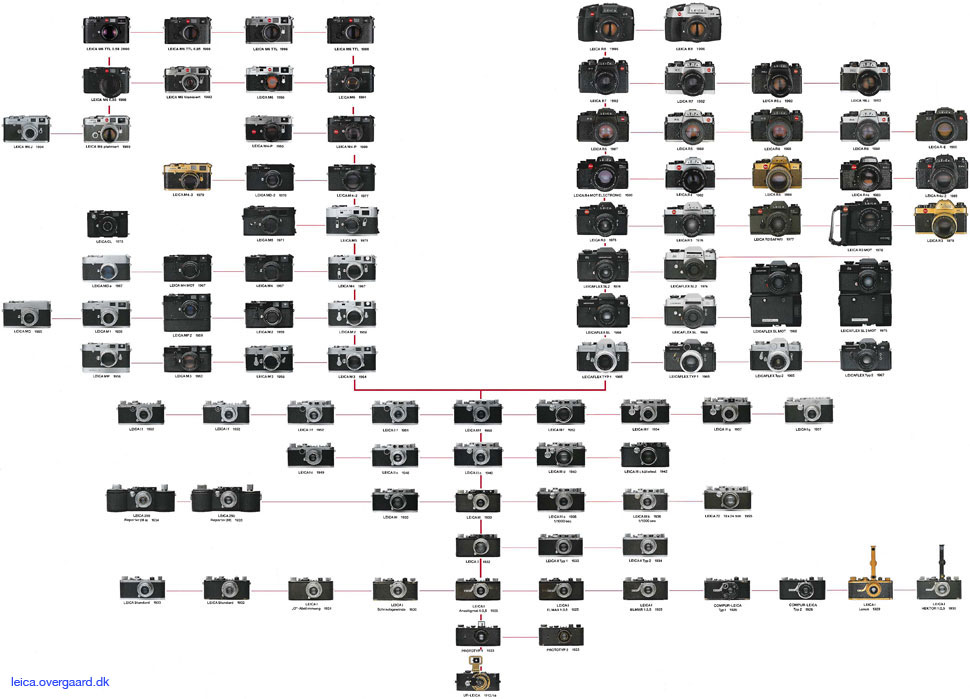
Leitz and Leica Family Tree as of 2003
From Ur-Leica to Leica R8 and M7 illustrated. Link: PDF poster
|
|
|
|
|
|
|
|
|
|
|
|
|
|
|
|
|
|
|
|
|
|