Thorsten Overgaard digital photography courses, seminars and eBooks, on-line courses and one-on-one tutoring
Digital photography courses, seminars, on-line courses and one-on-one tutoring
My goal is to instill enthusiasm in any photographer and raise his or her skill level, self-confidence and production volume. And I do.
By: Thorsten Overgaard
The very basis of becoming a better photographer stems from first having an intention to advance, an intention to improve. An intention to take a certain challenge, any particular thing that you think of, and then you have an idea that you would like to improve.
I generally don't focus on technology or offer Nirvana for gearheads. But I recognize any sort of photography as an art form and a way to communicate on an aesthetic level without words. Which is an ability we all have and which can be improved from no matter what level you are at.
And that is the only business plan I have: I can make you a better photographer by insatlling enthusiasm and raise skill level, self-confidence and production volume.
Since I started delivering photo seminars some years ago I have expanded the ways to share what I know. And here is an overview.
1. One-on-one tutoring with Thorsten Overgaard
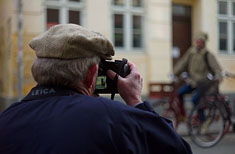
Working with Leica S2 and timing by shooting bicycles in speed.
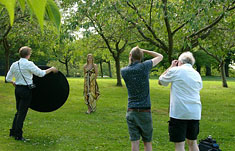
Student working with models, natural light and me and my assistant as helpers
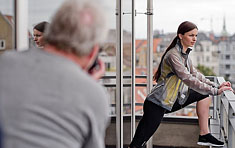
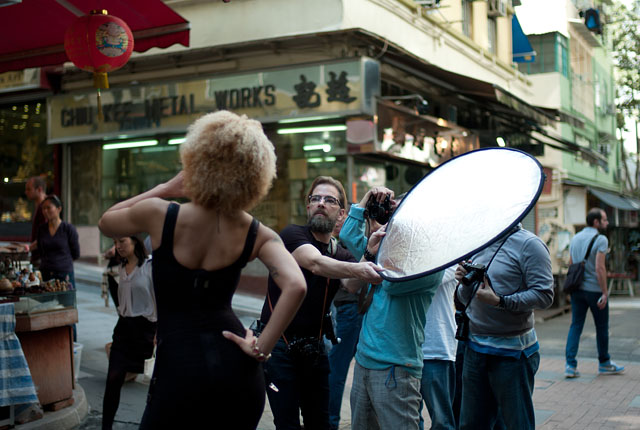
Working with model and natural light, wardrobe and assistants
A very fun and exclusive offer is my one-on-one training. It's usually a week or two of personalized workshop in the editing office and out shooting models and real life, mixed with bits of theory I find necessary to go over. It can take place anywhere in the world we see fit.
For some people it makes sense that now they have spend tens of tousands of dollars on equipment, they should spend a bit more money and learn how to utilize it, without spending months or years learing by them self. The need is always very specific why the tutoring is tailored to the exact need and choice of equipment.
Some times one-on-one training can be an afternoon where we go shoot and address a certain skill or problem. It's very easy to fix things and see how they are done correct when you experience them, rather tha read about them.
"This spring I spent a week with Thorsten Overgaard in Denmark. It was terrific! I would recommend the one-on-one course to anyone interested in photography.
Thorsten is very involved in the course, no "teaching assistants", and his input and guidance is invaluable."
- J.H., Dallas
Price is in the range of $3,000 a day. The way to go about is by sending an e-mail to me at thorsten@overgaard.dk
Student sample from the one-on-one:
As Lars Klottrup of Denmark stated after a daylight studio experience (above) where he couldn't believe that the display of his Nikon was not correct, he had the following comment after the images had been through Lightroom: "Ok, an external light meter isn't that bad an idea!". The two top samples are outdoor with the use of reflectors and silk screens.
The One-on-One training also comes around setting up a professional workflow for yourself.
"I could fly the best photographers in the world here to work with me (and I have), but they can't teach me.
You can. You are a very gifted teacher."
- B. K.
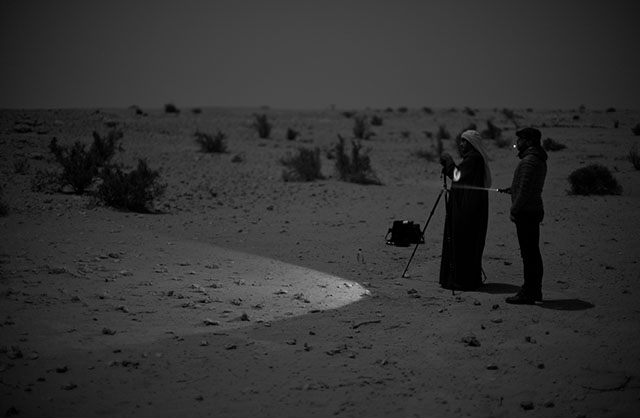
Khalid Al-Thani and me working by the moon light in the desert outside Doha, Qatar. Read the arrticle "Writing light letters by the moonlight" for more on this adventure.
2. The basic and very popular Overgaard Workshop
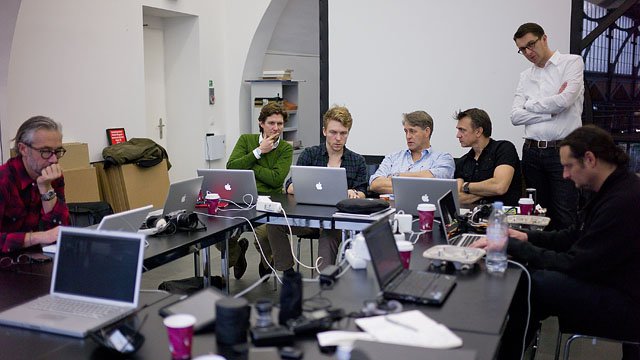
Seminar drilling on the first evening of the seminar at Fitzroy Square in London
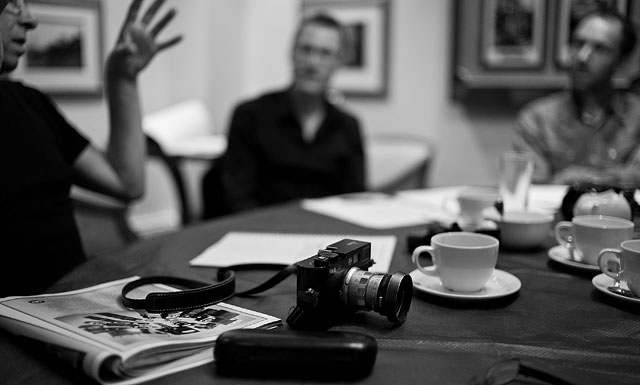
Theory on first evening in Copenhagen
National Arts Club \
Home assignment work in Aurba, December 2009
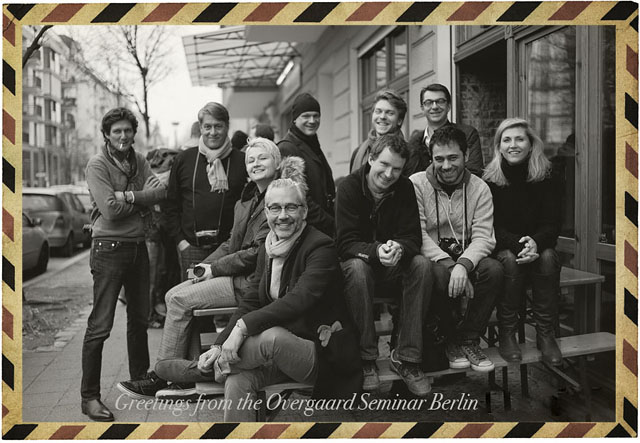
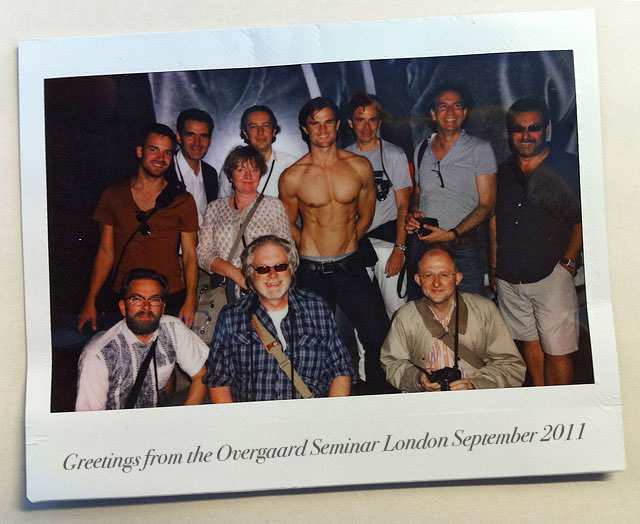
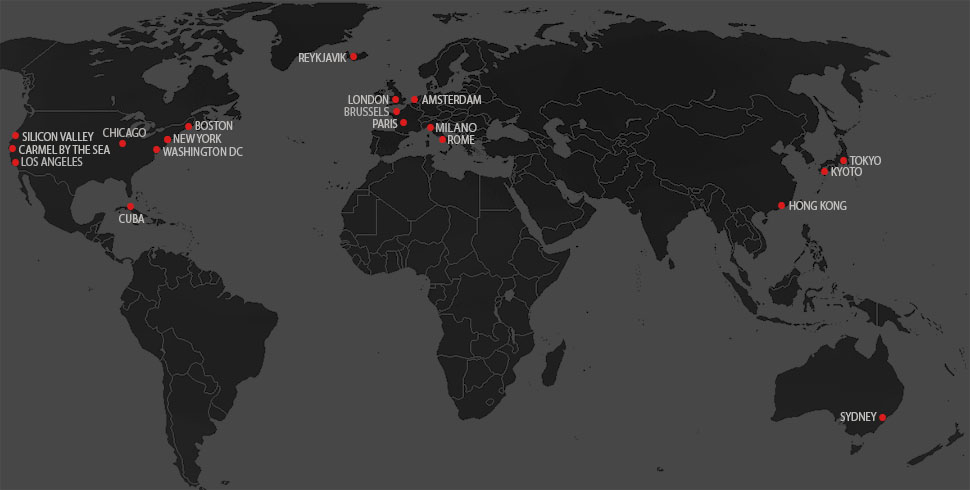
The photo seminar is usually for up to ten people in an exiting location somewhere in the world. e and
The workshop starts out the first evening where we go over theory and introduction. You will find the group to be people from all over the world but very likeminded and almost exclusively Leica photogrphers with many years experience, or brand new to Leica.
The next day we go out and shoot in the city, trying to shoot indoor, on large places and in more compact places, as well as people. We mainly look for light and you will find that when you walk a whole day, the most unexpected and surprising things happen.
Photogarphing people in the street is always a subject of interest to many. It's a very friendly experience as the group usually consist of people from that city as well as people who came in for the seminar from far away.
We get to exchange equipment, tips and tricks, and there is always time for individual questions either on the street or when we go to have coffee or dinner.
The first evening of the seminar contains a "dogma assignment" where each participant has to do three assignments. Those can be done on the day we go shoot or at other times.
The third day is a full day where we focus on workflow and editing in Lightroom. With digital photography you will find that you have to be able to edit your photographs on computer, as well as make painful selections as to which to keep.
To spice it all up, we each have to select three photos to show to the group by the end of the day. It's not as easy as it sounds, and of course the three you will want to show to this group will differ from what you would like to show to for example your family.
"Thank you again for the course. It was a great few days when I learnt a huge amount. I like your easy style. I’m now hoping to have enough money for a Leica M11"
- R.S., London
The fourth and last day we do portrait photography from the morning and then go into model photography. Both require finding a spot with good light, as well as handling both a person in front of the camera, as well as the camera itself.
We end off the last day with editing those pictures, and again we select three images to share before we say good bye to people you likely will stay in contacrt with in the future. Some times business relations is a biproduct of the workshop, and a large percentage of participants - 30% - will be doing my workshop again.
The group is usually a majority of Leica photographers, and those who are not usually become Leica users very soon after. Thing is that photography is simple and doesn't require loads of gear and features. It requires knowledge and workability, at least the way I teach it, and if there is one camera brand that delivers just that, it's Leica.
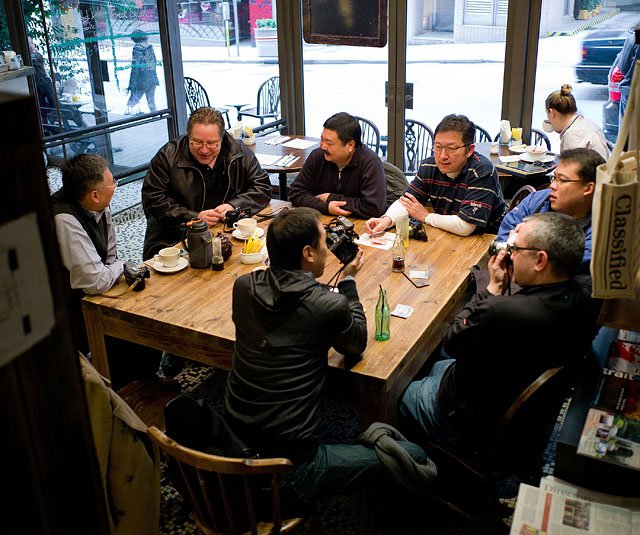
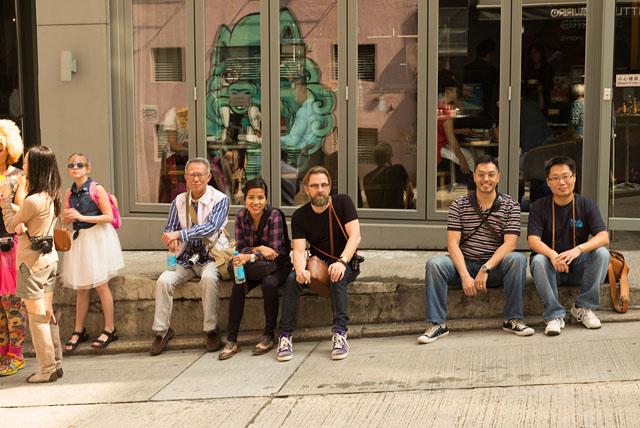
Student photo by William Lai. The group taking a relaxing moment in the sun in a rather cold Hong Kong November day in 2014, waiting for the rest having lunch on the other side.
Your skill level is not as important as the fact that you want to improve. For long-time photographers there are questions to be answered and holes to be filled, and for those new to Leica who have taken up the interst for serious photography up again recently, everything talked about is of interest, and there is time to address the questions most have.
The end product of the workshop is not that you know all technical details, but that you are enthusiastic and can make good photographs with the equipment you have.
Also, see the Hong Kong Workshop story from December 2014 here.
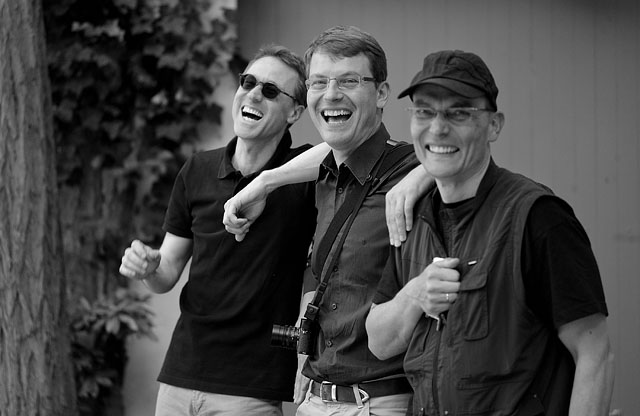
Matthias, Thomas and Chrostoph in Zürich, June 2011
"It has been truly enlightening and a great joy for me to share those seminar days with you all!
Many beautiful memories remain in the portait and especially the street photography departement ... and not last those personal talks we had about different styles of photography and Leica."
- M.F., Austria
Student photo by Bing Ling Bileen Yu from the model shoot in Hong Kong, December 2014.
"The set-up you provided was great. Taking pictures of models was new to me and gave me a lot of certaintiy that I can reach results with taking pictures of people as I envision them to be. I have made steady and tangible progress in photography above my expectations thanks to your seminars."
- M.J., Hamburg
Theory. Student photo by Ulli Seeberg from the London Seminar in September 2010(Leica M9 and new 35/1.4)
"Towards the end of 2012 I purchased a Leica M9P camera and Leica 35mm lens; I did not know how much this little black box was about to shape all of 2013 for me.
In Jan 2013 I attended a four day workshop in London with Danish photographer Thorsten Overgaard. It was, not only, an incredibly informative few days but also tons of fun and I met some wonderful people. The encouragement I got from Thorsten and everyone else gave me an incredible boost to get 2013 started. In fact I loved the workshop so much I immediately enrolled on the Sept 13 session which turned out to be even better.
I found Thorstens straight forward approach to both using the camera and towards editing extremely refreshing but it was the way he taught me how to look for light that, honestly, changed the way I view the world.
I see differently now and because of that I also think differently. I've started to compose and record music in a way that is much clearer and for the first time in my career true to how I want to hear it."
(Feel free to see images on my blog).
- B. G. (Music Composer & Producer London)
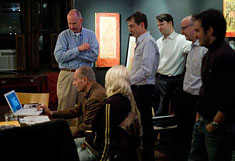
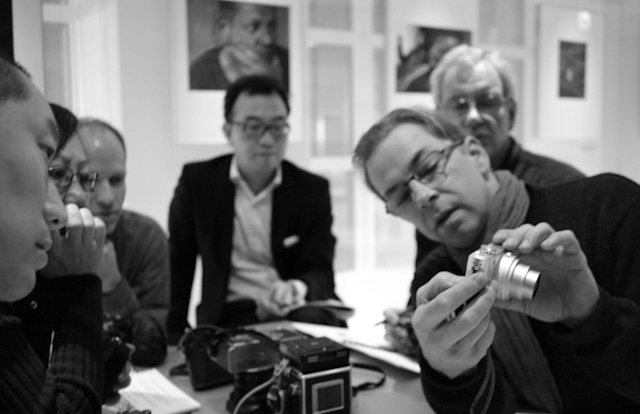
Thorsten explaining about small cameras at the seminar in Leica Gallery Tokyo in January 2011. Photo by Pieter Franken.
"Thanks so much for an inspiring weekend. I learned a lot, and it was a great group of people to spend the weekend with. I hope to see you again soon. "
- D.G.
Michael, Hans, Friedl and Oskar of the Advanced Workshop at work in the streets of Palermo.
"Thanks so much for all your instruction this past weekend. I really enjoyed meeting you and spending time understanding more of how you view things. I know there is a lot more to learn and hope we meet again."
- R.Y., Texas
Sori Gottdenker on the photo seminar, January 2011, with her white Leica M8.
(If you use iPad you may click here to visit the original video on Vimeo) "Picture Perfect" video about Danish feature writer and photographer Thorsten Overgaard, by Emma Brumpton for Channel Four. The video was done on The Faroe Islands in 2008 during a week of photographing climate changes, when Al Gore visited the islands.
One wouldn't be able to imagine all the equipment a handful of photographers can bring together... Photo by Pieter Franken.
"Photography has become dear to my heart again. Hope we have still some time to spend together."
- J., Spain
Advanced workshop in Palermo, May 2011. Photo by Ulli Seeberger.
The workshop challenge you and teach you new techniques and better control of camera and light by guided hands-on assignemnts. Some of the subjects we may indulge in will be "Timing in portraitture", "Making available light the best light", "Finding the exact right light", "Working with models and people", "Shooting strangers - and they like it!", "Using reflectors for portraits" ... and more.
Editing in London.
One thing you will learn is to actually use the basics of photography, work fast and get results. And have lots of fun doing so!
Adrian Hawkmoon working with a model in a very low light setup.
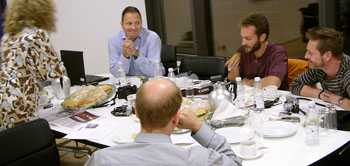
Coffee Break in Hong Kong, January 2011.
3. Lightroom Survival Kit
Before the Overgaard Workshop was expanded to include a Lightroom editing day, the workshop was solely focused on photography. People started requesting an editing workshop, and I did a few of them.
or you can send an e-mail to thorsten@overgaard.dk to enroll via invoice and bank transfer/checque.
You will receive your first materials in a few days.
Workflow seminar in London, 2010
However, a workshop on computer editing alone turned out to be so dull for photographers that I decided to include the editing teaching where it really matterered - in a worksshop where you make photos you need to edit!
Now you can buy the Lightroom Survival Kit Extension Course that will make you able to use all my experience from my years of working with editing and archiving, getting it all implemented for yourself in a matter of hours.
In short, it teaches the tricks necessary to produce a flood of final images ready to use.
There is usually quite some learning courve involved in going from amateur to professional, so the seminar teaches the pieces necessary to be a very high producing photographer in the digital age - not in terms of images shot but in terms of final images that are ready to be used.
As an example, I will usually shoot 200-1,200 images in a day and have finished the editing of all of them the same day. They are completely done, delivered and backed up.
So how does one do that every day? That is what one learn, and it involves color calibrated workflow, decision-making and selction of images, editing in Lightroom, Digital Asset Management, keywords, folders, backup, basic Photoshop skills (the ones necesary to finish an image), storing and delivering images ready for use on web and in print.
It's an 8-hour checklist and it will change your life from one who spend 2/3 of your time never actually finishing editing all of your images to one who will now spend 2/3 of your energy photographing and alwayshave final images from the day to present family, colleagues and clients with (and an orderly archive).
You can expect to get your materials
as a digital file immediately after you finished the payment. Enjoy!
There is no deadline for finishing
You are welcome to take as long as you need to finish each step and also to e-mail me during the course for any questions and doubts.
The New Inspiration Extension Course is for everybody, also people who have already done a Overgaard Workshop. It is an extension course that challenges your imagination and force you to use your photograhs.
The course was introduced in 2014 and has been a great success for those who have done it.
It offers the perhaps most important thing you need, which is inspiration to fire up enthusiasm for photography: An extension course that make you want to go out and make photographs! This Extension Course is for you!
The Overgaard Photography Extension Course is the basic technology and knowledge of photography for anyone who want to be an expert in handling a camera.
The extension course naturally doesn't have the live aspect and we don't get to meet in person. But I actually like extension courses myself because you get some data in bits that you can try out, then you get some more to build further on, then some more. It's a very good way to learn that is fitted individually so you can drink coffe, go on holidays, have babies, do the lawn and make money in between course sessions. And yet you get all the data because you are the "only one in the class room."
The extension courses also allow for more examples, more home assignments and more text than the live seminars, simply because we don't have to sit together with a time limit. So the extension course offers more material and more work and a much lower price than the seminar.
Start now. Only 498$
"The Overgaard Photography Extension Course"
Usual completion time is 40 hours of work, spread over 22 sections done over periods from 2 to 12 months. The price is 798$ for The Photography Extension Course and 498$ for the workflow course. You can click on the links and sign up immediately via PayPal.
Student example from the extension course (using Leica X1):
Manual white balance using grey card
Electronic flash setting
Outdoor sunlight
Incandescent light
Auto white balance
Cloudy
Shade
Some times home assignments can take a dramatic turn, as in the above with dangerous animals in the livingroom in front of the Leica X1. Jan Martijn Metselaar of Netherlands who did this impressive and methodical home assignment on the subject of white balance, noted "I always though Auto White Balance was fairly correct, but never realized the difference could be so big. The Manual White Balance results is a far better reproduction of the actual colors than the Auto White Balance."
6. Thorsten Overgaard eBooks on Photography
I continue to do eBooks and will be adressing many intersting subjects in the coming months. From the Magic of Light to how to use specific cameras. I like the PDF format because it can be read on computer and iPad and smartphones, and you may print your own sample of the book.
Below are a few of the titles available for order and preorder now:
Join the NEW Thorsten von Overgaard
Photography Extension Course
"My wife game me this course and I absolutely love it.
Now I think more in light and shadows. Used a lot of the techniques on a recent trip and
my photos have improved a lot. Well done, Thorsten!"
S.N. (Mexico)
"I am happy with my purchase of the extension course. Well written, easy to understand"
K.D. (USA)
“I very much enjoy the incredible knowledge”
V.V. (United Kingdom)
"Addictive, beautifully and simplistically written. Just amazing. Cleared my concepts"
V.P. (USA)
"The extension course is the best course I read about photography (and I'm still at the beginning)"
M.S. (Luxembourg)
"I'm already in page 81 of the Extension Course, and your communication and words provoked a change in me at an aesthetic level that I felt but I couldn't explain"
C.L. (USA)
The NEW
Overgaard Photography Extension Course
The waiting list is over!
After a couple of years with a long waiting list, I have finally redesigned the course so I can handle the students interested in this course. Not only that. The number of pages has gone up from 120 to 330..!
I teach you the basics of photography in an easy-to-understand and step-by-step way that anyone from age 12 to 90 years can understand and easily apply. This extension course is for everyone from 12-90 years.
The intention with this extension course is to get you going in your photography adventure with lightning speed and inspire you to reach to new heights.
Enjoy!
Specially tailored for Leica and digital photographers.
You work at your own pace after you recieve the full package of material via mail. It works as PDF on computer, iPad, Kindle, or - if you like - make your own print.
Join the Home School for
Leica and Digital Photographers
Only $798.00
Buy now. Instant delivery by mail.
ITEM #1708-2016
Note: If you have bought The Overgaard Extension Course (2010) previously you may enroll on this new course for free. Simply e-mail me.
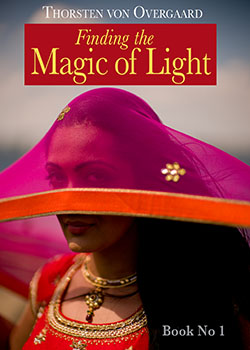
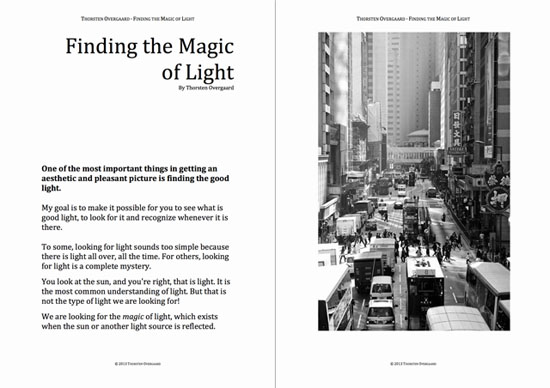
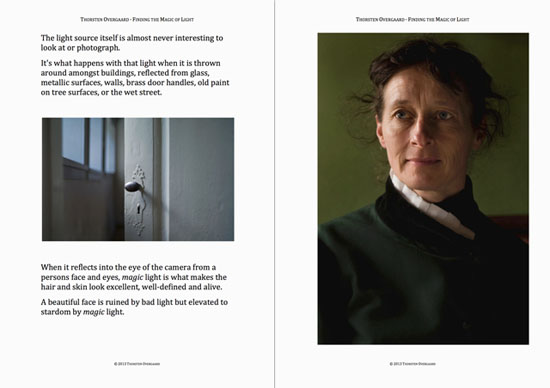
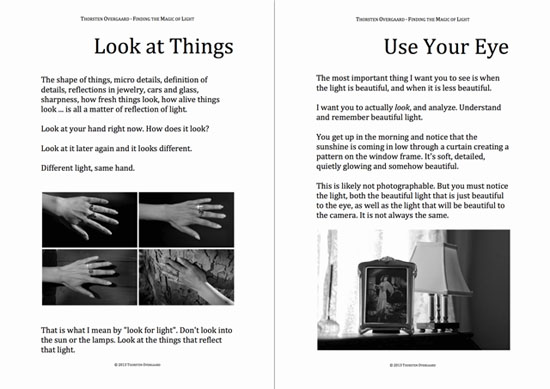
Buy this New eBook by Thorsten Overgaard "Finding the Magic of Light"
In this easy to read and apply eBook, Thorsten von Overgaard takes you on a journey to see, understand and simply use light.
"One of the most important ways to get an aesthetic and pleasant picture is to find the good light."
"Finding the Magic of Light"
eBook for computer and iPad. (40 pages) Only $47
Thorsten von Overgaard is a Danish writer and photographer, specializing in portrait photography and documentary photography, known for writings about photography and as an educator.
Some photos are available as signed editions via galleries or online. For specific photography needs, contact Thorsten Overgaard via e-mail.







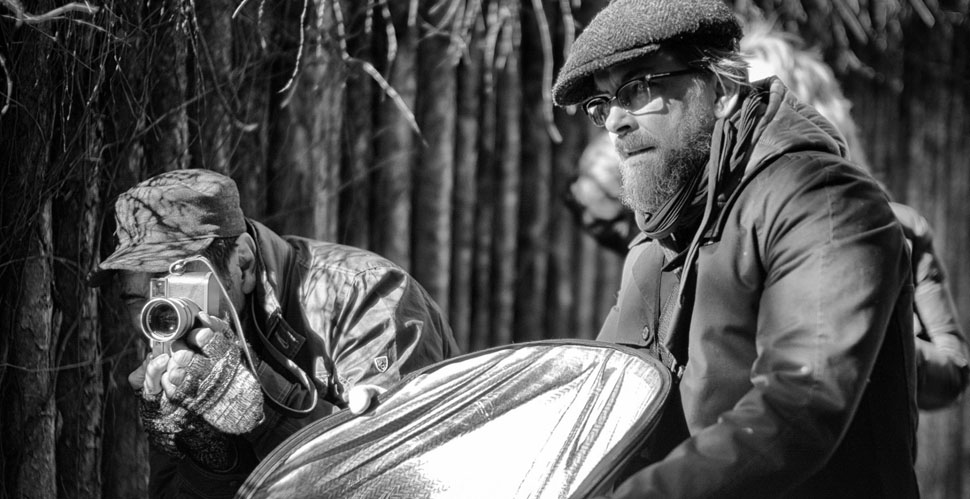


 Thorsten explaining about small cameras at the seminar in Leica Gallery Tokyo in January 2011. Photo by Pieter Franken.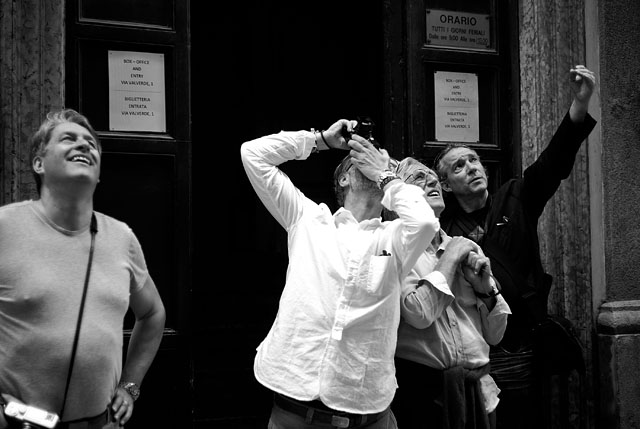
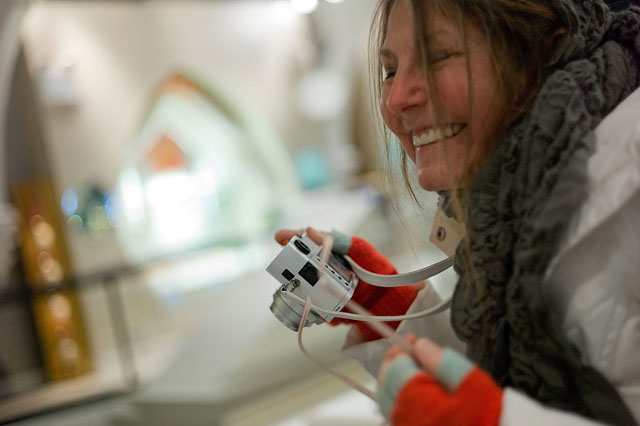 Sori Gottdenker on the photo seminar, January 2011, with her white Leica M8.